Published on November 4, 2025 at 4:00 PMUpdated on November 4, 2025 at 4:00 PM
The question arrives almost innocent: Is eating meat allowed in Hinduism?
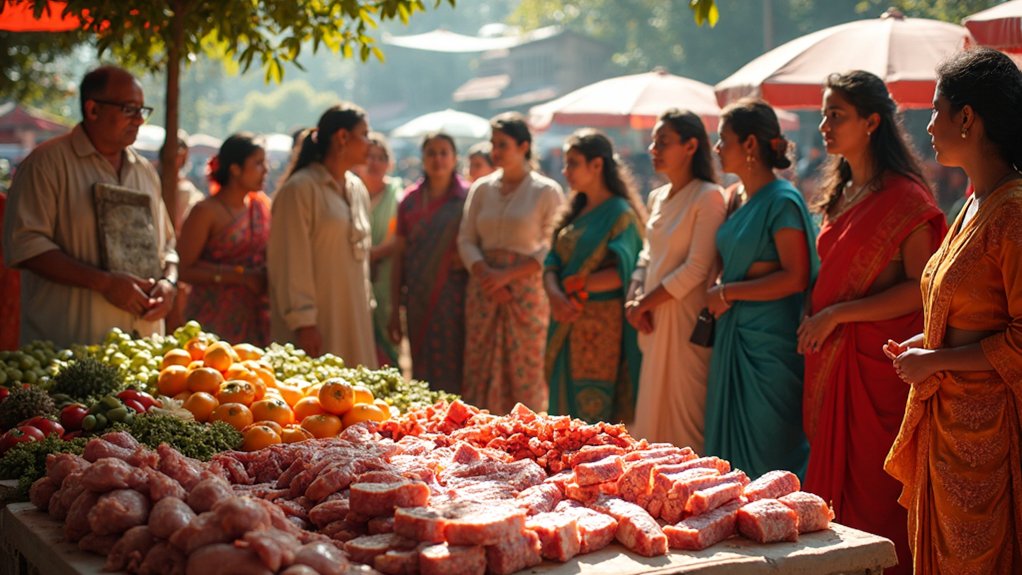
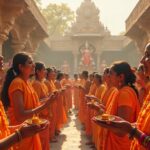
Meat, dharma and the Hinduism (image: Abpray)
But there is no innocent question in religion. There are only questions that expose who we are, what we’ve conveniently forgotten, and which truths we’ve chosen to believe because they felt right rather than because they held up under scrutiny.
I learned this not in any textbook. I learned it standing in two different rooms across five hundred kilometers on the same October morning, watching two Hindu men navigate the opening day of Navaratri in ways that obliterated every assumption I’d carried into the field.
The temple in Udupi, Karnataka sits precisely where it has sat for four centuries, buttressed by granite that remembers things nobody living can quite articulate. I arrived at 5:47 AM, thirteen minutes before the first pujas would begin, already sweating through my kurta. The air smelled of jasmine water, coconut oil, and something darker: the overnight oil lamps that had burned since the evening rituals, their smoke coating the walls in invisible history.
Anand was already there.
He moved through the sanctum with the muscular ease of someone whose body has performed these gestures ten thousand times. At forty, his face carried the particular compression of a man who has made peace with something he will never be able to fully articulate to others. His forehead bore not the elaborate tilaka of a fundamentalist practitioner, but a simple vertical line of vibhuti, ash, applied with what looked like afterthought. His dhoti was white, correct, immaculate. His hands, when they touched the deity, trembled with something I couldn’t immediately identify.
“You cannot photograph inside,” he said, without looking at me. Not unkind. Just factual.
I had met Anand three days prior through an acquaintance in Bangalore who described him only as “someone who takes the temple seriously but doesn’t take seriously what people say the temple means.” When I asked him if he would allow me to document his Navaratri practice, he hesitated for exactly four seconds before saying yes. That hesitation would matter later.
The morning unfolded in ritual repetition. Anand participated in the abhisheka, the ritual bathing of the deity, with hand movements so precise they bordered on mechanical, though the precision came from intimacy, not from formality. He chanted the Lalita Sahasranama, the thousand names of Devi, in a voice that carried the metallic accuracy of someone who had internalized every Sanskrit syllable before he was twelve years old. Other devotees arrived, older women in silk saris, their palms pressed together, their eyes half-closed; a young couple who looked like they’d been sent by a parent; a businessman checking his phone between prostrations, his apology written across his face.
Then came the prasada, the blessed offering.
The temple distributed banana chips and jaggery. Simple, vegetarian, ritually pure by even the most conservative standards. Anand took his portion, placed it briefly on his forehead in acknowledgment of the deity’s grace, and consumed it in two bites while standing, the way someone eats when the food is not the point.
What I noticed: his eyes flickered to his phone. 7:32 AM. Something in his expression shifted, a tightening around the eyes that lasted perhaps a quarter-second before he smoothed it away with the practiced ease of someone who has spent years hiding small rebellions.
“I need to eat breakfast,” he said to me, still not making direct eye contact. “Will you come?”
Morning two: the flexibility in the metropolis
Five hundred kilometers north, in Mumbai, Rohan was ordering eggs.
I had scheduled this observation for precisely the same morning, through a different introduction. Rohan works in corporate strategy for a financial services firm, the kind of job that requires you to think in systems and probabilities and contingencies. He is Hindu, born to a Brahmin family from Pune, though he hasn’t lived there in fifteen years. He is thirty-eight, unmarried, and exercises six mornings a week with the dedication of someone for whom physical discipline has become the only form of meditation that doesn’t require him to sit still with his own thoughts.
His apartment overlooks the Arabian Sea from Bandra. We met at a café near his gym, a place called “Rise & Grind” with floor-to-ceiling windows and the kind of aesthetic that announces its distance from traditional Hindu practice through sheer spatial grammar: chrome, glass, minimalism, the opposite of the ornamental density of any temple I’d ever entered.
“The egg thing,” he said, stirring his coffee without looking at me, “is not actually a big deal for me anymore. But I spent twenty-three years thinking it was.”
He had agreed to let me follow him through Navaratri as well. Unlike Anand, Rohan seemed almost relieved to have a witness to the paradoxes he was navigating. He ordered a spinach and feta omelet. The waiter, who was likely from a Muslim or Christian background, brought it without any visible moral complexity, as if eggs were just food, not the border between two versions of identity.
“My mother doesn’t know I eat meat,” Rohan continued. “Or rather, she knows I might eat meat, and we have achieved a mutual agreement not to discuss it explicitly. Every time I visit Pune, she makes elaborate vegetarian meals that take hours to prepare, and I eat them with what I believe is genuine appreciation, and then I fly back to Mumbai and eat mutton biryani, and we all pretend this is not a logical contradiction sitting at the center of how we relate to each other.”
He laughed, not bitterly, but with the tone of someone who has examined his own absurdity and decided it was worth living with rather than running from.
“The crazy part,” he said, “is that I actually feel more spiritual on the mornings I eat the egg. I know that makes no sense theologically. But I think clearer. My meditation sharpens. My focus holds. And I keep waiting for someone to tell me that this contradicts Hinduism, and nobody ever does, because it turns out Hinduism is much less consistent than the ideology we’ve built around it.”
The partition that nobody talks about
What Anand and Rohan were navigating, though neither had the vocabulary for it at first, was not a personal moral failure. They were caught between two entirely different Hinduisms, and the collision between them had been engineered over the past two hundred years by forces that had nothing to do with spiritual transmission and everything to do with power.
The vegetarian Hindu is a British construction.
This is not metaphorical. This is archaeological.
When scholars like Wendy Doniger examined Sanskrit texts from the Vedic and post-Vedic periods, they found something that contradicted the modern narrative entirely: meat consumption was woven through Hindu practice at every level. The Manusmriti, often cited as the foundational ethical text of Hinduism, explicitly permits meat-eating for Brahmins, with the caveat that the meat must be ritually offered first, that the killing must follow proper procedure, that the act itself is transformed through ritual intention. The Mahabharata and Ramayana contain hundreds of references to hunts, to animal sacrifice, to the preparation of meat in royal courts. Even the Bhagavad Gita, perhaps the most philosophically revered text, makes no explicit condemnation of meat-eating. Krishna himself, in his dialogue with Arjuna, does not say: Thou shalt not eat meat. What he says is far more interesting and far more complicated: that one should perform one’s duty (dharma) with detachment from the fruits of the action. The act itself, separated from ego and desire for results, is not inherently polluting.
The rewrite happened between 1850 and 1920.
British colonial administrators, operating from Victorian sensibilities and Protestant moral frameworks that were themselves barely a century old, needed to manage and classify a civilization they found simultaneously sophisticated and deeply threatening. One method of colonization is moral capture. By the late nineteenth century, Hindu reformers, influenced by Western thought and driven by a defensive need to prove that Hinduism was “rational” and “modern” and therefore deserving of respect, began reinterpreting their own tradition through a lens of absolute vegetarianism. Figures like Ram Mohan Roy and later Swami Vivekananda leveraged vegetarianism as proof that Hinduism was ethically superior to Christian colonialism. It was an ingenious rhetorical move: if we can demonstrate that our religion is purer, more ethical, more compassionate than yours, perhaps we deserve sovereignty rather than subjugation.
The bitter irony: they internalized the colonizer’s values while believing they were defending tradition.
Ramachandra Guha, in his histories of Indian ecology and thought, traces how this reframing took root with the force of a banyan tree. Vegetarianism became coded as the authentic voice of Hinduism, not because it was historically dominant, but because it was politically useful in a specific historical moment. By the time Independence arrived, vegetarianism had been so thoroughly stitched into the fabric of Hindu identity that multiple generations grew up believing it was ancient, essential, and morally non-negotiable. It felt like the bones of the tradition, not like bones that had been grafted on.
What this obscures: the historical reality was messier, more pragmatic, and far more diverse than any single narrative could contain.
The caste architecture of meat
The second silence Anand and I needed to breach was about caste.
We sat in a small restaurant near the temple, not fancy, the kind of place where construction workers ate alongside retirees, where nobody cared what you ordered or why. Anand ordered dosa and sambar. I was waiting for him to explain his morning hesitation. He was waiting for something too, though he didn’t know what until the words started coming.
After the third bite of dosa, he said: “My grandfather hunted. Regularly. Not as sport, though there was pleasure in it. As practice. There are Vedic texts that describe hunting as a legitimate path to accumulating ritual merit, to understanding the mechanics of life and death, to maintaining the warrior codes that were part of his station. He would never have called himself un-Hindu. He would have said he was being appropriately Hindu.”
“Does that bother you?” I asked.
“No,” he said. “What bothers me is that I feel like I’m supposed to be bothered by it. That I’m supposed to have rejected something primitive and adopted something purer. But that’s a lie I was sold in school, and I’ve spent twenty years trying to live it while my body keeps rejecting it.”
This is where caste becomes unavoidable, because the vegetarian Hindu ideology, the one that was politically weaponized in the colonial period, served a particular function in the caste hierarchy. If Brahmins were vegetarian, and vegetarianism was the highest expression of spiritual purity, then Brahmins were ipso facto the highest caste. Morality and heredity collapsed into each other. It was circular logic, and it was devastatingly effective at naturalizing the entire caste structure.
But the historical reality was different. Lower-caste groups and non-Brahminical Hindu lineages maintained entirely distinct relationships with meat. Shudras (the fourth varna) in many regions not only ate meat but were economically dependent on the meat trade. Fishing castes, hunter castes, warrior castes, these groups had ritual and economic systems entirely independent of Brahminical vegetarian ideology. They were not fallen Hindus trying to achieve purity. They were Hindus with different dharmas, different duties, different relationship to the cosmos.
The colonial reframing did something subtle and devastating: it universalized Brahminical practice as the standard of Hinduism, and then it delegitimized alternative practices as “lower,” “less spiritual,” and “backward.” It transformed caste hierarchy from a social organization into a spiritual hierarchy. It made inequality feel inevitable rather than constructed.
“The really perverse part,” Anand said, lowering his voice even though the restaurant was nearly empty, “is that now, when Shudras or Dalits want to claim vegetarianism as a form of spiritual ascension, they’re celebrated as being ‘truly Hindu.’ They’re moving toward the center. But that center is a colonial invention. It’s not authentically Brahminical. It’s Brahminical-as-filtered-through-Victorian-morality, which is something else entirely.”
He was speaking with the precision of someone who has thought about this at length, probably in isolation, probably while performing rituals that contradicted what he was saying.
“So what do you do?” I asked.
“I keep the ritual,” he said. “But I don’t pretend it’s what my grandfather would have recognized. And I eat meat when I’m away from the temple, because my body needs it and because I’m tired of performing a purity I don’t believe in. But I can’t say this aloud in my community, because it would be experienced as a betrayal. So I live the contradiction silently. I’ve gotten very good at it.”
The mumbai inflection point
Rohan’s version of the same contradiction was performed differently, through the grammar of metropolitan life rather than through ritual obligation.
When I caught up with him that evening, after his workday had ended and he’d spent two hours at the gym running through leg exercises with the intensity of someone working through something in his body that couldn’t be worked through in his mind, he was sitting on his balcony, looking out at the sea, his notebook open on his lap.
The notebook contained meal plans, macronutrient calculations, and what looked like a sincere attempt to reconcile physical optimization with spiritual tradition. Spreadsheets for dharma.
“Flexitarian,” he said, when I asked him to define his dietary practice, “is just a word invented so people like me don’t have to make a decision.”
But then he clarified, because the first statement had come out with more bitterness than he’d intended: “I mean, that’s unfair. It’s actually more honest than pretending consistency. I eat meat maybe three or four times a week. I avoid it on festival days or when I’m visiting family. I’ve become very good at compartmentalization. It’s like my life is divided into rooms, and in some rooms I’m one kind of Hindu, and in other rooms I’m different.”
What’s crucial to notice: Rohan was not ignorant of the vegetarian ideal. He had been raised in it like he’d been raised in air. His guilt was not absent, it was simply distributed across his week, compartmentalized into moments and spaces where he could manage it. He had negotiated with it. Decided it was worth bearing.
“The thing nobody tells you,” he said, “is that the vegetarian ideal in modern Hinduism is actually enforced primarily by other Hindus, not by any inherent theological logic. I’ve read the texts. I’ve actually sat down and read the Bhagavad Gita in translation, multiple translations, and what I found was something much more interesting than what people say it says. Krishna doesn’t say ‘thou shalt not eat meat.’ He says something much more specific: that you should act according to your nature and your duty, and that the act itself is morally neutral if performed without attachment to the outcome.”
He was paraphrasing, though he didn’t know it, Swami Vivekananda’s reading of the Gita, a reading that was itself a form of modern reinterpretation, though Rohan had no awareness of that pedigree.
“So technically,” he continued, “I could eat meat while maintaining perfect fidelity to what Krishna actually says. But I can’t maintain fidelity to what my mother believes Krishna says. Those are different things. And I’ve internalized the guilt of the second while remaining completely ignorant of the actual logic of the first.”
The tragedy and comedy of this: Rohan had intuited the gap between text and interpretation, between ancient practice and modern ideology, without having the historical framework to understand that the gap was engineered, that it was not a natural erosion but a deliberate construction.
Ahimsa as a contested concept
Let me pause the parallel narratives to address the theological anchor that both men were circling without directly confronting: the principle of ahimsa, non-violence.
Ahimsa is typically invoked as the ethical foundation of Hindu vegetarianism. The logic is simple and intuitively compelling: if you believe in non-violence, you should not eat meat, because eating meat requires the killing of animals.
The problem is that this is a recent invention.
Ahimsa first appears prominently in Hindu thought in the Upanishads, but its interpretation has been radically unstable across centuries and traditions. The Chandogya Upanishad associates ahimsa with truth-telling and ritual purity, not with dietary practice. The Yajnavalkya Smriti, written centuries later, explicitly permits meat-eating while simultaneously endorsing ahimsa. How does this logical impossibility resolve itself? Through the notion that ritual sacrifice is a form of sacrifice (yajna), not violence (himsa). The Vedic worldview made a fundamental distinction: an action is violent only if it is performed with malice or selfish attachment. A ritual action performed with the proper intention and mantra is not violent, even if it involves killing an animal. The act is transformed by its context.
This is where the modern reinterpretation became crystalline.
As Hindu nationalism developed in the nineteenth and twentieth centuries, ahimsa was retrofitted into a doctrine of absolute non-violence. Gandhi’s deployment of ahimsa as the philosophical foundation of non-violent resistance was both spiritually inspired and politically ingenious. But it created something new: a theology in which violence was not context-dependent or intention-dependent, but absolute and categorical.
Gandhi himself was a vegetarian. But he was also pragmatic enough to state publicly that he did not believe vegetarianism was a requirement of Hinduism, only of his personal practice, his own path (sadhana). The distinction mattered to him.
The reinterpretation that followed him was less nuanced.
By the mid-twentieth century, vegetarianism had become so thoroughly coded as the expression of ahimsa that many Hindus began to believe they had always believed this. The belief became recursive: we have always been vegetarian because ahimsa is central to Hinduism, and ahimsa is central to Hinduism because we have always been vegetarian. It is a perfect epistemological trap.
The South and the North: two different histories
By the second day of my observations, the geographical distinction became impossible to ignore.
In Tamil Nadu and Karnataka, the regions of Hindu tradition that had most resisted brahminical standardization, the relationship to meat remained structurally different. The Smarta Brahmin tradition, to which Anand belonged, had a theoretical stance of vegetarianism, but the practice had always been more flexible than the theory. Southern temples maintained their own internal hierarchies: what a high priest could eat was different from what a lower priest could eat. What a priest could eat during ritual was different from what he could eat in private. What a priest could eat on festival days was different from what he could eat on ordinary days. Pragmatism had always existed in the cracks of orthodoxy, and nobody pretended otherwise.
In the North, particularly in the urban centers influenced by Hindu nationalism and Brahminical reform movements, the ideology had become more uniform. The vegetarian ideal had achieved near-hegemonic status, especially among the upper castes and in urban environments. When North Indian Hindus encountered meat-eating, it was experienced as a deviation, a lapse, something to be corrected. The system had less room for pragmatism.
This geographical distinction is not trivial. It explains why Anand’s pragmatism felt different from Rohan’s guilt. Anand was returning to a historical practice that had never fully disappeared in South Indian Brahminism, even as he was transgressing against modern ideology. He was not inventing something new; he was remembering something old. Rohan was stepping outside a wall that had been built around his identity in metropolitan North India, a wall that was solid and recent and still being reinforced by every family phone call.
Comparative timeline: the remaking of Hindu identity
Period
South Indian Practice
North Indian Ideology
Colonial Architecture
Pre-1800
Flexible meat-eating; ritual and social context entirely determine practice; hunting honored among warrior castes; brahmin practice varies by region
Brahminical vegetarian ideal (theory); practical flexibility in implementation; context-dependent; no universal standard
No direct intervention; Hindu practice contains multitudes
1800-1850
Colonial administrators study Vedic texts, are disturbed by meat references, classify as “primitive”; local resistance begins
British missionaries equate vegetarianism with “civilization”; Hindu reformers begin defensive reframing out of anxiety
Moral judgment imposed; creates defensive anxiety; Hindu intellectuals begin reinterpreting own tradition
1850-1920
Southern temples begin formalizing vegetarian ideology to align with Northern reputation; local practice erodes under pressure; older practices become secretive
Gandhi and nationalist movement weaponize vegetarianism as proof of Hindu superiority; becomes politically essential; meat-eating becomes “un-Hindu”
Colonial narrative internalized; vegetarianism becomes “authenticity marker”; Hindu identity becomes rigid around dietary purity
1920-1947
Vegetarianism becomes law through temple reforms; older practices stigmatized; meat-eating becomes shameful; but hidden practice continues
Vegetarianism codified as the essence of Hindu spirituality; meat-eating becomes “betrayal”; becomes part of nationalist identity
Independence struggle uses vegetarianism as identity anchor; becomes non-negotiable part of decolonial pride
Vegetarianism remains hegemonic in ideology, but urban practice diverges; compartmentalization becomes norm; guilt increases
Globalization creates new tensions; Indian diaspora invents “authentic” vegetarian Hinduism for export to Western audiences
2000-Present
Meat-eating among educated classes increases; cognitive dissonance remains high; younger generation more explicit about contradiction; tension with older generation intensifies
Flexitarianism and “cheat days” normalize deviation; ideology persists but enforceability weakens; younger generation openly questions inherited guilt
Digital connectivity reveals the gap between belief and practice; younger Indians compare notes; questions traditional authority; new interpretations emerge
The interview that changed everything
On the third evening, something shifted in my conversations with both men.
Anand called me. Not to correct anything I’d said or written, but because he needed to say something he hadn’t said before, and having already spoken it aloud once, he wanted to say it again, to someone who would listen.
“I realized I’ve been framing this as my personal failure,” he said. “My inability to maintain purity. My weakness. But that’s the wrong frame entirely. The frame itself is colonial. I’m judging myself by a standard that was invented in the nineteenth century to control a population. Once you see that, you can’t unsee it.”
He paused. I could hear the sound of evening prayers in the background, chanting from somewhere in his neighborhood.
“My grandfather wasn’t less Hindu because he hunted. He was differently Hindu. And I’m differently Hindu because I live in a different moment and I’ve been shaped by different forces. The question isn’t whether I’m maintaining some pure tradition. The question is whether I’m being honest about where I actually stand.”
For Rohan, the shift came through a different door.
He had been invited to a Navratri celebration at a colleague’s house, a woman who was Hindu, but from a different regional tradition entirely. The food was abundant and explicitly mixed: there were vegetarian dishes that took hours to prepare, but also meat preparations. His colleague’s mother explained, unapologetically, that in their tradition, Navratri involved a specific type of fasting that actually required meat-eating after dark, as a way of maintaining the body’s temperature and energy through the ritual period. The body needed building up. Abstinence alone would weaken it.
“I had never even heard of this,” Rohan said, when I spoke with him the next day. “This whole time, I’ve been operating under the assumption that there was one Hinduism, and my deviation from it was a personal moral failing. But there are Hinduisms. Plural. With completely different rules. And somehow I’ve internalized the rules of the one that makes me feel guilty, while remaining completely ignorant of the ones that would make me feel fine.”
The real question beneath the question
By day five of Navaratri, I had stopped trying to answer the surface question: Is eating meat allowed in Hinduism?
The answer, of course, is yes and no. Historically yes. Theologically complicated. Ideologically no (within the modern narrative). Practically yes (for most urban Hindus, who compartmentalize in ways they don’t speak about). Socially risky (because communities will judge you for it, will question your purity, will doubt your commitment).
The more interesting question emerged through the cracks: What does it mean to maintain fidelity to a tradition that is itself constantly being rewritten by forces outside your control?
Both Anand and Rohan were, in different ways, living faithfully. Anand was maintaining ritual practice while quietly acknowledging the gap between ideology and historical reality. Rohan was being honest about compartmentalization rather than pretending consistency.
Neither was “truly Hindu” or “falsely Hindu.” Both were navigating a tradition that had been fractured, reformed, politicized, and internalized in ways that made perfect coherence not just difficult but impossible. And both had arrived at the same realization, from different directions: that coherence itself was not the goal. Honesty was the goal. Integrity was the goal. Living through the contradiction without being destroyed by it was the goal.
What the scholars don’t tell you (but should)
When I began researching this question academically, I was struck by something that bothered me: most contemporary Hindu intellectual writing tends to do one of two things.
Either it defends vegetarianism as the authentic Hindu position (often through selective reading of texts and strategic omission of historical context), or it criticizes vegetarianism as a colonial imposition while offering little guidance on how to actually live through the contradiction, how to maintain spiritual practice while doubting inherited doctrine.
What’s missing is the middle ground: an honest reckoning with the fact that Hinduism contains multitudes, that the multitudes are genuine, that they are not errors or corruptions, and that the attempt to reduce them to a single consistent position is itself a form of violence.
Doniger, in her work on Hindu mythology and philosophy, emphasizes that contradiction is not a bug in Hindu thought, it’s a feature. The same text will contain multiple, mutually contradictory positions. The Mahabharata is explicitly structured as a series of nested stories and perspectives, each offering a different answer to the same moral question. This is not a failure of clarity. It’s a sophisticated epistemological stance: the world is complex, truth is not simple, and wisdom requires holding multiple perspectives simultaneously.
The modern attempt to reduce Hinduism to a single, consistent doctrine of vegetarianism represents a loss of this sophistication. It imposes a kind of false clarity that the tradition itself rejects. It makes the tradition more legible to the colonizer, but less true to what it actually is.
The pragmatism of living through paradox
What Anand eventually articulated, and what Rohan slowly intuited, was something like a mature relationship to tradition.
Not the fundamentalist stance: I will maintain perfect fidelity to what I believe are the eternal rules of my tradition.
Not the iconoclastic stance: I will reject my tradition entirely because its rules are oppressive or outdated.
But a third position: I will maintain ritual practice and engage seriously with the texts, while remaining honest about the gap between what I’ve been told the tradition means and what historical evidence suggests it actually meant. I will live through that gap with integrity, rather than pretending it doesn’t exist.
This is the pragmatism that emerges from maturity. It is not cynicism. It is not relativism. It is a hard-won recognition that fidelity to tradition is not the same as fidelity to ideology.
For Anand, it meant continuing his temple practice, the rituals, the Sanskrit, the community participation, the emotional and spiritual infrastructure that had shaped his being, while eating meat at home and acknowledging (at least to himself) that his grandfather’s hunting was not a deviation from authentic Hinduism but an expression of it. He was honoring both: the ritual he had inherited and the freedom his grandfather had lived.
For Rohan, it meant stopping the exhausting work of compartmentalization and instead naming his practice clearly: I am a flexitarian Hindu who eats meat while maintaining spiritual practice. This is consistent with some versions of Hindu theology and inconsistent with others. I can live with that tension.
He was choosing honesty over performance.
What remains unresolved (and should)
I do not end this with resolution, because resolution would be dishonest.
Anand still experiences the tension between his temple practice and his private eating habits. He has not resolved it. He has simply named it clearly enough that it no longer poisons his integrity.
Rohan still navigates the guilt imposed by family expectation, even as he has become more honest about his actual practice. That guilt has not disappeared. It has become proportional, neither dominating his life nor driving him to pretense.
Neither man has “solved” the question of how to be authentically Hindu while deviating from the modern ideology of Hinduism. Instead, they have both arrived at something more valuable: a kind of lived wisdom about how to hold contradiction without being destroyed by it.
This is not the answer most people want. Most people want to be told: You are right, and your critics are wrong. Or: You were wrong, but here is the correct path forward.
But Hinduism, in its actual depth, does not offer these certitudes. It offers instead something harder and more valuable: a framework for thinking through moral complexity, a tradition that insists that simple answers to complex questions are usually lies, and a philosophical vocabulary for holding multiple truths simultaneously.
The meat question, in the end, is not really about meat.
It is about whether we have the maturity to inhabit our traditions as living conversations rather than as dead doctrines. It is about whether we can distinguish between what our traditions actually say and what we have been told they say. And it is about whether we have the courage to teach the next generation the truth, which is messier, richer, and far more interesting than the simplified versions we were given.