Are Brahma, Vishnu, and Shiva from Hinduism or Buddhism? This is a common question for anyone interested in Indian spirituality. Brahma, Vishnu, and Shiva are central deities in Hinduism, representing creation, preservation, and destruction. In Hinduism, these three gods form the powerful Trimurti, shaping the universe and its cycles.
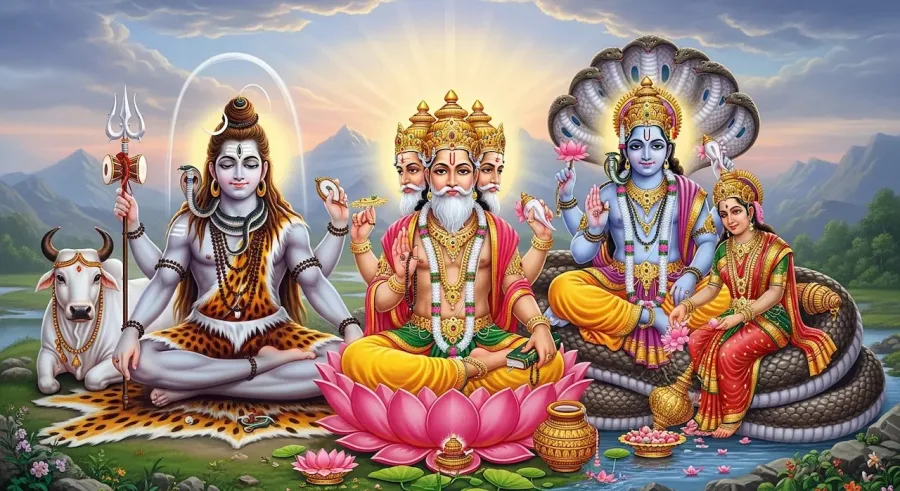
Is Brahma, Vishnu, and Shiva Hinduism or Buddhism? (image: Abpray)
While Brahma, Vishnu, and Shiva are also mentioned in Buddhist texts, Buddhism does not worship them as supreme beings. Instead, Buddhism views Brahma, Vishnu, and Shiva as important celestial figures, but not as ultimate creators or rulers.
Understanding the roles of Brahma, Vishnu, and Shiva in Hinduism and Buddhism helps clarify the unique beliefs of each tradition and offers deeper insight into their spiritual worlds.
When you explore the origins of Brahma, Vishnu, and Shiva, you uncover the fascinating story of how these three deities shape Hindu beliefs.
The origins of Brahma, Vishnu, and Shiva reveal that each god represents a vital force in the universe: Brahma is known as the creator, Vishnu as the preserver, and Shiva as the destroyer.
By understanding the origins of Brahma, Vishnu, and Shiva, you gain insight into how creation, preservation, and destruction work together in a continuous cycle.
Learning about the origins of Brahma, Vishnu, and Shiva not only deepens your knowledge of Hinduism but also highlights the balance and harmony present in all aspects of life.
The role of Brahma in Hindu cosmology
Brahma in Hindu cosmology holds a vital place as the creator god, shaping the universe and initiating the cycle of life.
In Hindu cosmology, Brahma is credited with bringing the world into existence, setting everything in motion, and ensuring the order of creation.
The significance of Vishnu as the preserver
Vishnu as the preserver holds a vital place in Hinduism, acting as the divine force that maintains balance and stability in the universe.
As the preserver, Vishnu embodies compassion, mercy, and the commitment to upholding dharma, or cosmic order.
Through his many avatars, such as Rama and Krishna, Vishnu as the preserver steps in during times of turmoil to protect righteousness and guide humanity.
Shiva: the destroyer and transformer
Shiva, known as the Destroyer and Transformer, is a vital figure in Hindu mythology and plays a key role in the ongoing cycle of the universe.
As the Destroyer and Transformer, Shiva’s power isn’t just about bringing things to an end—it’s about making way for fresh beginnings.
Embracing Shiva as the Destroyer and Transformer helps us understand that change and transformation are necessary for growth.
With Shiva’s influence, we see that every ending leads to a new start, making him an essential force in life’s continuous journey.
The concept of Trimurti in Hinduism
When learning about Hinduism, one key idea you’ll discover is the concept of Trimurti.
The Trimurti in Hinduism refers to the three main gods: Brahma the creator, Vishnu the preserver, and Shiva the destroyer and transformer.
The Trimurti in Hinduism symbolizes the ongoing cycle of creation, preservation, and destruction, showing how all parts of life are connected.
Buddhist perspectives on Brahma, Vishnu, and Shiva
When examining Buddhist perspectives on Brahma, Vishnu, and Shiva, it becomes clear that Buddhism recognizes these prominent Hindu deities, but interprets them differently.
In Buddhist thought, Brahma, Vishnu, and Shiva are seen as powerful celestial beings, yet they aren’t regarded as ultimate realities or creators.
While Buddhism respects the qualities associated with Brahma, Vishnu, and Shiva, its teachings emphasize going beyond attachment to any deity.
Instead, Buddhism encourages followers to focus on understanding the nature of suffering and pursuing enlightenment.
Through this unique perspective, Buddhism acknowledges Brahma, Vishnu, and Shiva, but ultimately prioritizes the path to liberation over devotion to any particular god.
Shared mythological themes in Hinduism and Buddhism
Exploring the shared mythological themes in Hinduism and Buddhism reveals fascinating connections between these two ancient religions.
Shared mythological themes in Hinduism and Buddhism include powerful concepts such as karma, rebirth, and enlightenment.
These shared mythological themes in Hinduism and Buddhism are reflected in stories about deities and legendary figures, who often represent similar virtues and life lessons.
Cultural representations and artistic depictions
Cultural representations and artistic depictions of Brahma, Vishnu, and Shiva play a key role in illustrating the heart of Hindu and Buddhist traditions.
These cultural representations can be seen in vibrant paintings, detailed sculptures, and magnificent temple architecture, each emphasizing the distinct qualities of Brahma, Vishnu, and Shiva.
Through these artistic depictions, viewers gain a deeper understanding of religious beliefs and cultural values.
The influence of Brahma, Vishnu, and Shiva on Indian spirituality
Brahma, Vishnu, and Shiva have a deep influence on Indian spirituality, shaping the beliefs and practices of millions.
The presence of Brahma, Vishnu, and Shiva is seen in vibrant artistic expressions, reflecting their importance in both Hindu and Buddhist traditions.
Indian spirituality is enriched by their teachings, which are woven into daily rituals, meditation, and acts of devotion.
The stories of Brahma, Vishnu, and Shiva inspire moral values, unity, and the pursuit of enlightenment, creating a spiritual tradition that resonates across generations.
Through their lasting influence, Indian spirituality continues to thrive and inspire seekers around the world.
Conclusion
Brahma, Vishnu, and Shiva are central deities in Hinduism, representing creation, preservation, and destruction. In Hinduism, Brahma, Vishnu, and Shiva are worshipped as the key gods of the Trimurti, each playing a vital role in the cycle of the universe.
While Buddhism recognizes Brahma, Vishnu, and Shiva, it views them differently—as powerful celestial beings rather than ultimate creators. Buddhism encourages followers to seek enlightenment beyond attachment to any deity.
By understanding the roles of Brahma, Vishnu, and Shiva in Hinduism and their depiction in Buddhism, you can better appreciate the fascinating connections between these two major spiritual traditions.
José Lucas is a researcher driven by a lifelong fascination with the history of religions and how faith shapes the human experience. Specializing in the historical contexts of diverse traditions, José possesses a unique ability to translate ancient wisdom into practical, relevant insights for the modern seeker. At ABPray, his mission is to guide readers through the world’s vast spiritual heritage with both curiosity and reverence. He plays a crucial role in our Content Creation and Fact-Checking process, ensuring that all biblical, historical, and doctrinal references are grounded in legitimate sources and in-depth research. Through his articles and guides, José promotes understanding and compassion, connecting the facts of the past with the contemporary search for purpose. His work is essential in establishing ABPray as a global reference for interfaith content, nurturing the universal values that unite all of humanity.
To provide the best experiences, we use technologies like cookies to store and/or access device information. Consenting to these technologies will allow us to process data such as browsing behavior or unique IDs on this site. Not consenting or withdrawing consent, may adversely affect certain features and functions.
Functional
Always active
The technical storage or access is strictly necessary for the legitimate purpose of enabling the use of a specific service explicitly requested by the subscriber or user, or for the sole purpose of carrying out the transmission of a communication over an electronic communications network.
Preferences
The technical storage or access is necessary for the legitimate purpose of storing preferences that are not requested by the subscriber or user.
Statistics
The technical storage or access that is used exclusively for statistical purposes.The technical storage or access that is used exclusively for anonymous statistical purposes. Without a subpoena, voluntary compliance on the part of your Internet Service Provider, or additional records from a third party, information stored or retrieved for this purpose alone cannot usually be used to identify you.
Marketing
The technical storage or access is required to create user profiles to send advertising, or to track the user on a website or across several websites for similar marketing purposes.