For the Maya, numbers were far more than practical tools used for counting crops or planning architecture, they were sacred forces that shaped the universe. Mathematics guided their calendars, rituals, predictions, and the design of temples, weaving faith, measurement, and cosmic observation into a single spiritual vision. To understand Maya civilization, one must understand how deeply they valued numbers, astronomy, sacred geometry, and numerology. For the Maya, mathematics was not a neutral system; it was a divine language that revealed the structure of the cosmos and humanity’s place within it.
But what deeper meaning did the Maya find in this union of math and religion, and how did it shape their understanding of time, cycles, and the spiritual world? Why did sacred mathematics hold such power in their rituals, temples, and cosmological beliefs?
Let’s explore how the Maya connected numbers, religion, and cosmic balance.
The Role of Calendars in Maya Spiritual Life
In Maya spirituality, calendars were far more than organizational tools, they were sacred guides. The Maya created some of the most advanced and accurate calendars in the ancient world, including the Tzolk’in, the Haab’, and the Long Count. Each calendar served both mathematical and spiritual purposes, demonstrating the deep relationship between numerical knowledge and religious practice.
The Maya believed that time itself was sacred, and every day carried its own spiritual energy, purpose, and divine influence. Priests used intricate calendar cycles to time rituals, predict cosmic events, and schedule ceremonies that aligned the community with celestial rhythms. Choosing the wrong day for a ritual could disrupt cosmic harmony, while choosing the right day strengthened communal faith and spiritual balance.
These sacred calendars helped priests identify auspicious days for important activities such as planting, harvesting, coronations, and religious festivals. They were essential tools for maintaining social harmony and spiritual order. By linking timekeeping with religious observance, the Maya demonstrated how spirituality, ritual practice, and cosmic cycles were inseparable.
For anyone exploring religion, spirituality, ancient astronomy, or cultural anthropology, the Maya calendar stands as a powerful example of how sacred time shapes belief, ritual, and daily life.
Sacred Geometry and Symbolism in Maya Temples
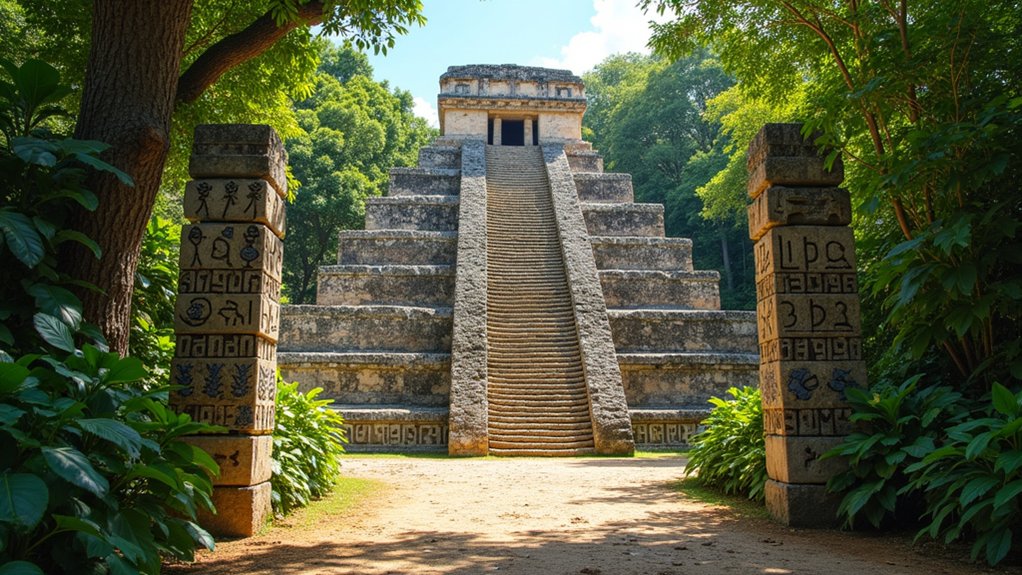
Maya temples were not simply architectural achievements, they were spiritual instruments designed with sacred geometry and astronomical precision. Every angle, platform, staircase, and alignment carried symbolic meaning connected to the gods, the sky, and the natural world.
Through sacred geometry, the Maya built temples that mirrored their cosmology:
- the underworld (Xibalba),
- the earthly realm,
- and the celestial world, where gods and ancestors resided.
Many temples were aligned with the solstices, equinoxes, and planetary events. At Chichén Itzá, for example, the pyramid of Kukulkan casts a serpent-like shadow during the equinoxes—an intentional fusion of mathematics, astronomy, and spiritual symbolism. Such alignments were not coincidences; they reflected deep knowledge of the sky and a worldview where architecture functioned as a bridge between humanity and divine forces.
By encoding spiritual symbolism into stone structures, the Maya ensured that their temples served as sacred spaces where rituals, offerings, and ceremonies connected worshippers with cosmic order.
Numerology and Divine Meaning in Maya Beliefs
In Maya culture, numbers themselves carried spiritual power. Numerology shaped rituals, calendars, mythic stories, and social decisions. To the Maya, numbers were living forces, each associated with gods, energies, and cosmic cycles.
The number 13 represented the layers of the heavens.
The number 9 symbolized the levels of the underworld.
The number 20 formed the basis of their vigesimal (base-20) numerical system, reflecting sacred completeness.
The Maya believed that numerical cycles influenced everything from agricultural success to moments of personal destiny. This spiritual numerology guided leaders, determined the timing of rituals, and helped communities maintain harmony with the universe.
By linking numbers with divine meaning, the Maya created a spiritual mathematics that shaped the rhythms of daily life and reinforced a worldview where everything was interconnected.
Mathematical Astronomy and Ritual Timing
The Maya were exceptional astronomers. Using mathematical astronomy, they observed the movement of the Sun, Moon, planets, especially Venus, and seasonal cycles with remarkable accuracy. This astronomical knowledge influenced nearly every aspect of their religious life.
Priests tracked lunar cycles, planetary alignments, eclipses, and solstices to determine the precise timing of rituals. Certain celestial events were believed to open spiritual portals or signal interactions between gods and humans. For example, the cycles of Venus were linked to warfare, sacrifice, and rulership.
Mathematical astronomy allowed the Maya to synchronize their agricultural rituals with seasonal changes, ensuring prosperity and community stability. Their observations were so precise that they could predict solar eclipses centuries in advance. These predictions were woven into religious ceremonies that honored the gods and reflected trust in cosmic order.
For the Maya, the sky was not a distant object of study, it was an active, living realm influencing human existence.
Priestly Knowledge: Mathematics as a Sacred Tool
In ancient Maya culture, mathematics was at the heart of priestly knowledge. Priests were the keepers of calendars, astronomical tables, and numerical wisdom. Their ability to interpret signs from the heavens gave them immense spiritual authority.
Mathematics allowed priests to:
- read and interpret cosmic cycles,
- choose the right days for rituals,
- align temples with celestial events,
- predict eclipses and planetary movements,
- and maintain harmony between the earthly and divine realms.
This sacred mathematics reinforced the belief that numbers connected the human world to the gods. Rituals performed with precise mathematical timing were believed to strengthen cosmic balance, ensuring the prosperity and protection of the community.
Through this deep integration of mathematics, religion, and spirituality, the Maya created a universe where numerical wisdom served as a bridge between humans and the divine.
Conclusion
In Maya culture, mathematics and religion were profoundly interconnected. Numbers were sacred, calendars were spiritual guides, and geometry was a pathway to understanding the divine. By using mathematics to align temples with the stars, time rituals with celestial cycles, and interpret cosmic patterns, the Maya created a worldview where spirituality and science worked together.
Their priests relied on mathematical astronomy to track planetary movements, predict celestial events, and maintain cosmic harmony. Sacred numerology shaped mythology, ritual practice, and social structure. Through these intertwined systems, the Maya kept their spiritual practices aligned with the heavens and preserved a cosmic order that honored both humanity and the gods.
The legacy of Maya sacred mathematics remains one of the most extraordinary examples of how numbers can shape belief, identity, ritual, and the spiritual structure of an entire civilization.
Amanda Torati is a linguist and postgraduate researcher dedicated to the study of interfaith dialogue and cultural expression. With an academic background in languages, she specializes in analyzing spiritual texts and universal values to bridge the gap between ancient traditions and modern reflection. At ABPray, Amanda combines her passion for research with a mindful approach, ensuring that every article promotes harmony, respect, and deep spiritual insight for seekers of all backgrounds.