In ancient Greece, religion and mythology were not merely collections of stories or symbolic traditions, they were the foundation upon which people understood the world, human behavior, and the forces of nature. For the Greeks, faith, myth, and everyday life were completely intertwined. The gods influenced politics, agriculture, family decisions, and community identity. Mythology shaped values, art, and literature, while rituals and festivals defined the rhythm of life in every city-state.
But how did these beliefs evolve across different regions of Greece? And what lasting impact have they left on modern culture, philosophy, and spirituality?
Let’s explore in depth.
The Pantheon of Greek Gods and Their Influence
The pantheon of Greek gods formed the spiritual backbone of ancient Greek religion. Unlike distant divine figures found in some traditions, Greek gods were deeply human in personality. Zeus, Athena, Apollo, Artemis, Poseidon, and the many others each represented natural forces, emotions, and elements of human experience. Their stories provided explanations for storms, harvests, disease, victory, and fate.
The pantheon of Greek gods also created a clear hierarchy that structured religious practice. Each deity had a domain—war, wisdom, love, the sea, the underworld—and worshippers sought their favor through rituals, sacrifices, and prayers. This divine interaction reinforced morality, courage, justice, and social responsibility. The belief that gods rewarded virtue and punished hubris shaped laws, politics, and interpersonal relationships.
Through myths and worship, the pantheon of Greek gods helped the Greeks understand their place in the cosmos, making religion a living force woven into every aspect of daily life.
Mythology as a Reflection of Greek Values and Beliefs
Greek mythology served as a mirror of ancient Greek values, spiritual beliefs, and cultural identity. More than heroic tales, myths explained ethical principles such as bravery, loyalty, moderation, and respect for divine law.
In religion and spirituality, Greek mythology played the role of a moral guide. Stories like those of Hercules, Perseus, and Odysseus taught lessons about perseverance, intelligence, and humility. Myths about Prometheus, Pandora, and Medusa conveyed warnings about pride, curiosity, and injustice.
These mythological narratives helped communities connect to shared traditions. When people gathered to hear epics or watch dramatic performances, they strengthened cultural identity and reinforced spiritual values.
Mythology also illustrated how Greeks viewed the divine: gods were powerful but relatable, capable of love, anger, jealousy, and generosity. This blended divine-human relationship shaped the unique spiritual worldview of ancient Greece.
Religious Rituals and Their Social Significance
Religious rituals stood at the heart of ancient Greek life. Whether honoring the gods, marking seasonal cycles, or celebrating civic unity, rituals were essential for maintaining harmony between humans and the divine.
These rituals included:
- Sacrifices of animals, food, or wine
- Public festivals honoring gods like Athena, Dionysus, or Demeter
- Processions carrying offerings to temples
- Purification ceremonies for births, marriages, and important transitions
- Oracles and divination for guidance in political and personal decisions
Religious rituals were community events that brought people together. Through collective worship, citizens strengthened social bonds, shared cultural identity, and reinforced spiritual values. Rituals also helped maintain order, connecting religion, politics, and civic life.
In this way, religious rituals reflected both the spirituality and the social structure that shaped ancient Greece across generations.
The Role of Temples and Sacred Sites
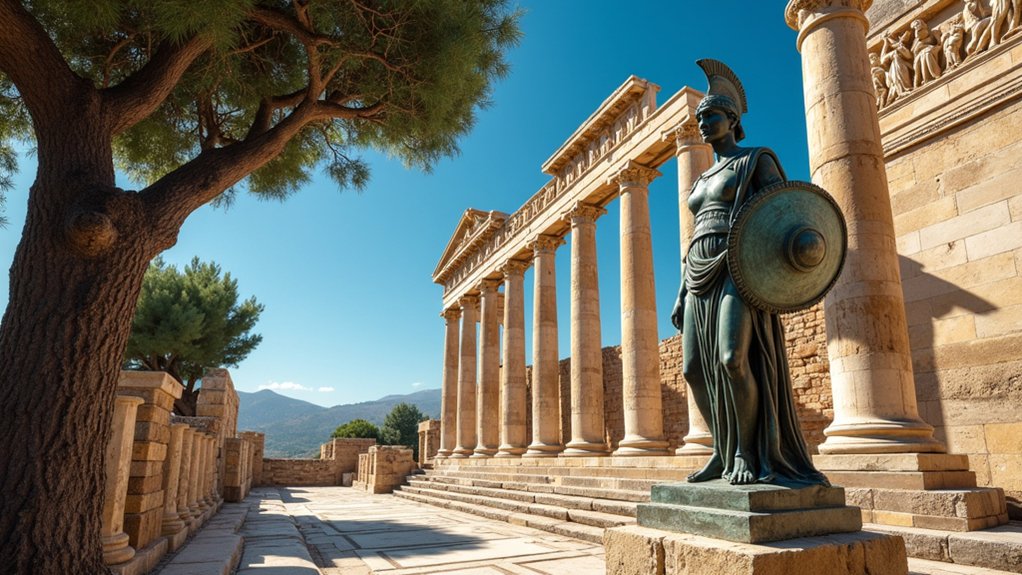
Temples and sacred sites were the physical centers of Greek religious practice. Far more than architectural marvels, these structures were considered homes of the gods, designed to reflect divine order through symmetry, geometry, and symbolism.
Each temple, from the Parthenon in Athens to the Temple of Apollo at Delphi—was crafted with deep spiritual intention. Priests carried out rituals inside, while worshippers gathered outside to pray, offer sacrifices, or receive guidance.
Sacred sites also played major roles in community identity. They served as meeting places, cultural centers, and markers of civic pride. Some locations, like Delphi and Olympia, were pan-Hellenic sanctuaries where Greeks from different city-states came together for festivals, athletic competitions, and religious ceremonies.
Through these sacred spaces, the Greeks connected myth, devotion, and public life, showing how religion and spirituality shaped their physical and cultural landscape.
Festivals and Their Impact on Community Life
Festivals were among the most important expressions of religion in ancient Greece. They blended faith, art, music, dance, theater, athletics, and communal feasting to honor the gods and celebrate spiritual unity.
Some of the most famous festivals included:
- The Panathenaia, honoring Athena
- The Dionysia, dedicated to Dionysus and the birth of Greek theater
- The Eleusinian Mysteries, centered on Demeter and Persephone
- The Olympic Games, held in honor of Zeus
These festivals strengthened community identity and reinforced shared beliefs. Citizens from different social classes participated, creating a sense of unity and belonging. Through festivals, the Greeks connected everyday life with divine celebration, turning religion into a vibrant expression of culture.
The impact of festivals on community life demonstrates how deeply spirituality shaped the rhythms, values, and traditions of ancient Greece.
Mythology’s Influence on Greek Art and Literature
Mythology’s influence on Greek art and literature was profound and long-lasting. Artists and writers used mythological themes to explore spiritual questions, moral dilemmas, divine power, and human destiny.
In sculpture, gods and heroes were depicted with grace and idealized beauty. In pottery, scenes from myths illustrated battles, love stories, and epic journeys. In literature, poets like Homer and Hesiod shaped Western storytelling through works that blended history, religion, and imagination.
Greek tragedies and comedies brought mythology to life on stage, allowing audiences to reflect on justice, fate, and the will of the gods. These artistic expressions preserved spiritual lessons and cultural identity, ensuring mythology’s influence endured across centuries.
Even today, Greek myths continue to inspire art, literature, psychology, and modern entertainment, proof of their timeless power.
Conclusion
Religion and mythology formed the spiritual and cultural foundation of ancient Greece. Through the pantheon of Greek gods, mythological narratives, sacred rituals, temples, and festivals, the Greeks created a worldview where the divine and human were deeply connected. These beliefs shaped daily life, moral values, political decisions, and artistic expression.
The legacy of ancient Greek religion and mythology remains visible today, in literature, philosophy, architecture, theater, and storytelling. By exploring these traditions, we gain insight into how a civilization used faith, myth, and ritual to understand the universe and build a lasting cultural identity.

Linguist and Interfaith Dialogue Researcher: Amanda Torati is a linguist and postgraduate researcher dedicated to the study of interfaith dialogue and cultural expressions of faith. With a strong academic background in Languages and Linguistics, Amanda specializes in analyzing spiritual texts and universal values, seeking to build bridges between ancient traditions and modern reflection. At ABPray, Amanda applies her academic rigor and ethical sensitivity to ensure that every article fulfills our mission of promoting harmony and mutual respect. Her role is fundamental to our Human and Ethical Review process, where she uses her expertise to ensure doctrinal and historical fidelity while maintaining an inclusive and accessible tone. By combining her passion for research with a mindful approach, Amanda transforms complex themes into practical reflections for daily life, helping seekers from all backgrounds find meaning and inner peace. Her commitment to authenticity ensures that ABPray remains a reliable source of inspiration and knowledge within the global spiritual landscape.
Linguist and Interfaith Dialogue Researcher: Amanda Torati is a linguist and postgraduate researcher dedicated to the study of interfaith dialogue and cultural expressions of faith. With a strong academic background in Languages and Linguistics, Amanda specializes in analyzing spiritual texts and universal values, seeking to build bridges between ancient traditions and modern reflection. At ABPray, Amanda applies her academic rigor and ethical sensitivity to ensure that every article fulfills our mission of promoting harmony and mutual respect. Her role is fundamental to our Human and Ethical Review process, where she uses her expertise to ensure doctrinal and historical fidelity while maintaining an inclusive and accessible tone. By combining her passion for research with a mindful approach, Amanda transforms complex themes into practical reflections for daily life, helping seekers from all backgrounds find meaning and inner peace. Her commitment to authenticity ensures that ABPray remains a reliable source of inspiration and knowledge within the global spiritual landscape.