Published on December 4, 2025 at 4:00 PMUpdated on December 4, 2025 at 4:00 PM
I was standing in the Meenakshi Temple in Madurai, watching an elderly man make offerings to a statue of Kali, the goddess with the severed head of a demon in her hand, her feet planted on the corpse of her consort Shiva, her black tongue extended in ecstatic violence. He was chanting prayers of devotion to this image of murder and destruction.
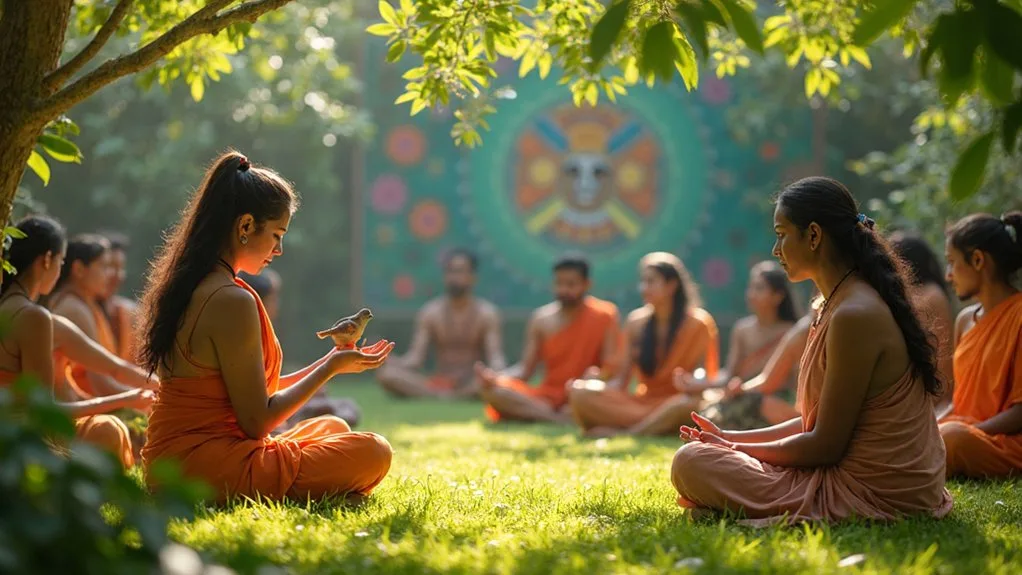
Is Hinduism's commitment to non-violence? (image: Abpray)
Later, I asked a temple priest directly: “Hinduism preaches non-violence. But your most beloved goddess is depicted murdering demons. She wears a garland of severed heads. How do you reconcile this?”
The priest smiled with the patience of someone who’d answered this question many times. “Kali is destroying the forces of evil. Violence in the service of dharma is not violence. It’s righteousness.”
I pressed him. “But that’s what every warrior says. Everyone who commits violence claims it’s righteous, in service of something good. How is Kali’s violence different from the violence of a soldier or a revolutionary?”
He paused. “The difference is… intention. Kali acts without ego, without attachment. She destroys because it’s necessary for cosmic order. She doesn’t desire the violence. She simply does what dharma requires.”
In that moment, I encountered what would become the central paradox of my eighteen-month investigation into Hinduism and non-violence: the most systematic philosophical articulation of non-violence (ahimsa) ever developed exists side-by-side with a historical practice so soaked in warfare, caste violence, gender violence, and ritual animal sacrifice that calling Hinduism “non-violent” seems not just inaccurate but almost obscene.
This is not a disagreement between ancient philosophy and modern practice. This is not a case of a perfect ideal being corrupted over time. This is a fundamental contradiction embedded within Hinduism itself, between its philosophical ideal and the worldview that permits (and often sanctifies) violence when it serves dharma, caste hierarchy, or cosmic order.
Over the course of that investigation, I spent time in temples and with philosophers. I read the sacred texts. I interviewed practitioners across class and caste lines. I studied how non-violence functioned differently for Brahmin philosophers than for untouchable laborers. I examined how dharma, the central concept supposed to constrain violence, actually functioned as a permission structure for it. And I came to understand that the question “Is Hinduism non-violent?” is malformed in a way that reveals something profound about how religious traditions operate: the gap between idealized philosophy and historical practice is not a gap between what Hinduism is supposed to be and what it has become. It’s a gap between what Hinduism claims about itself and what Hinduism has always been.
The philosophical ideal: Ahimsa as the foundation of Hindu ethics
Let me begin with the philosophical articulation, because it’s genuinely profound and worthy of serious engagement.
Ahimsa, non-harm, non-violence, appears throughout Hindu philosophy as a fundamental ethical principle. The term appears in the Upanishads, in the Mahabharata, in the Yoga Sutras of Patanjali, and throughout Hindu philosophical tradition.
Patanjali’s Yoga Sutras, written somewhere between the 4th and 2nd centuries BCE, begins with the ethical foundation: “Yoga is the cessation of the mind’s oscillations. Then the witness is established in its own nature.” And the path to yoga includes specific ethical observances called yamas, the first of which is ahimsa: “Non-harming in thought, word, and deed.”
This is not simply the avoidance of physical violence. It’s non-harming in thought and word. It requires a specific consciousness, a commitment to not wishing harm on anyone, even mentally.
The Chandogya Upanishad teaches: “Austerity, alms-giving, righteousness, and non-injury to any creature, this is the path to immortality.”
The Bhagavad Gita, the most famous Hindu philosophical text, features extensive teaching on non-violence. Krishna teaches Arjuna about the path of renunciation and the path of ascetic discipline, and throughout these teachings, non-harming is presented as a fundamental virtue.
From these sources developed a sophisticated philosophical tradition of ahimsa. The philosophical position is elegant: all beings are manifestations of the same underlying reality (Brahman). To harm another being is to harm that manifestation of Brahman. To harm another is to fail to recognize the fundamental unity of all existence.
This philosophy developed into a comprehensive system that goes beyond the mere avoidance of killing. It includes compassion for all beings, recognition of the equal worth of all creatures, and a commitment to minimize suffering in the world.
When I spoke with a Hindu philosopher in Delhi, a traditional pandit trained in classical Sanskrit philosophy, he articulated this with remarkable clarity: “Ahimsa is not a rule you follow. It’s an insight you realize. When you truly understand that all beings are one, that the distinction between self and other is ultimately illusory, then non-harming flows naturally. You don’t harm others because harming them is harming yourself. The deepest truth of Hindu philosophy is that violence is fundamentally ignorance, it emerges from the false belief that others are separate from you.”
This is a genuine philosophical achievement. It represents a sophisticated understanding of ethics rooted in metaphysics. And it goes further than most ethical systems in suggesting that non-violence is not just a rule but an expression of ultimate reality.
But here’s where the problem emerges, and it emerges directly from within the Hindu texts themselves.
The internal contradiction: the Bhagavad Gita’s impossible logic
The most profound statement of Hindu non-violence, and also the most direct philosophical justification for violence, exist in the same text: the Bhagavad Gita.
The Gita is structured around a crisis: the warrior Arjuna is standing on a battlefield, about to fight his cousins and former teachers. He’s filled with doubt and revulsion at the violence he’s about to commit. He tells Krishna: “I will not fight my own people. I don’t want to kill my relatives.”
And Krishna’s response is to justify warfare and violence.
This is the central paradox. The same text that teaches non-violence as the foundation of ethics also teaches that violence is not only permissible but required when it serves dharma, when it’s necessary to maintain righteousness and cosmic order.
Krishna teaches Arjuna about several philosophical paths: the path of renunciation (sannyasa), the path of action (karma yoga), the path of devotion (bhakti yoga), and the path of knowledge (jnana yoga). Through all these teachings, he emphasizes non-attachment, which means Arjuna should fight without ego, without hatred, without desire for the fruits of his action. But he should fight.
“Your duty is to fight. A warrior who refuses to fight his rightful duty is committing moral transgression. Better to perform your own duty imperfectly than another’s duty perfectly. Duty according to one’s nature is dharma. Abandoning it is adharma (unrighteousness).”
The philosophical move here is crucial and ingenious: the Gita acknowledges that violence is inherently problematic. But it argues that there are situations where non-violence would itself be a violation of dharma. Where renouncing violence would be a failure of duty.
This creates an internal permission structure: violence is not good, but dharma, cosmic order, social duty, righteousness, can require it.
I spent weeks with a Gita scholar, going through the text carefully, asking him how this contradiction was supposed to work.
He explained: “The Gita is not saying violence is good. It’s saying that sometimes non-violence is a form of cowardice. Sometimes failing to act against evil is itself wrong. The key is intention and attachment. If you kill without hatred, without ego, without attachment to the outcome, then the violence is not karmically binding. The action itself is neutral. What matters is the consciousness with which you act.”
I pressed: “But couldn’t every violent person claim this? Couldn’t a soldier killing in war claim he has no hatred, that he’s just doing his duty?”
He said: “Yes. And that’s the problem. The Gita provides a framework that, in principle, justifies violence whenever it’s claimed to be in service of dharma. The framework is supposed to be constrained by actual dharma, by what’s truly righteous. But in practice, anyone can claim their violence serves dharma.”
This is the fundamental internal contradiction of Hinduism: the philosophical ideal of ahimsa coexists with a conceptual framework (dharma) that can be mobilized to justify violence.
And this contradiction is not a later corruption. It’s baked into the foundational texts themselves.
The dharma loophole: how non-violence becomes a permission structure for violence
The key to understanding how Hinduism can claim non-violence while practicing violence lies in the concept of dharma.
Dharma is often translated as “duty” or “righteousness” or “cosmic order.” But it’s more specific than these translations suggest. Dharma is the principle of order that maintains the cosmos. It’s what keeps chaos (adharma) at bay.
Critically, dharma is not universal. Dharma is contextual. Your dharma (svadharma) is determined by your position in society, your caste, your stage of life, your role.
A Brahmin’s dharma is to study, teach, and perform rituals. A Kshatriya’s (warrior’s) dharma is to fight and protect. A Vaisya’s (merchant’s) dharma is to trade. A Shudra’s (servant’s) dharma is to serve others.
Within each caste, dharma is further differentiated by stage of life: the dharma of a student is different from the dharma of a householder, which is different from the dharma of a renunciate.
This creates a system where violence can be not just permissible but required if it serves dharma. A Kshatriya warrior who refuses to fight is violating dharma. A king who fails to wage war against evil is failing his duty.
But here’s the permission structure: because dharma is defined by those in authority, and because dharma can justify violence, the system creates a framework where those in power can justify almost any violence as dharmic.
A Brahmin can justify violence against an untouchable as maintaining the ritual purity that’s essential to dharma. A husband can justify violence against a wife as enforcing the dharmic order. A king can justify conquest as protecting dharma.
The system creates what we might call the “dharma loophole”, a way to affirm non-violence in principle while permitting violence in practice, because violence in service of dharma is not considered “real” violence. It’s considered necessary action.
I spoke with a scholar of classical Hindu law (Smriti Shastras) about this. She explained: “The dharma concept is genuinely sophisticated. It tries to create order in a complex world. But it’s also deeply problematic because it’s defined hierarchically. Brahmins determine what dharma is. They determine what maintains cosmic order. And they justify their own authority through this system.”
The genius and the tragedy of Hinduism is that its central ethical concept, dharma, contains within itself the capacity to justify nearly any existing social arrangement as cosmic necessity.
The comparison with Jainism: a tradition that actually means non-violence
To understand what genuine, consistent non-violence looks like in a religious tradition, I need to compare Hinduism with Jainism.
Jainism emerged around the same time as Buddhism, in the 6th century BCE, in the same region of India. It developed its own philosophy and practice. And while Hinduism used non-violence as one principle among many (subject to dharma), Jainism made non-violence absolute.
In Jainism, ahimsa is not one ethical principle among others. It’s the supreme principle. Nothing supersedes it. Not duty, not social order, not cosmic necessity.
The Jain philosophy is built on a specific metaphysics: every living being (jiva) has a soul. Every soul is essentially equal in worth and dignity. To harm a soul is to bind that soul with karma. To practice non-violence is to free souls from karma.
This creates a radical commitment to non-violence. Jains practice non-violence not just toward humans but toward all living beings, animals, insects, even microorganisms.
Jain monks and nuns practice extreme asceticism specifically to minimize harm:
They wear masks to avoid inhaling insects
They sweep the ground before them to avoid stepping on living beings
They strain water before drinking it to avoid killing microorganisms
They avoid certain foods (like root vegetables) that would kill the entire plant
They avoid activities that might cause harm to any being
This is not theoretical philosophy. This is consistent, disciplined practice rooted in principle.
When I visited a Jain temple and spoke with monks, I asked: “What if practicing non-violence meant your child would die? What if you could save your child’s life only by killing something?”
The monk paused seriously. “This is a hard question. But in Jain teaching, we would accept the child’s death rather than violate ahimsa. Because the violation of ahimsa would bind our soul with karma. And the real harm would be spiritual, not physical.”
This represents a genuine commitment to non-violence where it’s not subordinated to other principles. It’s not “non-violence when possible, but violence when necessary for dharma.” It’s an absolute principle that overrides all competing concerns.
Now, interestingly, Jainism didn’t become the dominant religion of India. Hinduism, with its ability to justify violence through dharma, spread much more widely. And Buddhism, which also emphasized non-violence but in a more moderate way than Jainism, became dominant in many parts of Asia.
This suggests something uncomfortable: the tradition that explicitly affirms non-violence absolutely (Jainism) remained a minority tradition. The traditions that affirmed non-violence while maintaining frameworks to justify violence (Hinduism and Buddhism) became dominant.
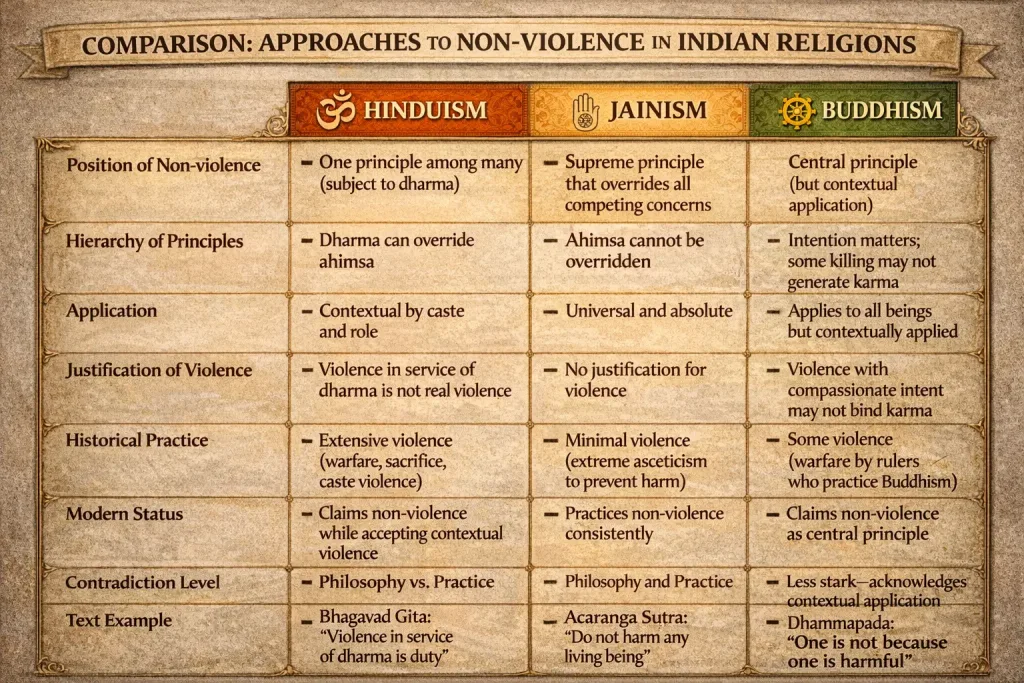
Here’s a comparative table showing the difference:
Comparison: approches to non-violence in indian religions. (Image: ABPray)
The comparison is illuminating. Jainism provides what Hinduism claims, a tradition genuinely committed to non-violence as a supreme principle. But Jainism remained a minority tradition. Hinduism, with its ability to accommodate violence through the concept of dharma, became the dominant religion.
The Buddhist parallel: non-violence with flexibility
Buddhism offers an interesting middle position between Hindu contextualism and Jain absolutism.
Buddhism, emerging from the same cultural context as Jainism, also emphasized non-violence (ahimsa). The first precept of Buddhist ethics is “refrain from killing.” Non-violence is central to Buddhist practice.
But Buddhism also developed a framework for understanding karma that allowed for some flexibility. The key is intention (cetana). An action is karmically binding based on the intention behind it, not just the action itself.
This created space for Buddhist-majority kingdoms (in Thailand, Burma, Sri Lanka, Japan) to wage warfare while maintaining that Buddhism is fundamentally non-violent. The violence could be practiced (and was practiced extensively) while the principle of non-violence was affirmed.
What’s interesting is that Buddhism and Hinduism both developed frameworks that affirm non-violence while permitting violence, through dharma (in Hinduism) and through intention/karma (in Buddhism). But they developed these frameworks in slightly different ways.
The Buddhist framework is perhaps slightly more rigorous because it focuses on intention. But it still creates the possibility of justifying violence as long as it’s not done with hatred or ego-attachment.
Jainism, by contrast, offers no such framework. Harm is harm, regardless of intention. The violence is binding regardless of whether it’s done with good or bad intention.
Gender violence and the hierarchy hidden in non-violence philosophy
One of the most striking aspects of my research was recognizing how the philosophy of non-violence actually functioned to justify violence against women and lower castes.
Consider sati, the practice of burning widows on their husbands’ funeral pyres. This practice was justified through philosophy. The widow was understood as merging with her husband, achieving moksha (liberation). Her death was not violence against her; it was liberation for her.
The practice was described in philosophical language as voluntary, even desirable. Sacred texts were interpreted to suggest that a woman who underwent sati achieved spiritual advancement.
In reality, what was happening was systematic violence against women; women who had lost economic support and who were being eliminated to preserve family property. But the violence was obscured by philosophical language.
Similarly, the entire caste system was justified through dharma philosophy. Untouchables’ exclusion and abuse was justified as cosmic necessity, they had sinned in past lives and deserved their low status. Their dharma was to serve and remain pure through separation.
What appears to be non-violence philosophy (everyone should accept their dharmic role peacefully) was actually a permission structure for violence (those in lower positions should accept violence against them as dharmic necessity).
I spoke with a Dalit historian, someone from an untouchable background, about this. She said: “When I hear Hindus talk about ahimsa, about how Hinduism is fundamentally non-violent, I think about my ancestors who were forbidden from entering temples, who couldn’t touch people of higher castes, who were forced to do the most degrading work. All of this was justified through dharma. The philosophy of non-violence was used to justify systematic violence against us.”
This is a crucial insight: the philosophy of non-violence did not prevent violence. In many cases, it provided the conceptual framework through which violence was justified and perpetuated.
The modern reinterpretation: when did Hinduism become non-violent?
One of my most important findings was recognizing that the modern equation of Hinduism with non-violence is a relatively recent development.
For most of Hindu history, non-violence was one principle among many, subject to dharma. Hindu kingdoms waged wars. Hindu priests performed animal sacrifices. Hindu society enforced caste hierarchy through violence.
The modern equation of Hinduism with non-violence emerges primarily through two sources:
First: Colonial encounter and reform. When Hindu intellectuals encountered European criticism of Hindu practices (sati, caste discrimination), they responded by reinterpreting Hinduism through the lens of Western philosophical ideals. They emphasized the non-violent, spiritual, philosophical aspects of Hinduism while downplaying the violent, ritualistic, hierarchical aspects.
Ram Mohan Roy, in the early 19th century, founded the Brahmo Samaj, a reform movement that emphasized Hindu philosophy while rejecting animal sacrifice and caste hierarchy. He was responding to European criticism by reinterpreting Hinduism as fundamentally spiritual and non-violent.
Swami Vivekananda, in the late 19th century, presented Hinduism to Western audiences as a deeply spiritual, non-violent tradition focused on meditation and self-realization. He emphasized Vedanta philosophy while downplaying ritual practice and caste.
This was not simply returning to an original, pure Hinduism. This was a reinterpretation, shaped by colonial encounter and the need to defend Hinduism against European criticism.
Second: Gandhi’s reinterpretation. Mahatma Gandhi’s non-violent resistance movement explicitly tied Hinduism to ahimsa. Gandhi presented non-violence as the essence of Hinduism and argued that Hindu philosophy naturally led to non-violent resistance.
This was a profound reinterpretation. In the Bhagavad Gita, Krishna teaches violence as duty. Gandhi reinterpreted this to teach non-violence as duty. He explicitly rejected the Gita’s teaching that violence in service of dharma is righteous. He argued that true dharma required non-violence absolutely.
Gandhi’s reinterpretation was creative and powerful. But it was a reinterpretation, not a return to original teaching. The original Gita taught that warriors should fight. Gandhi taught that they should not.
The result of Gandhi’s influence was that modern Hinduism became officially committed to non-violence. The Indian Constitution, written after independence, enshrines principles of non-discrimination and equality, principles Gandhi fought for using non-violence.
But this doesn’t erase the history. It doesn’t change what actually happened in Hindu kingdoms and Hindu practice for centuries.
What’s crucial is that the modern equation of Hinduism with non-violence is not ancient practice continuing. It’s a modern reinterpretation that emerged in response to specific historical pressures.
This doesn’t mean the reinterpretation was wrong. Gandhi’s interpretation of the Gita may well be more ethically sound than the traditional interpretation. But it does mean that the claim “Hinduism is fundamentally non-violent” is not supported by most of Hindu history.
The unresolved tension: dharma’s shadow side
The deepest issue underlying all of this is that Hinduism contains an unresolved tension at its philosophical core.
On one hand, Hindu philosophy teaches that all beings are manifestations of the same ultimate reality (Brahman). On this basis, non-violence should flow naturally, harming another is harming oneself.
On the other hand, Hindu philosophy teaches dharma, cosmic order that requires hierarchy, different duties for different people, and sometimes violence in service of order.
These two commitments are in tension. The commitment to universal unity suggests equality and non-harm. The commitment to dharmic order suggests hierarchy and contextual violence.
For most of Hindu history, dharma has been the winning principle. When non-violence and dharma conflict, dharma typically prevails. A Brahmin performing a ritual sacrifice is serving dharma, even if it harms animals. A husband enforcing his authority over his wife is serving dharma, even if it involves violence. A warrior fighting for his king is serving dharma, even if it involves killing.
The philosophy of unity and non-violence provides the ideal. But the concept of dharma provides the permission structure for violating it.
What troubles me is that modern Hinduism tries to claim that non-violence is the real tradition, while dharma is a corruption or misunderstanding. But that’s not historically accurate. Dharma is as central to Hindu teaching as non-violence is.
A pandit I spoke with late in my research acknowledged this tension. He said: “Hinduism contains within itself both the teaching of universal unity and compassion, and the teaching of dharmic hierarchy and order. Both are true in our tradition. We have not resolved the tension between them. Sometimes one principle dominates, sometimes the other. The tension is part of what it means to be Hindu.”
This honesty seems to me more truthful than the modern claim that Hinduism is fundamentally non-violent. Hinduism contains non-violence as a principle, sometimes subordinated to other principles, sometimes central. The tradition has not resolved the tension.
What I understand now
After eighteen months of research, reading the texts, observing practice, interviewing practitioners across class and caste lines, examining history, I’ve reached something like clarity, though it’s a clarity that is uncomfortable.
First: The philosophical ideal of non-violence (ahimsa) in Hinduism is genuine and profound. The understanding that all beings are manifestations of ultimate reality, and therefore harming others is harming oneself, is philosophically sophisticated and ethically compelling.
Second: This ideal has coexisted throughout Hindu history with a permission structure (dharma) that justifies violence in service of cosmic order, social hierarchy, and duty. The two have not been resolved. Instead, they have coexisted in tension.
Third: The modern claim that “Hinduism is fundamentally non-violent” is a reinterpretation that emerged in response to colonial critique and Gandhi’s influence. It’s not the historical reality of Hindu practice for most of Hindu history. It’s an aspiration and a modern redefinition.
Fourth: The concept of dharma, which is supposed to constrain violence through cosmic order, has actually functioned as a permission structure for violence. It allows those in authority to justify violence as necessary for maintaining order. It allows systems of oppression (caste hierarchy, patriarchy) to be presented as cosmic necessity.
Fifth: Jainism represents what genuine, absolute non-violence looks like, a principle that overrides all competing concerns. Hinduism never developed this level of consistency. It maintained frameworks (dharma) that could override non-violence when necessary.
Sixth: The comparison with Jainism and Buddhism reveals that all religious traditions that claim non-violence also contain frameworks that permit or justify it. Pure, absolute non-violence is rare. Traditions typically develop philosophical frameworks that allow violence when it serves higher purposes (dharma, intention, compassion).
Seventh: The violence that has been done in Hindu contexts, caste violence, gender violence, communal violence, has often been justified through Hindu philosophy. The philosophy of non-violence did not prevent this violence. Sometimes it enabled it by suggesting that victims should accept their suffering as dharmic necessity.
Eighth: The question “Is Hinduism non-violent?” cannot be answered simply yes or no. Hinduism contains both the ideal of non-violence and frameworks that justify violence. Modern Hinduism claims non-violence as its core identity, but this is a reinterpretation, not a description of historical practice.
What remains is a lived tension that Hinduism has not resolved: between the ideal of universal compassion and the acceptance of hierarchy, between the teaching of unity and the practice of division, between the aspiration to non-violence and the permission for violence in service of dharma.
Modern Hinduism has chosen to emphasize the non-violent ideal. This is a worthy choice. But it requires acknowledging the history honestly. It requires recognizing that the equation of Hinduism with non-violence is not ancient truth recovered, but modern aspiration articulated.