Published on December 3, 2025 at 4:00 PMUpdated on December 3, 2025 at 4:00 PM
The question seems simple until you realize it contains three questions, each with a different answer depending on where you are standing, what caste you were born into, and whether anyone is watching.
The question is not whether Hinduism eats pork. (image: Abpray)
Does Hinduism eat pork?
I learned the answer not from books, but from watching three men navigate the same food, pork, across the same country, on the same days, each living in a completely different version of what it means to be Hindu.
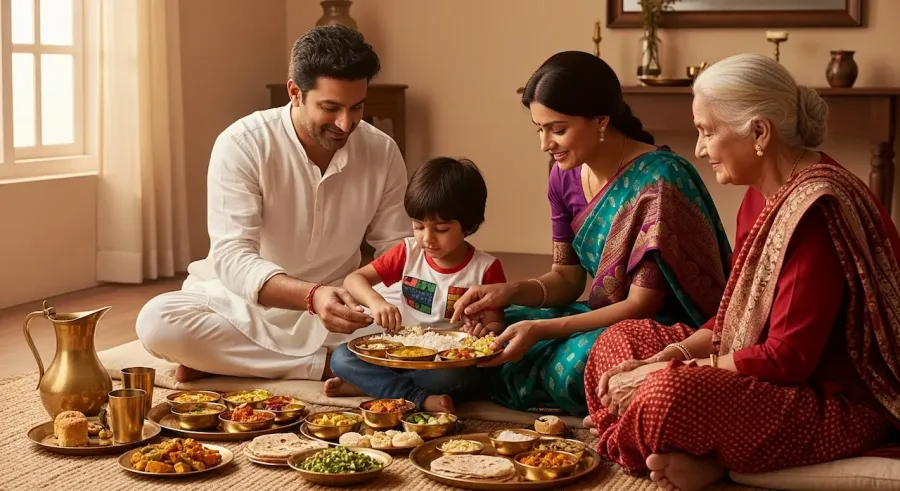
I arrived in Kottayam, Kerala on a Tuesday morning in October. The heat came at you sideways here, humid and pressing, carrying the smell of coconut, fish, and something darker that I would later understand was old blood from the butcher stalls near the market. I had arranged to spend the day with David, who works as an accountant for a rubber cooperative and eats pork three or four times a week without experiencing the slightest spiritual discomfort.
David was born Hindu. His family converted to Christianity in the 1950s, a choice that was, they understood, both spiritual and social. His mother still maintains a small altar to Devi in the back of the kitchen, a gesture that nobody comments on and everybody sees. When I asked him about the pork, he laughed.
“In Kerala,” he said, “pork is what you eat. My grandmother ate pork. My Hindu grandmother, before she converted. The idea that Hinduism doesn’t eat pork is something people from the North invented.”
He was preparing appam for breakfast, a rice pancake that would be served with pork curry. The curry had been cooking since 5 AM, pork, coconut, vinegar, spices that I couldn’t identify. The smell was not the smell of something forbidden. It was the smell of breakfast.
On the same morning, six hundred kilometers north in a village outside Belgaum, Karnataka, Prakash was waking up at 4:30 AM to work in the brick kiln before the heat became unbearable. Prakash is forty-two, though he looks older, which is what happens when your body has been worked since childhood. He is Dalit, the word carries history, and history carries weight.
His grandmother had been a hunter. Not as profession, but as survival. The forests around Belgaum held wild boar, deer, small game. A woman and her daughters could feed a family through hunting. This was before the forests became reserves, before hunting became something only the wealthy could do with permits, before the British had criminalized what his family had done for generations.
Prakash still hunts, but he doesn’t call it hunting. He says he “works with a friend who has land.” What he means is that twice a month, they take a rifle into the scrubland and return with something wrapped in cloth. His wife cooks it only at night, only when the neighbors’ windows are dark.
When I asked him why he hides it, he looked at me with an expression that suggested I had asked something truly naive.
“Because I’m Dalit,” he said. “And if upper-caste people see me eating pork, it confirms what they already believe about me. That I’m unclean. But if they don’t see it, maybe I can live like everyone else pretends to live.”
The same morning in Mumbai, Ahmed was standing in the processing facility where he has worked for seventeen years. Ahmed is Muslim. The facility handles halal slaughter for Muslim clients, but it also processes pork for the Hindu market. He stood in the cold room, watching the carcasses move along the line, and I watched him watching.
“The irony,” he said, without looking at me, “is that Hindus have more restrictions on pork than Muslims do. We eat pork. It’s permitted. It’s not something we do, but it’s not forbidden. But Hindus, they have constructed this whole theology of pollution around something that’s not even mentioned in their main texts.”
He said this while pulling on gloves, preparing to work with meat that he himself would never touch outside this place. His own practice of Islam is strict. But his job requires him to be intimate with the very substance his religion permits him to avoid.
“And the Hindus who buy this meat,” he continued, “they whisper when they come in. They don’t want anyone to see them. They’re ashamed of eating something that’s completely normal for them to eat.”
The architecture of caste and the question of pork
What David, Prakash, and Ahmed were each describing, though none of them had the historical framework to fully understand it, was the consequences of a rewrite that had been imposed on India over two centuries.
The pork tabu in Hinduism is not ancient. It is not theological. It is architectural, built into the very structure of caste hierarchy, and reinforced through colonialism, nationalism, and the desperate need for religious coherence in a fragmented tradition.
Before I explain what happened, you need to understand what was true before the rewrite.
Pork was eaten in India. The Mahabharata contains references to wild boar hunts. The Arthashastra, Kautilya’s ancient text on statecraft and economics, mentions pork as a commodity of value. Archaeological evidence from South Indian temple sites shows bones of pigs in ritual contexts. Pigs were not universally forbidden. They were, like all food, context-dependent. Your caste determined whether you could hunt them. Your region determined what animals were available. Your economic position determined whether you could afford them. Your ritual status determined whether they were appropriate for you to consume.
The caste system was, among many other things, a system of dietary control. Different castes had different foods, different preparation methods, different animals they were permitted to touch. Brahmins were theoretically vegetarian, though the theory had many exceptions. Warriors (Kshatriyas) ate meat as part of their martial training. Merchants (Vaishyas) had their own dietary codes. Laborers and service castes (Shudras) ate what they could access or were permitted. Untouchables, below the varna system entirely, hunted and scavenged, consuming wild animals, including pigs.
This was not experienced as oppression, necessarily. It was experienced as order. Everyone had a place, and that place included a dietary identity.
Then the British arrived.
What colonialism did to pork (and to the people who ate it)
The British faced a problem. They needed to understand Indian society in order to govern it efficiently, but Indian society was not legible to them. It did not operate according to the categories they understood. So they began systematizing it.
They categorized caste. They categorized religion. They categorized animal species. They categorized what was “clean” and what was “unclean.” And in doing this, they made several crucial moves that would reshape Hindu identity forever.
First, they criminalized wild boar hunting.
In 1878, the British declared large portions of India as “Forest Reserves.” Hunting in these reserves became illegal. The stated reason was conservation. The actual effect was to criminalize the primary livelihood of entire castes, the hunter-gatherers, the Adivasi communities, the forest-dependent groups who had sustained themselves through hunting for centuries.
Prakash’s grandmother had hunted legally. His mother had hunted, though increasingly in fear. By the time Prakash was born, hunting had become something you did at night, something you lied about, something you could be imprisoned for.
This was economic devastation dressed up as environmental protection. And it was specifically destructive to lower castes, because it was lower castes who depended on hunting. Upper castes could simply switch to purchased meat or embrace vegetarianism. Lower castes lost their food source and their autonomy.
Second, the British reformulated the relationship between pork and pollution.
British scholars, writing in the late 1800s, began describing pork-eating as inherently polluting in Hinduism. They pointed to Muslim and Jewish prohibitions and assumed that Hinduism must have something similar. They found pieces of evidence, certain texts that discouraged pork, certain regions where it was less common, and they generalized from these pieces into a universal principle.
Worse, they connected pork-eating to caste status. Pork-eating communities were “lower caste.” Therefore, pork-eating itself was a lower-caste marker. Eating pork became evidence of low status.
Hindu reformers, desperate to modernize and to compete with British notions of civilization, seized on this narrative. If we can prove that Hinduism has always been vegetarian, or nearly so, then Hinduism is civilized. Then we deserve respect. Then we deserve self-governance.
By the early twentieth century, the relationship between pork and pollution had become so embedded in Hindu consciousness that many Hindus believed it had always been this way. The belief became self-perpetuating. Young Hindus grew up learning that pork was forbidden. They taught their children the same thing. By the time independence arrived, vegetarianism and the prohibition on pork had been thoroughly stitched into the identity of Hinduism.
The irony is devastating: the very thing that was supposed to prove Hindu superiority was actually a colonial construct. The Hindu nationalists had internalized the colonizer’s categories and then fought for independence using the colonizer’s values.
Regional variations: the pork that nobody talks about
The problem with declaring something universal is that it erases the places where it was never true.
Kerala: the pork that never left
In Kerala, pork never became forbidden. This is the crucial fact that the Northern Hindu narrative cannot accommodate.
Kerala has a different history. It was never fully integrated into the brahminical caste system in the way that the North was. It had its own traditions, its own social hierarchies, its own religious diversity. When the British arrived, they found Christian communities in Kerala that had been there for over a thousand years, not converted by colonial missionaries, but established in the early centuries of Christianity itself.
These Christian communities ate pork. They had always eaten pork. There was no theological prohibition.
But beyond the Christian communities, Hindu communities in Kerala also had pork traditions. The Nairs, who were traditionally warriors and landowners, ate meat. Lower-caste groups hunted and consumed pork. In the backwaters and wetlands of Kerala, pork was part of the economy and the diet.
When I sat with David and his mother, a woman named Suma who still attends the local temple every Friday despite being Christian, she spoke about this with a kind of matter-of-fact clarity that made it obvious how recent the prohibition was.
“My mother,” Suma said, “who was born in 1920, ate pork regularly. It was normal. It was not something we thought about as forbidden. The prohibition came later, when people started trying to make Hinduism look respectable to the British.”
David’s sister, who still identifies as Hindu and has married a Hindu man, eats pork with her family, but she doesn’t discuss it outside the family. She experiences it as normal but unspeakable, the exact opposite of how Prakash experiences it.
Goa: pork as history and taste
Goa has an even more complicated relationship to pork. It was Portuguese territory until 1961. For nearly five hundred years, it was governed by a European Catholic power. The cuisine that developed in Goa is a fusion, Hindu ingredients and techniques, Portuguese ingredients and preparations, Muslim influences from the Deccan, Christian practices of eating meat.
Pork vindaloo is the most famous dish to emerge from this fusion. It is distinctly Goan. It is also distinctly Christian and Hindu simultaneously, you cannot separate them out.
When I visited Goa, I spent a day with a man named Vishnu who owns a small restaurant in Panaji. Vishnu is Hindu by birth, though he identifies as secular. He cooks pork regularly and without apology. His customers are a mix, Goans of all religions, tourists, people from other parts of India who come to Goa and feel they have permission to eat pork because they are away from home.
“Goa is different,” Vishnu said, as he prepared the vindaloo, marinating pork in vinegar, spices, and the slow history of Portuguese colonization. “We were Catholic for five hundred years. Then we became Indian. But the food, the food remembers both things.”
The pork in his restaurant is not forbidden. It is not shameful. It is simply what you eat.
But even in Goa, the pressure from mainland India is increasing. Younger Goans who move to Mumbai or Delhi encounter the Northern Hindu narrative and begin to feel that their food traditions are un-Hindu. Some internalize this. They begin to hide their pork consumption or justify it as cultural exception rather than Hindu practice.
Tamil Nadu and the wild boar
In Tamil Nadu, hunting has a different status. The Sangam literature, ancient Tamil poetry from the first few centuries of the common era, contains references to hunts, to boar, to the relationship between warriors and wild animals.
The Irulas, a hunter-gatherer community in Tamil Nadu, have hunted wild boar for millennia. They have developed sophisticated knowledge about animal behavior, forest ecology, sustainable hunting practices. This knowledge is not theoretical. It is embodied, passed down through practice and story.
The British criminalization of hunting destroyed their primary livelihood. They were forced into wage labor, into poverty, into dependence on upper-caste landowners. The prohibition on hunting was experienced not as environmental protection but as cultural annihilation.
Today, the Irulas still hunt, but illegally. They are subject to arrest, to fines they cannot pay, to the constant threat that their practice will be criminalized further.
Prakash’s situation mirrors this. His hunting is illegal. His consumption of pork is experiencing increasing social censure. His caste status means that when people see him eat pork, they interpret it not as a normal human behavior but as evidence of his “natural” place in society, low, unclean, polluted.
The tragedy is that the very thing that was supposed to mark him as polluted, the pork eating, was something his ancestors did with pride. It was their expertise, their livelihood, their way of being in the world. Colonialism and Hindu nationalism transformed it into shame.
The table: comparative theologies and tabus
To understand what’s happening with pork in Hinduism, it’s useful to see it alongside what’s happening with pork in other traditions.
Aspect
Hindu Pork Tabu
Muslim Pork Tabu
Christian Pork Practice
Theological Basis
Constructed; tied to caste pollution, not to sacred text
Quranic; explicit and categorical
None; consumption is permitted and normal
Historical Consistency
Pre-colonial: regional and caste-dependent; post-colonial: universalized
Pre-Islamic to present: consistent; Quranic interpretation uniform
Pre-Christian to present: consistent; no prohibition
Regional Variation
Massive variation; Kerala, Goa different from North
Minimal variation; tabu is global across Muslim communities
Some variation (Portuguese vs. Anglo cultures), but consumption consistent
Enforcement Mechanism
Social shame, caste pollution, family pressure, nationalism
Religious law (shariah), community enforcement, theology
Hidden consumption: Dalits, lower castes, certain regions
Nobody; the tabu is nearly universal among Muslims
Normal practice: all Christian populations
Experience of Eating
Guilt, shame, transgression (for those raised Hindu)
Not applicable; tabu is internalized
Normal, unmarked, no religious significance
Source of Prohibition
Colonial reinterpretation + nationalist ideology
Sacred text + theological consistency
No source; consumption is permitted
The key difference: Hindu pork tabu is constructed, recent, and unstable. Muslim pork tabu is theological, ancient, and stable. Christian non-prohibition is simply the absence of a tabu.
The crisis moment: when secrecy breaks
On the eighth day of my observation period, Prakash’s hidden practice nearly became public.
His wife, Lakshmi, had cooked pork biryani late at night, a celebration, because their son had been accepted into an engineering college. They were eating together in the kitchen, just the two of them, when Prakash’s older brother arrived unexpectedly. He had come to discuss the family’s finances. He opened the door without knocking, as relatives do, and saw them eating.
The moment that followed was compressed. Recognition. The meat was identifiable. The smell was unmistakable.
What surprised me was that the brother’s response was not moral condemnation. It was something more complicated. A mixture of recognition and denial. He saw what they were eating. He pretended he didn’t see it. He moved through the kitchen, greeting them, asking about their son, never acknowledging the biryani.
Later, I spoke with Prakash about this moment.
“He knows,” Prakash said. “His wife’s brother hunts too. Everyone knows. We all know. But we’ve agreed not to say it out loud. Because saying it out loud makes it real, makes it shameful, makes it into a violation. Keeping it quiet, we can live.”
This is the architecture of caste shame. It is not simply about individual judgment. It is about collective agreement not to see, not to speak, not to know.
The ritual boundary: where the split becomes absolute
The most revealing observation came during Dussehra, the festival that celebrates the victory of good over evil. Prakash attended the local temple for the ritual. He participated in the pujas, received the prasada (blessed offerings, vegetarian), sang the hymns.
Three days later, on the same family occasion, he killed a boar with his friend’s help.
When I asked him about the contradiction, he didn’t see it as contradiction.
“The temple,” he said, “is where I honor the gods. The gods understand that I am Dalit, that I must eat what I can access, that my body needs nourishment. The gods don’t care about ritual purity the way Brahmins do. They care about whether your heart is right.”
This is the theological sophistication that gets lost in the universalizing narrative. Different contexts have different rules. The temple requires one thing. Your family requires another. Your body requires food. These are not contradictions to be resolved. They are realities to be navigated.
David experiences this differently. As a Christian, he has already crossed the boundary. The temple is not his space. His pork consumption is not a transgression because he has already chosen a different path. But even David’s mother, who still prays to the Hindu gods, experiences the split between ritual and everyday.
“When I go to the temple,” Suma said, “I am participating in something sacred. I am not eating there. I am not bringing my everyday life into that space. But when I come home and cook pork, I am taking care of my family. These are different things.”
The geography of shame
What struck me most forcefully over the course of my observations was how shame correlates to distance from the South, from Kerala, from regions with continuous pork traditions.
In Kerala, pork consumption carries minimal shame. It is normal. It is food.
In Tamil Nadu, among hunting communities like Prakash, shame exists but coexists with memory. He remembers that his ancestors hunted with pride. The shame is imposed from outside, not internal to the tradition.
In Mumbai, where Rohan had lived before the earlier observations, and where I spoke with urban Hindus who occasionally eat pork, the shame was maximum. These were people who had been completely socialized into the vegetarian/pork-prohibition narrative. Eating pork required active rebellion. It required overcoming internal programming.
In North India, particularly among upper castes who had most thoroughly internalized brahminical vegetarianism, pork was experienced as literally disgusting, not just morally wrong, but physically repellent.
Ahmed, the Muslim butcher, had observed this repeatedly.
“Hindus who buy pork from me,” he said, “they come in ashamed. They whisper their order. They don’t want anyone to see them. But then they take the meat home and cook it and eat it. They have shame about something that’s completely normal for them to eat. That’s the colonialism. That’s what colonialism does, it makes you ashamed of yourself.”
The inheritance question: what gets passed down
By the end of my observations, I was struck by what was not being said between parents and children.
Prakash’s son, the one accepted into engineering college, has grown up in the city more than his father had. He has Hindu friends from upper castes. He has internalized some of the vegetarian narrative. His mother serves him vegetarian meals when his friends visit. She serves him pork only at night, only with family.
The son is being prepared for a different world, one in which his caste background is less determinative, one in which he might marry an upper-caste woman, one in which his eating practices will be scrutinized.
David’s sister is raising her children in Mumbai, away from Kerala. Her children eat pork at home but don’t discuss it outside the family. They are learning, without being explicitly taught, that some foods are for inside spaces and some are for outside spaces. Some foods are for people like us and some are for people in other places.
None of these parents are lying to their children, exactly. But they are teaching them a compartmentalization that mirrors their own. The children will learn to split themselves, to perform one identity in ritual space and another in private space.
The unresolved tension: living with the contradiction
What I have learned from David, from Prakash, from Ahmed, is that the question “Does Hinduism eat pork?” is actually unanswerable in any singular way.
Hinduism is not one thing. It contains multitudes. Some of those multitudes eat pork. Some don’t. Some eat pork in secret. Some eat it without shame. Some experience pork as completely repellent. Some understand the prohibition as ancient and essential. Some understand it as recent and constructed.
All of these are simultaneously true. The tradition is not coherent, but that incoherence is not a failure. It is evidence of complexity, of regional variation, of caste difference, of historical change.
The real tragedy is not that Hinduism contains these contradictions. It’s that modern Hindu nationalism has tried to erase the contradictions, to create a false coherence, to transform something culturally and geographically specific (brahminical vegetarianism) into something universally Hindu.
In doing this, the nationalist project has actually impoverished Hinduism. It has made it less able to accommodate its own diversity. It has turned regional practices into sources of shame. It has criminalized the knowledge and livelihoods of entire communities.
Prakash continues to hunt and eat pork and attend the temple. He has made peace with the contradiction.
David cooks pork every week and prays to Hindu gods and identifies as Christian. He does not experience this as contradiction, because for him, these are simply different aspects of his existence, his heritage, his spirituality, his embodied practice.
Ahmed processes pork for Hindus while maintaining his own Islamic practice. He sees the contradiction, but he observes it from outside, with a clarity that comes from not being trapped in the same narrative.
The question is not whether Hinduism eats pork. The question is whether we are brave enough to acknowledge that the answer is messier, more regional, more caste-dependent, and more historically contingent than any singular narrative can contain.
Timeline and territorial memory
The transformation of pork in Hindu consciousness follows a specific temporal arc. This arc is not natural. It was constructed.
Pre-1800: Pork is eaten in certain regions, by certain castes, in certain contexts. It is not universally forbidden. It is not theologically prohibited. It is simply one food among many, with its availability and appropriateness determined by geography, caste, and circumstance.
1850-1880: British administrators classify pork-eating as evidence of low caste status. They criminalize hunting. They reinterpret Hindu texts to suggest that pork has always been forbidden. Hindu reformers, seeking to prove Hinduism is civilized, accept this interpretation and begin promoting vegetarianism as essentially Hindu.
1880-1920: Pork prohibition becomes increasingly coded as Hindu identity. It becomes a marker of Hindu nationalism, of opposition to the colonizer, of spiritual superiority. Regions like Kerala and Goa that have pork traditions begin to experience shame about this. The traditions do not disappear, but they become hidden, shameful, relegated to private spaces.
1920-1947: Independence struggle uses vegetarianism and pork prohibition as markers of Hindu identity. Gandhi, though personally vegetarian, does not mandate it for all Hindus, but his example and the nationalist movement’s ideology associate vegetarianism with Hindu nationalism. Pork becomes increasingly “un-Hindu.”
1947-1990: Post-independence, pork prohibition is further consolidated through Hindu nationalist ideology. It becomes even more difficult to speak about pork consumption. Upper-caste urban Hindus internalize the prohibition completely. Lower-caste and rural communities continue practices in secret.
1990-Present: Economic liberalization and urbanization create new tensions. Urban Hindus increasingly consume meat in secret. Meat consumption becomes coded as Western, secular, modern. Regional pork traditions (Kerala, Goa) are positioned as exceptions or as influenced by Christianity/Islam rather than as authentically Hindu. The prohibition is now so thoroughly internalized that many Hindus genuinely believe it has always been part of their tradition.
What the historians found (but the nationalists ignored)
When scholars like Wendy Doniger and others examined the actual historical record, they found something quite different from the nationalist narrative.
The Manusmriti, the foundational legal text of brahminical Hinduism, explicitly permits meat-eating in certain contexts. It does not mention pork specifically as prohibited. The Arthashastra discusses pork as a commodity. The Mahabharata contains hunting scenes. The archaeological record shows pig bones in ritual contexts.
What the historians did not find was a consistent, universal prohibition on pork that stretched back to antiquity.
What they did find was regional variation. What they did find was caste-specific dietary codes. What they did find was historical change. What they did find was evidence of colonialism reshaping the tradition.
But these findings are not convenient for Hindu nationalism. They don’t prove Hindu superiority. They don’t provide a singular, coherent identity. They suggest instead that Hinduism is more complex, more contested, more historically contingent than any nationalist narrative can accommodate.
So the nationalist interpretation persists, while the historical evidence remains marginal, confined to academic circles, not part of the common sense that shapes how Hindus understand their own tradition.
The silence at the center
What struck me most forcefully about all three men, David, Prakash, Ahmed, was the silence surrounding pork.
Nobody talks about pork in Hindu families. If someone eats it, they eat it in secret. If they know someone who eats it, they pretend not to know. If they themselves are from a region or caste with a pork tradition, they learn to hide it or to frame it as exception, as local, as not truly Hindu.
This silence is not neutral. It is the silence that colonialism imposes. It is the silence of shame that has been imposed from outside, internalized, and now defended as authentic.
Prakash’s silence about his hunting is a survival strategy. But it is also a loss. He cannot pass on his knowledge to his son with pride. He can only pass it on with the instruction to hide it.
David’s silence about his mother’s Hindu worship alongside her Christian practice is a way of avoiding the endless questions and judgments that would come if he spoke about it openly. But it is also a way of keeping his inheritance invisible.
Ahmed’s observation of Hindu shame around pork is a kind of clarity purchased through distance. Because he is outside the Hindu system, he can see its contradictions clearly. But this clarity does not help the Hindus who are trapped inside.
The question that emerges is not really “Does Hinduism eat pork?” The question is: “Can Hindus develop a relationship to their own tradition that is honest about its actual history, its regional variations, its caste dimensions, and the ways that colonialism and nationalism have reshaped it?”
Until that happens, the silence will persist. The shame will persist. The contradiction between ritual purity and private consumption will persist.
And Prakash will continue to hunt at night and attend the temple by day, living the split that his tradition now requires of him.