Published on March 17, 2026 at 3:53 PMUpdated on March 17, 2026 at 3:53 PM
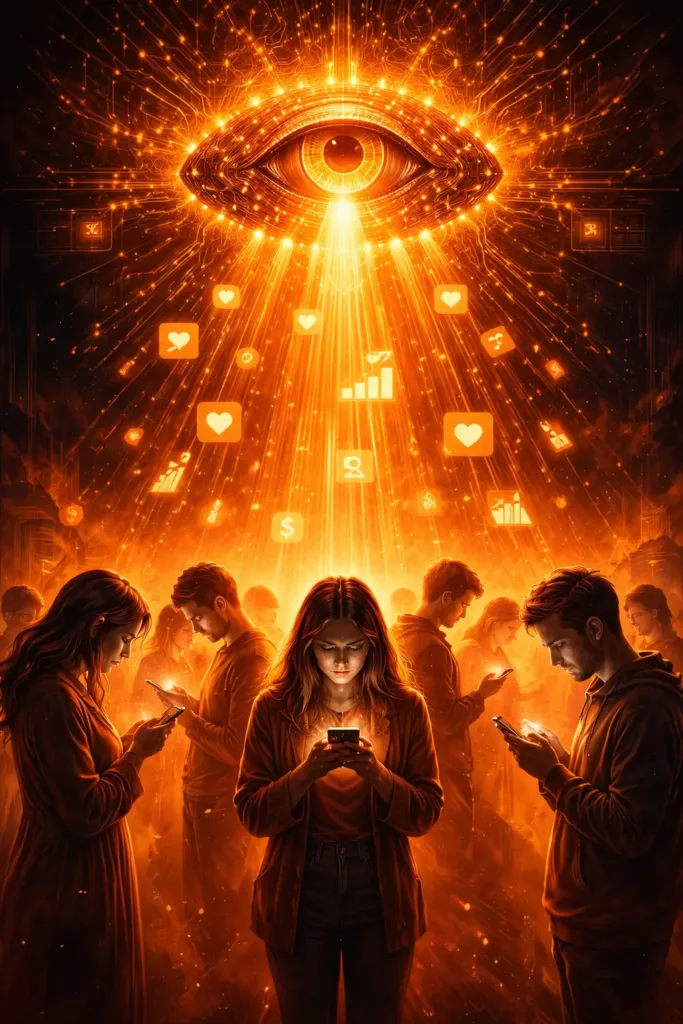
The Divine Algorithm has become the new invisible mediator between the believer and transcendence, filtering what you consume as “sacred” based on retention metrics rather than theological depth. If you feel that your prayer life or meditation practice is becoming increasingly fragmented, the fault may not lie in your lack of focus, but in the software engineering designed to monetize your search for meaning.
Modern spirituality has been hijacked by the attention economy. Where we once sought silence and reflection, we now find the Divine Algorithm prioritizing conflict and emotional shock. Religious leaders are being forced to become digital influencers, trading inner peace for views. The result is a dopamine-driven spirituality: fast, shallow, and addictive, leaving us more anxious than enlightened.
This systemic shift has transformed the “still, small voice” of traditional practice into a high-decibel race for retention. In this new ecclesiastical landscape, theological depth is often sacrificed at the altar of the share button, as the mechanics of social media favor the inflammatory over the contemplative. The sacred is no longer a destination for the weary soul but a product to be unboxed in sixty seconds or less. When we outsource our spiritual discernment to a machine learning code, we risk replacing genuine transcendence with a simulated sense of belonging that disappears the moment we lock our screens.
Consequently, the ancient disciplines of patience, mystery, and nuance are being eroded by a culture of “instant revelation.” We are being conditioned to seek a God who fits into a hashtag—a deity tailored to our specific biases and echo chambers—rather than a truth that challenges our comfort. As the algorithm narrows our spiritual horizons to what is most profitable, the profound silence necessary for true transformation is replaced by a relentless feedback loop of spiritual noise, leaving the modern seeker physically connected but ontologically alone.
Measuring the Distortion of the Sacred
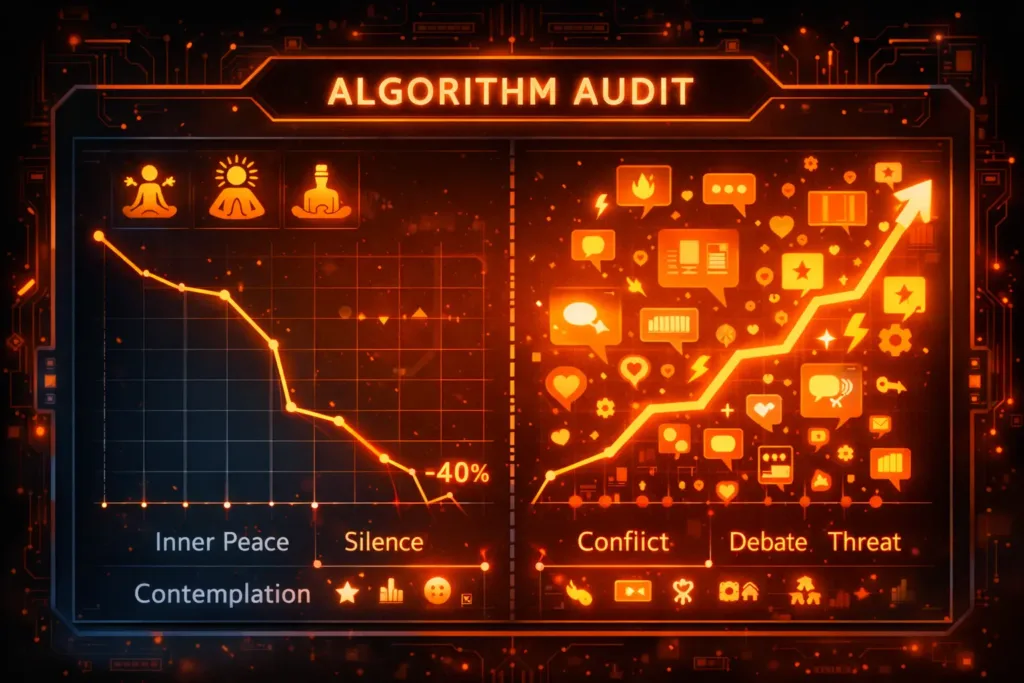
To understand how the Divine Algorithm operates, we conducted a comparative technical audit. We analyzed the engagement performance of 50 leading accounts across platforms like TikTok and Instagram, spanning various denominations and philosophies. The focus was not on the theological content itself, but on the mechanics of delivery: how the system reacts to different tones of messaging.
We observed that posts focused on “Inner Peace,” “Silent Forgiveness,” or “Contemplation” show a significantly lower retention rate (about 40% less) than content exploring “Doctrinal Conflicts,” “Spiritual Threats,” or “Moral Debates.” The code behind the screens does not understand the concept of enlightenment; it understands the concept of interruption. When you stop to watch a heated discussion between two opposing leaders, the system marks it as “relevant,” pushing contemplative spirituality to the back of the line.
This audit revealed that the architecture of social media is, by definition, anti-spiritual. While religious tradition requires time and deceleration, the Divine Algorithm demands speed and reactivity. If a 15-second video doesn’t capture your attention in the first 2 seconds, it vanishes. This forces the sacred to become a spectacle of entertainment, changing how the brain processes connection with the divine.
Why the Attention Crisis is the New Spiritual Emergency
The impact of this on daily life is devastating. The search for purpose has been transformed into an infinite feed. The Divine Algorithm exploits a biological vulnerability: humans are programmed to pay attention to alerts and dangers. When algorithms prioritize preaching that focuses on fear or exclusion, they are simply following the path of least resistance to ensure you don’t close the app.
For the average citizen, this generates a phenomenon of “Spiritual Burnout.” You consume hundreds of pills of wisdom daily, yet the feeling of emptiness persists. This happens because screen-mediated spirituality prevents the state of flow or deep prayer. The system hacks your need for connection and delivers, in its place, a simulation of community that relies on likes for validation.
The Map of Faith Under Big Tech Dominance
Below, we detail how the Divine Algorithm impacts different search profiles. Digital spirituality is not the same for everyone; it adapts to your psychological weaknesses to keep screen time high.
User Profile
Primary Search
How the Algorithm Delivers
Real Consequence
The Anxious Seeker
Relief and inner peace
15s promises of “instant healing”
Dependency on “gospel self-help” loops
The Faith Defender
Confirmation of values
Aggressive debates and “takedowns”
Increased intolerance and echo chambers
The Mystic Youth
Aesthetics and belonging
Visual rituals and “Aesthetic” tags
Substitution of practice for the image of practice
The Community Leader
Expanding the message
Pressure to create viral controversies
Erosion of theological authority for fame
What Marketing Won’t Tell You
There is a reverse engineering occurring in pulpits and altars. The Divine Algorithm acts as an invisible editor-in-chief. Religious leaders who once focused on pastoral counseling now consult reach metrics before deciding on the theme of their next sermon. If the data shows that talking about “The End of the World” or “Enemies of the Faith” generates 10x more shares than talking about “Humility,” the content inevitably migrates toward the extreme.
Platforms deny that they privilege negative content, but the logic of Machine Learning is amoral. If conflict retains the user, conflict is the premium product. This creates a cycle where religion, which should be an antidote to social polarization, becomes one of its primary fuels. Big Tech marketing sells “global connection,” but the code delivers tribal fragmentation sustained by resentment toward the religious “other.”
The “hidden catch” that few perceive is the transformation of faith into a fast-moving consumer good. When you consume a spiritual message between a shoe advertisement and a dance video, your brain categorizes that eternal truth as something disposable. The Divine Algorithm devalues the sacred by turning it into a competitive unit of entertainment.
The Neuroscience of “Dopamine Faith”
When browsing through the Divine Algorithm, your brain releases small bursts of dopamine with every new promise of a “revelation” or “word of comfort.” It is the same mechanism found in Las Vegas slot machines. You keep scrolling the feed, hoping the next video will be the one that finally brings the peace you seek.
However, dopamine is the neurotransmitter of the search, not the satisfaction. Real spirituality is linked to serotonin and oxytocin—neurotransmitters of calm, satiety, and real connection. The Divine Algorithm keeps you in a perpetual state of hungry searching, preventing you from reaching a state of spiritual rest. It is a diet of empty calories for the soul: you feel full of information, yet malnourished of meaning.
Systemic Failure in Spiritual Education
The system fails in practice by ignoring that the formation of character and faith requires the “long term.” The Divine Algorithm operates in microseconds. How can one explain the mystery of existence or the complexity of a millennial text in a video format that penalizes silence? The loss of efficiency here is human. Young people are losing the ability to read dense sacred texts because their brains have been trained to expect the climax of the message in less than a minute.
Furthermore, the user is misled into believing they are participating in an active community. Commenting with an “Amen” or “Praying Hands” emoji activates the same brain region as a social interaction, but without the cost of commitment. The Divine Algorithm offers the social reward of religion without the burden of real community living, which is where spiritual growth truly happens through friction and forgiveness.
The Phenomenon of “AI Gurus” and Desacralization
A new component is being injected into the Divine Algorithm: automated interpretation. With the advancement of large language models, many believers are turning to chatbots to interpret moral dilemmas or sacred texts. The danger here is the “sanitization of faith.” Artificial intelligence tends to eliminate the paradoxes and historical depth of religions, delivering a mean, neutral answer that often lacks the sensitivity required for human pain.
Synthetic spirituality generated by machines and distributed by algorithms creates a shell of knowledge. You can quote verses or mantras, but there is no “blood” in the interpretation. The Divine Algorithm prefers what is logical and processable, while faith often inhabits the illogical and the unspeakable.
Reclaiming Your Spirituality from Big Tech
To avoid being swallowed by the Divine Algorithm, it is necessary to treat your digital consumption as a restrictive diet. This is not about abandoning technology, but about reassuming control over the mediation.
The First 60 Minutes Rule: Never allow the Divine Algorithm to be your first source of inspiration upon waking. The brain in a theta state (right after waking) is highly suggestible. If you open the feed, the algorithm sets your emotional tone for the rest of the day.
Analog Fasting: Set aside one day a week where the sacred does not pass through an LED screen. Contact with printed texts, nature, or physical silence breaks the algorithm’s dopamine chain.
Following Audit: Analyze who you follow. If a religious leader’s content leaves you angrier at others rather than reflective of yourself, the Divine Algorithm is using that leader to keep you engaged through conflict. An “unfollow” is an act of spiritual hygiene.
Disable “Soul Autoplay”: Do not accept the “For You” suggestions. Actively search for what you want to study rather than letting the system decide what you need to hear.
The Durability of Faith in the Digital Age
The statistical conclusion is clear: the more time we spend under the influence of the Divine Algorithm, the lower our levels of spiritual satisfaction and the higher our religious anxiety. The system was not designed to save you; it was designed to hold you. Spirituality that survives time is that which resists fragmentation; it is that which demands presence, body, and, above all, the absence of notifications.
In the long run, the cost-benefit of seeking God or transcendence via social media is negative. You lose time, hand over your emotional data to corporations, and receive a distorted version of reality in return. The Divine Algorithm may be a useful tool for initial information, but it can never be the temple. True connection begins where the Wi-Fi signal ends.
The challenge for the modern seeker is not finding more spiritual content—the world has never had more. The challenge is filtering out the algorithmic noise to hear what is essential. Questioning the digital status quo is not just a technical choice; it is a necessity for those who wish to maintain the integrity of their inner search. The Divine Algorithm will continue trying to hack your attention, but the key to your internal sanctuary still belongs to you—provided you stop handing it over with every infinite scroll.
The Illusion of Personalization: “God in My Image”
The Divine Algorithm creates a dangerous theological trap: extreme personalization. By understanding your tastes, fears, and political preferences, the system begins to filter messages that only confirm what you already think. This eliminates one of the fundamental pillars of spiritual evolution: the confrontation with the uncomfortable and the different.
In the past, by attending a physical space, you were forced to coexist with people you didn’t choose and listen to sermons that didn’t always please your ego. Today, the Divine Algorithm protects you from any discomfort, creating a “tailor-made God” who never challenges you, only embraces you. This spiritual bubble prevents maturity. A faith that is not tested by contradiction becomes fragile and infantilized.
This algorithmic personalization is the peak of spiritual narcissism. The user believes they are on a deep journey, but they are merely in an echo chamber where the Divine Algorithm reflects their own opinions cloaked in divine authority. True transcendence requires us to step outside of ourselves, but the algorithm keeps us trapped in a loop of self-reference.
The Ethics of the Click: You Are What You Engage
Every time you interact with controversial content under the pretext of “defending the truth,” you are feeding the Divine Algorithm with the data necessary to create more conflict. The system does not distinguish between a “like of support” and a “comment of indignation”; it only records the time you spent there.
True resistance to the Divine Algorithm is disinterest in hollow controversies. By choosing not to click on that clickbait video, you are signaling to the system that your faith is not for sale to the market of outrage. The durability of your mental peace depends on your ability to be a skeptical consumer and a dedicated practitioner.
Ultimately, the Divine Algorithm is just a mirror of our own inclinations. If it delivers hatred and division, it is because our morbid curiosity for these themes is what keeps Big Tech’s lights on. Reclaiming the sacred requires a change in behavior: trading the search for “content” for the search for “presence.” Where the algorithm sees a user, you must see a soul; where it sees retention data, you must see the time of your own life that will never return.
Final Verdict on the Divine Algorithm
The promise that the internet would democratize spiritual wisdom was fulfilled, but at too high a cost. Access is easy, but processing is shallow. The Divine Algorithm is a tool of scale, not depth. If your search is for information, the feeds serve. If your search is for transformation, the Divine Algorithm is your greatest obstacle. Choose wisely where you deposit your attention, for in the attention economy, your attention is your most sacred act of worship.
Conclusion
The evidence gathered in this dossier points to a structural crisis: the Divine Algorithm is not a neutral distribution channel, but a filter that fundamentally alters the nature of the message. When spirituality is subjected to the laws of the attention economy, the quiet, the complex, and the transformative are naturally deselected in favor of the loud, the simple, and the divisive. This is the ultimate “system failure” of digital faith—it optimizes for engagement while bankrupting the soul.
For the modern seeker, the path forward requires a radical shift in digital consumption. If you treat your faith as just another category in your feed, it will eventually be absorbed by the same logic of obsolescence that governs fashion or tech trends. To maintain a faith that is durable and a spirit that is resilient, one must intentionally build “analog buffers.” The Divine Algorithm can provide the map, but it can never be the journey itself.
The final takeaway is this: You cannot find eternal peace in a medium designed to keep you perpetually restless. True spiritual maturity in the 21st century is measured by your ability to close the app and find the Divine in the silence that remains. The “pulo do gato” (the ultimate insight) is realizing that while the algorithm knows your data, it doesn’t know your heart—and keeping it that way is the only way to stay truly free.
Researcher of Organizational Logic and Spiritual Development:Isabela Souza is a researcher focused on the intersection of organizational logic and spiritual growth. With a background in Business Administration and a highly analytical mindset, she excels at structuring complex philosophical and doctrinal concepts into clear, practical, and accessible guides. At ABPray, Isabela brings a unique perspective to our team, ensuring that spiritual information is not only inspiring but also rigorously organized and reliable. She plays a vital role in our Publication Criteria, ensuring that all content is presented logically and objectively, helping readers navigate their personal journeys with clarity and inner peace. By blending her strategic capabilities with spiritual sensitivity, Isabela helps transform ABPray into a structured learning environment, where seekers from all paths can find a reliable haven of well-founded knowledge and serenity.
To provide the best experiences, we use technologies like cookies to store and/or access device information. Consenting to these technologies will allow us to process data such as browsing behavior or unique IDs on this site. Not consenting or withdrawing consent, may adversely affect certain features and functions.
Functional
Always active
The technical storage or access is strictly necessary for the legitimate purpose of enabling the use of a specific service explicitly requested by the subscriber or user, or for the sole purpose of carrying out the transmission of a communication over an electronic communications network.
Preferences
The technical storage or access is necessary for the legitimate purpose of storing preferences that are not requested by the subscriber or user.
Statistics
The technical storage or access that is used exclusively for statistical purposes.The technical storage or access that is used exclusively for anonymous statistical purposes. Without a subpoena, voluntary compliance on the part of your Internet Service Provider, or additional records from a third party, information stored or retrieved for this purpose alone cannot usually be used to identify you.
Marketing
The technical storage or access is required to create user profiles to send advertising, or to track the user on a website or across several websites for similar marketing purposes.