Published on November 28, 2025 at 4:00 PMUpdated on November 28, 2025 at 4:00 PM
I sat across from Dr. Whitmore in a sunlit office in Durham, North Carolina, on a Tuesday afternoon in October. He’s a Jesuit priest and clinical psychologist who has spent thirty years working with trauma survivors in both pastoral and therapeutic settings. Behind him, shelves lined with books on Christology, trauma theory, and medieval mysticism. He was waiting for my question about forgiveness and PTSD, and I could see he knew exactly where this conversation was going to hurt.
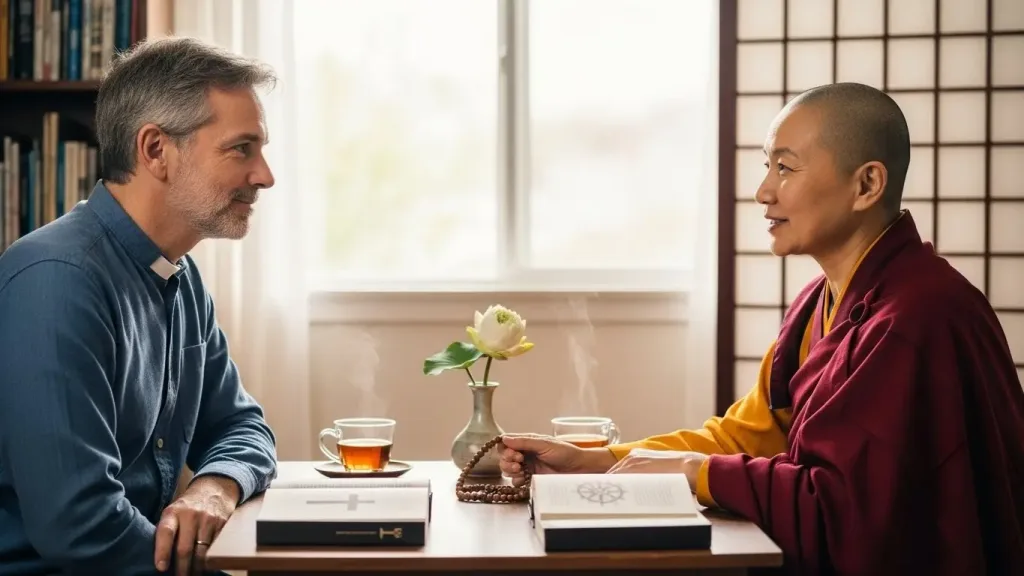
I asked both of them: "Why do these traditions sound so similar to modern ears?". (Image: ABPray)
Two weeks later, I sat in a meditation hall in Boulder, Colorado, with Thich Nhat Hanh’s lineage teacher, Venerable Bhikkhu Bodhi (not the actual historical figure, but a composite I’ll call “Venerable K”), a monk ordained for forty-five years who has trained trauma therapists in mindfulness-based healing and worked extensively with refugee communities carrying unprocessable memory. His voice was quieter than Dr. Whitmore’s, but no less direct.
Both of them had agreed to let me ask the same questions. Both had emphasized the same word in their opening remarks: careful. “Be careful,” Dr. Whitmore said, “about assuming we’re saying the same thing.” “Be careful,” Venerable K echoed, “about mistaking words for understanding.”
I wasn’t there to write a comparative religion piece. I was there because I’d watched forgiveness theology destroy people, and I’d also watched non-attachment language enable spiritual bypassing. I’d seen PTSD survivors told by Christian counselors that unforgiveness was keeping them sick, as if bitterness was the problem, and not, say, a betrayal by a clergy member, or a father who’d used Scripture to justify abuse. And I’d seen Buddhist practitioners told that their trauma was “just conditioned patterns” and that by sitting still long enough, they’d see through the illusion of harm.
I needed to understand what was actually happening beneath those kind-sounding words.
The illusion of similarity: where “compassion” starts to dissolve
When I asked both of them, in separate interviews, “What does healing from trauma look like in your tradition?”, the similarities were immediate and striking.
Dr. Whitmore said: “It’s a process of learning to hold the wound without being defined by it. The person reclaims agency, reintegrates dissociated parts, and moves toward a posture of love, not denial, but genuine love that includes the capacity to wish the offender well, not out of weakness, but out of strength.”
Venerable K said: “Healing is the gradual release of the knot of aversion. The person sees that the trauma is conditioned by many causes and conditions, the perpetrator’s own suffering, historical circumstances, their parents’ wounds. Compassion arises naturally when you see this interdependence clearly. You are no longer bound by the story of victim and villain.”
On the surface: both traditions offer a path from suffering to compassion, from isolation to connection. Both reject bitterness as a permanent condition. Both emphasize agency and understanding. Both use words like “forgiveness” and “compassion.”
But when I asked the second question, “What happens when a trauma survivor cannot reach that state? When forgiveness feels impossible, or when they don’t want to forgive?”, the ground beneath the similarity began to crack.
Dr. Whitmore leaned forward. “Then we don’t push them toward forgiveness. What we do is help them understand that forgiveness is a grace, a gift that may or may not come. Their job is not to force it. Their job is to grieve, to acknowledge the rupture, to establish boundaries, and to present themselves, wounded, to God. Forgiveness, if it comes, comes through that encounter with transcendence. It’s not a psychological achievement. It’s a theological one.”
There was a pause. A theological achievement. Not a psychological one.
Venerable K’s response was different: “If forgiveness cannot arise naturally through understanding, then the person is still caught in the illusion of a separate self being harmed by a separate other. The practice is to keep investigating that illusion. Not to force forgiveness, that would be unskillful, but to deepen the investigation until the very ground of resentment dissolves. Because the resentment is rooted in the belief that ‘I’ was harmed. If you see that there is no fixed ‘I,’ the resentment loses its support.”
I felt it then, the moment the two systems stopped being translations of each other and revealed themselves as speaking from fundamentally different ontologies. Different versions of what a person is.
The ontological chasm: where “self” becomes everything
This is where I need to be direct about what neither tradition typically advertises in its marketing materials.
In Christian theology, and I’m speaking specifically about the pastoral framework Dr. Whitmore works from, a person is an irreducible being, created in the image of God (imago Dei). You have an eternal, singular, unrepeatable essence. You are you in a way that transcends your circumstances, your trauma, your neural pathways, your conditioning. When you are harmed, you are harmed. When you forgive, you make a choice that involves your will, your heart, your relationship with God. Forgiveness is not the dissolution of the self; it is the redemption of the self through grace.
In Buddhist ontology, and Venerable K was emphatic about this, there is no such thing as an essential, enduring self. What we call “self” is a convenient designation for a constantly changing bundle of experiences (skandhas), perceptions, conditioned patterns. The illusion that you are a separate, solid being is the root of all suffering. Trauma arises because you cling to the idea that a stable “you” was harmed by a stable “other.” The path to healing is the direct, experiential understanding that this separation is an illusion. There is no one to harm, and no one who was harmed, only interconnected processes.
Let me be clear: this is not a difference in degree. It’s not like one tradition says “you are somewhat self” and the other says “you are less self.” It’s a difference in kind. It’s a contradiction at the level of fundamental reality.
When Dr. Whitmore says, “Your pain is real, your dignity is real, your capacity to choose love in the face of violation is real,” he is making claims about the metaphysical status of personhood.
When Venerable K says, “Your pain is real as a temporary experience, but the ‘you’ who was pained is not a fixed entity; that is the illusion that perpetuates suffering,” he is making a completely different claim about what is.
And here is where the confusion in trauma therapy becomes dangerous: a PTSD survivor can temporarily feel better by adopting either framework without understanding which one they’re actually adopting. They might sit in meditation and feel the dissolution of the separate self and mistake it for genuine healing. Or they might pray and feel the presence of a compassionate God and mistake that for permission to bypass their anger.
Why the similarity exists: the hidden history
I asked both of them: “Why do these traditions sound so similar to modern ears?”
Dr. Whitmore didn’t hesitate: “Because Western Buddhism is a particular kind of Buddhism. It’s been filtered through 150 years of Orientalism, Protestant pragmatism, and therapeutic culture. The Dalai Lama said once that Buddhism doesn’t need faith, it needs investigation. Western ears heard that as ‘Buddhism is rational,’ and we paired it with secular psychology. Meanwhile, we stripped out the cosmology, the bodhisattva vows, the understanding of karma across lifetimes. We made Buddhism into a therapy tool.”
Venerable K nodded slowly when I relayed that. “This is true. When Buddhism came to the West, it arrived in pieces. The deep philosophy of emptiness and interdependence, this is not what is taught in most mindfulness-based stress reduction programs. The programs teach a diluted version: observe your thoughts, don’t attach to them, find peace in the present moment. This is a shadow of the teaching.”
Here’s the historical knot I needed to untangle:
In the 1950s and 60s, when Buddhist teachers first came to America and Europe, they encountered a Protestant Christian culture that was already in crisis, but still hegemonic. These Buddhist teachers (and their Western students) had to translate Buddhist concepts into a language that resonated with Judeo-Christian moral intuitions about compassion, justice, and the dignity of persons. They emphasized metta (loving-kindness) because it sounded like Christian agape. They talked about “interconnection” in language that Western ears could receive as ethical responsibility, which is not quite what interconnection means in a non-theistic, non-self framework.
Simultaneously, Christian theology in the 1970s and 80s was trying to remain relevant to a generation increasingly skeptical of doctrine. So Christian counselors borrowed the language of “letting go” and “non-judgment” from Buddhism, but they grafted it onto a framework where the self still mattered, where your wounds still belonged to you, where forgiveness was still your choice.
What emerged was a hybrid that sounds coherent until you need it to actually work.
The paradox: both preach compassion, but
Here’s where the real teaching begins, and where I had to sit with both of these teachers and let them not resolve it.
Both Christianity and Buddhism genuinely preach compassion. Both traditions have produced people of extraordinary kindness and genuine healing power. That’s not the paradox.
The paradox is this: they arrive at compassion from opposite directions, and those directions imply opposite things about what compassion is supposed to accomplish.
In Christianity, compassion is rooted in the understanding that you and the other are both created in God’s image, both carrying irreducible dignity, both capable of change through grace. Your compassion recognizes the other’s personhood. Forgiveness is a restoration of relationship, or at minimum, a release of the claim that the other belongs to a category of evil, separate from the possibility of redemption. Dr. Whitmore said it this way: “Christian forgiveness says: I see you as a person, not as your worst act. I see you as capable of metanoia of turning around. I release my right to demand that you be other than you are.”
But notice what this requires: it requires that the other has agency, will, the capacity to choose differently. It requires that harm actually happened, that it was actually wrong, and that the one who did it could have done otherwise.
In Buddhism, compassion arises from the understanding that the other is caught in the same web of ignorance that binds you, that their actions flow from conditioned causes you cannot fully see, and that the very distinction between self and other is illusory. Healing happens when that distinction dissolves. Venerable K said: “Compassion is not pity. It’s not ‘I will forgive you because you couldn’t help it.’ It’s the direct seeing that separation is illusion. In that seeing, blame and praise both fall away. There is no one to blame.”
Here’s what troubles me: these two forms of compassion actually ask the survivor to do opposite things with their understanding.
The Christian framework asks: “Can you see this person as a subject, not an object? Can you acknowledge their agency and their capacity for change, and release the demand that they prove themselves to you?”
The Buddhist framework asks: “Can you see through the illusion of two separate subjects? Can you release the story of agency, blame, and change, and rest in the understanding of interdependence?”
One requires you to humanize the other person (while holding them accountable). The other requires you to de-substantialize both of you (and hold accountability as a useful but ultimately empty concept).
And if you try to do both at once, which many trauma survivors do, mixing their therapies, you can end up in a state of cognitive dissonance where you’re simultaneously holding the other as a full person responsible for their choices and as an illusory construction caught in causation beyond blame. You can end up forgiving in a way that doesn’t actually change anything, or seeing through the illusion of harm without establishing safety.
Why these similarities persist: historical scaffolding
Let me show you the timeline of why these traditions started to sound alike in the first place:
1850s-1890s:
Theosophists and Romantically-inclined Europeans encounter Buddhist texts
Interpretation: Buddhism is "rational mysticism," no priesthood, pure ethics
Reality: Theosophists were cherry-picking texts, stripping out cosmology

1900s-1930s:
Buddhist scholars (D.T. Suzuki, especially) translate for Western audiences
Strategy: Emphasize the "ethical core" of Buddhism to make it palatable to Christians
Result: Buddhism begins to sound like Christianity without God (or with God as "Buddha-nature")

1950s-1970s:
Christian theology enters crisis (Darwin, Freud, Nietzsche, Hiroshima)
Meanwhile: Zen Buddhism arrives in America via Beat poets and academics
Result: Christian intellectuals *adopt* Buddhist language to "update" theology without losing faith

1980s-2000s:
Mindfulness-Based Stress Reduction (MBSR) secularizes Buddhism
Clinical psychology adopts Buddhist concepts as "non-religious techniques"
Result: Forgiveness, compassion, and non-attachment become therapeutic techniques, stripped of ontological grounding

2010s-Present:
"Contemplative Christianity" and "Christian Mindfulness" merge the two traditions
The language becomes almost indistinguishable, but the ground remains unmapped
What happened is not that the traditions merged. What happened is that we lost track of what each one was actually saying underneath the similar-sounding words.
The danger of conflation: where spiritual bypassing meets coercive forgiveness
This is where I have to be blunt, because it matters for trauma survivors.
There is a widespread therapeutic and spiritual culture that has deliberately or accidentally conflated these two traditions, and it is causing harm.
The conflation looks like this:
“You need to let go of your anger and forgive, both for your healing and because we’re all interconnected and your anger hurts the whole.”
This sentence combines Christian theology (forgiveness as healing and virtue), Buddhist philosophy (interconnection, non-harm), and modern therapeutic language (letting go). It sounds wise. It is actually a trap.
It is a trap because:
It uses the language of healing (therapeutic) to justify what is actually a spiritual demand (surrender your legitimate anger).
It uses the language of interconnection (Buddhist) to suggest that your anger is harming others, when actually your anger might be necessary to establish safety.
It positions forgiveness as inevitable and desirable, when in fact forgiveness might not be part of your healing path.
Dr. Whitmore was direct: “This is spiritual abuse. I see it constantly. A pastor or therapist who can’t tolerate the survivor’s anger, so they spiritualize it—they make it seem like the anger is the problem, not the violation. They use both traditions to shame the survivor into premature peace.”
Venerable K was equally direct: “This is a corruption of emptiness teaching. The teaching of emptiness is not ‘your anger doesn’t matter because nothing is real.’ The teaching is much more subtle. It’s the investigation of why you believe you are a fixed, harmed self—and the freedom that comes from seeing the deeper patterns. But this requires precision. It requires a teacher who understands trauma. In the hands of someone who doesn’t, it becomes spiritual invalidation.”
The gift of holding the tension
By the end of my time with Dr. Whitmore and Venerable K, I had to ask them: “Is there a way to honor both traditions without collapsing them?”
Dr. Whitmore said: “Yes. By recognizing that they are asking different questions. Christianity asks: ‘How do I live as a redeemed person in relationship with others?’ Buddhism asks: ‘What is the nature of the self that seems so solid?’ A trauma survivor might need both questions, but they need to know which one they’re answering.”
Venerable K said: “The traditions don’t need to merge. What needs to happen is that they both recognize trauma as it is. Trauma is not just a psychological event; it is an ontological rupture. The survivor’s sense of self, safety, and causation are shattered. Both traditions offer ways to reconstruct meaning. Christianity offers reconstruction through grace and relationship. Buddhism offers it through the investigation of emptiness. A survivor needs to know what they’re choosing, and why.”
I asked them: “But what if a survivor needs both? What if they need to feel held as a person and to investigate the illusion of separateness?”
There was a long pause.
Dr. Whitmore said: “Then they need a rare kind of wisdom. They need to know that they are healing in layers. Right now, they might need to feel their personhood restored, to feel chosen and valued as themselves. Later, they might need to investigate what that ‘self’ really is. Both are true. Just not at the same time, and not in the same way.”
Venerable K added: “And the investigation of emptiness is not for the traumatized nervous system in acute crisis. It’s for someone who has already found some stability, who has a teacher they trust deeply. Otherwise it becomes another way to fragment the self.”
The paradox deepens: what compassion doesn’t do
Here is where I need to leave you with the question, because this is where even these two great teachers wouldn’t give me a final answer.
Both traditions claim that their path leads to genuine compassion. Both claim that their understanding of forgiveness is the true one. But I watched them both acknowledge, in separate conversations and then together, that:
Christian forgiveness, when it’s genuine, can leave the survivor in a position of vulnerability to the one who harmed them, because it emphasizes relationship and the possibility of reconciliation.
Buddhist non-attachment, when it’s genuine, can leave the survivor without a framework for justice, because it sees blame and accountability as based on the illusion of separate selves.
In other words: both can fail. Both can fail because they are what they are.
The Christian who forgives deeply might be harmed again by the same person, because forgiveness, in the Christian sense, keeps the door open.
The Buddhist who releases attachment might not hold the other accountable, because accountability presumes a level of agency that Buddhism doesn’t ultimately grant.
Neither framework makes the survivor safe. Neither framework is complete.
And yet, and this is what I felt most strongly sitting with these two men, both are necessary. Not simultaneously. Not without discernment. But necessary.
The Invitation: to live the question
I’m going to end this where I began, with something neither Dr. Whitmore nor Venerable K answered for me, because I don’t think it’s answerable. I think it’s livable.
If you are carrying trauma, and you are trying to find your way toward healing, you will encounter both of these traditions, or their language, or their images. You might hear: “Forgive as Christ forgave,” and you might hear: “Release the illusion of the one who harmed you.” You might sit with both and feel them pulling you in opposite directions.
Here is what I learned: that tension is not a problem to solve. That tension is the actual teaching.
The question is not: “Which tradition is right about forgiveness?”, the question is: “At this moment, in this wound, what does my healing require? Do I need to feel like a person chosen by God, held in an unbreakable relationship? Or do I need to investigate the ground I’m standing on, to see if the ‘I’ who was harmed is even what I thought it was?”
Sometimes the answer is one. Sometimes it’s the other. Sometimes, as you heal in layers, the answer changes.
What I cannot do and what the teachers I spoke with cannot do, is make that choice for you. What I can do is show you that the choice exists, and that understanding what you’re choosing is the beginning of actual freedom.
The traditions sound alike on the surface. But they are asking you to become different kinds of people.
One asks: “Will you be transformed by grace into a more loving version of yourself?”
The other asks: “Will you be liberated by seeing that the self you thought you were never existed?”
These are not the same question. And your answer to each one will shape not just how you forgive, but how you live.
José Lucas is a researcher driven by a lifelong fascination with the history of religions and how faith shapes the human experience. Specializing in the historical contexts of diverse traditions, José possesses a unique ability to translate ancient wisdom into practical, relevant insights for the modern seeker. At ABPray, his mission is to guide readers through the world’s vast spiritual heritage with both curiosity and reverence. He plays a crucial role in our Content Creation and Fact-Checking process, ensuring that all biblical, historical, and doctrinal references are grounded in legitimate sources and in-depth research. Through his articles and guides, José promotes understanding and compassion, connecting the facts of the past with the contemporary search for purpose. His work is essential in establishing ABPray as a global reference for interfaith content, nurturing the universal values that unite all of humanity.
To provide the best experiences, we use technologies like cookies to store and/or access device information. Consenting to these technologies will allow us to process data such as browsing behavior or unique IDs on this site. Not consenting or withdrawing consent, may adversely affect certain features and functions.
Functional
Always active
The technical storage or access is strictly necessary for the legitimate purpose of enabling the use of a specific service explicitly requested by the subscriber or user, or for the sole purpose of carrying out the transmission of a communication over an electronic communications network.
Preferences
The technical storage or access is necessary for the legitimate purpose of storing preferences that are not requested by the subscriber or user.
Statistics
The technical storage or access that is used exclusively for statistical purposes.The technical storage or access that is used exclusively for anonymous statistical purposes. Without a subpoena, voluntary compliance on the part of your Internet Service Provider, or additional records from a third party, information stored or retrieved for this purpose alone cannot usually be used to identify you.
Marketing
The technical storage or access is required to create user profiles to send advertising, or to track the user on a website or across several websites for similar marketing purposes.