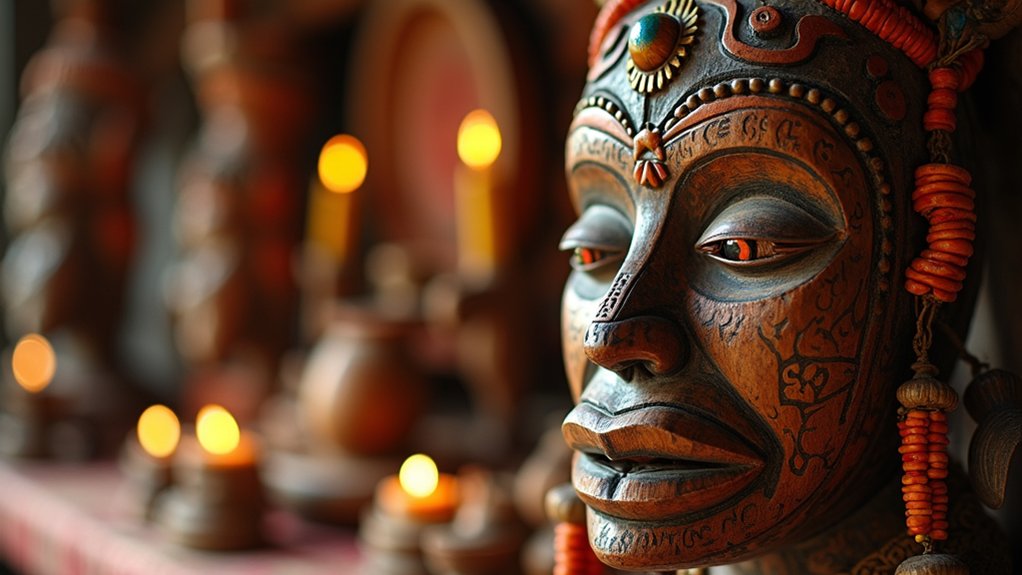
In many African cultures, art is far more than decoration, it acts as a spiritual language that connects people to ancestors, deities, and unseen forces. Masks, sculptures, textiles, music, dance, and body art all reflect deep spiritual meaning, shaping how communities worship, communicate, and preserve sacred traditions.
But how exactly does art influence religious life, and what truths does it reveal about African spirituality? Let’s explore how artistic expression and religion intertwine across the continent.
The role of masks in spiritual ceremonies
The role of masks in spiritual ceremonies is central to many African traditions. These sacred objects act as powerful intermediaries between the physical and spiritual realms. Often carved from wood and decorated with symbolic colors, metals, or animal elements, masks embody ancestors, spirits, or protective forces.
In spiritual ceremonies, mask symbolism communicates identity, morality, and community values. Masks appear in rites of passage, healing rituals, funerals, harvest celebrations, and conflict-resolution ceremonies. When a dancer wears a mask, they are believed to transform, temporarily becoming the spirit it represents.
Used respectfully, masks guide participants through sacred experiences, strengthen social bonds, and preserve the community’s connection to the ancestors.
Sculptures as representations of deities and ancestors
Sculptures as representations of deities and ancestors are another powerful form of African spiritual expression. These artworks, whether carved from wood, molded from clay, or cast in metal, serve as physical embodiments of divine presence.
As representations of deities and ancestors, sculptures do more than decorate shrines. They:
- act as intermediaries for prayers,
- offer protection and blessings,
- guide rituals and divination,
- commemorate lineage and heritage.
Sculptures help practitioners communicate with spiritual forces while honoring the continuity between the living and the ancestral world. They are essential tools for maintaining religious traditions and cultural identity.
Symbolism in African textile art and its religious significance
African textile art carries deep symbolism, with religious significance woven into every stitch. Textiles often feature patterns, colors, and motifs that communicate spiritual ideas, prayers, and cultural values.
Examples include:
- Kente cloth patterns symbolizing proverbs and moral teachings,
- Mudcloth (bogolanfini) designs used for protection and rites of passage,
- Adinkra symbols expressing beliefs about ancestors, unity, and divine guidance.
Because of this, African textile art functions as a visual language in religious ceremonies. These fabrics are worn during festivals, weddings, funerals, initiation rituals, and other sacred events. Rather than being merely ornamental, textile art reinforces communal identity and spiritual connection.
Body art and its connection to rituals and beliefs
Body art in African cultures is deeply connected to rituals, beliefs, and expressions of identity. Scarification, tattooing, beadwork, paint, and henna patterns communicate messages that go beyond aesthetics.
Body art can:
- signal spiritual protection
- mark adulthood or initiation
- express devotion to deities
- symbolize social rank or family lineage
- connect individuals to ancestral spirits
These designs act as a sacred visual language that reinforces religious values and strengthens community bonds. Through body art, people carry their spirituality with them, literally written on their skin.
The use of music and dance in religious artistic expression
Music and dance are essential forms of religious artistic expression across Africa. They serve as rhythmic pathways to spiritual connection, helping communities communicate with ancestors, invoke divine presence, or enter states of trance.
In many traditions, drums are believed to speak a spiritual language. Chants, call-and-response singing, and ritual dances are used to:
- honor deities,
- accompany mask performances,
- celebrate important ceremonies,
- unite participants in collective worship.
Music and dance not only deepen spiritual connection but also strengthen social ties, making them vital to the living practice of African religion.
Sacred spaces and their artistic decorations
Sacred spaces and their artistic decorations play a powerful role in African spirituality. Shrines, temples, altars, and ceremonial grounds are carefully designed with symbolic materials such as clay, wood, stone, or natural pigments.
These artistic decorations may include:
- carved pillars,
- sacred sculptures,
- painted murals,
- offerings of cloth or beads,
- symbolic patterns drawn on the ground.
These elements help establish a sense of divine presence, guiding worshippers in rituals and creating a space where the spiritual world feels close and accessible.
Storytelling through visual art in African religious traditions
Storytelling through visual art in African religious traditions preserves sacred knowledge and connects generations. Artists use symbols, colors, and imagery to communicate stories about creation, morality, ancestral wisdom, and divine power.
These visual narratives appear in:
- murals
- masks
- sculptures
- textiles
- ceremonial objects
Storytelling through visual art ensures that religious teachings remain alive, meaningful, and accessible, even for those who cannot read or who rely on oral tradition. It reinforces identity, teaches values, and transmits spiritual lessons across time.
Conclusion
Art in African cultures is deeply intertwined with religion, shaping how people express spirituality, honor ancestors, and maintain sacred traditions. Whether through masks, sculptures, textiles, body art, music, dance, or sacred spaces, artistic expression becomes a bridge between the human and spiritual worlds.
These practices guide rituals, protect communities, and mark life transitions, showing how spirituality and culture are inseparable. By preserving stories, values, and sacred knowledge, African religious art strengthens identity and unites generations. In this way, creativity continues to play a vital role in keeping African spirituality meaningful, vibrant, and alive.

Linguist and Interfaith Dialogue Researcher: Amanda Torati is a linguist and postgraduate researcher dedicated to the study of interfaith dialogue and cultural expressions of faith. With a strong academic background in Languages and Linguistics, Amanda specializes in analyzing spiritual texts and universal values, seeking to build bridges between ancient traditions and modern reflection. At ABPray, Amanda applies her academic rigor and ethical sensitivity to ensure that every article fulfills our mission of promoting harmony and mutual respect. Her role is fundamental to our Human and Ethical Review process, where she uses her expertise to ensure doctrinal and historical fidelity while maintaining an inclusive and accessible tone. By combining her passion for research with a mindful approach, Amanda transforms complex themes into practical reflections for daily life, helping seekers from all backgrounds find meaning and inner peace. Her commitment to authenticity ensures that ABPray remains a reliable source of inspiration and knowledge within the global spiritual landscape.
Linguist and Interfaith Dialogue Researcher: Amanda Torati is a linguist and postgraduate researcher dedicated to the study of interfaith dialogue and cultural expressions of faith. With a strong academic background in Languages and Linguistics, Amanda specializes in analyzing spiritual texts and universal values, seeking to build bridges between ancient traditions and modern reflection. At ABPray, Amanda applies her academic rigor and ethical sensitivity to ensure that every article fulfills our mission of promoting harmony and mutual respect. Her role is fundamental to our Human and Ethical Review process, where she uses her expertise to ensure doctrinal and historical fidelity while maintaining an inclusive and accessible tone. By combining her passion for research with a mindful approach, Amanda transforms complex themes into practical reflections for daily life, helping seekers from all backgrounds find meaning and inner peace. Her commitment to authenticity ensures that ABPray remains a reliable source of inspiration and knowledge within the global spiritual landscape.