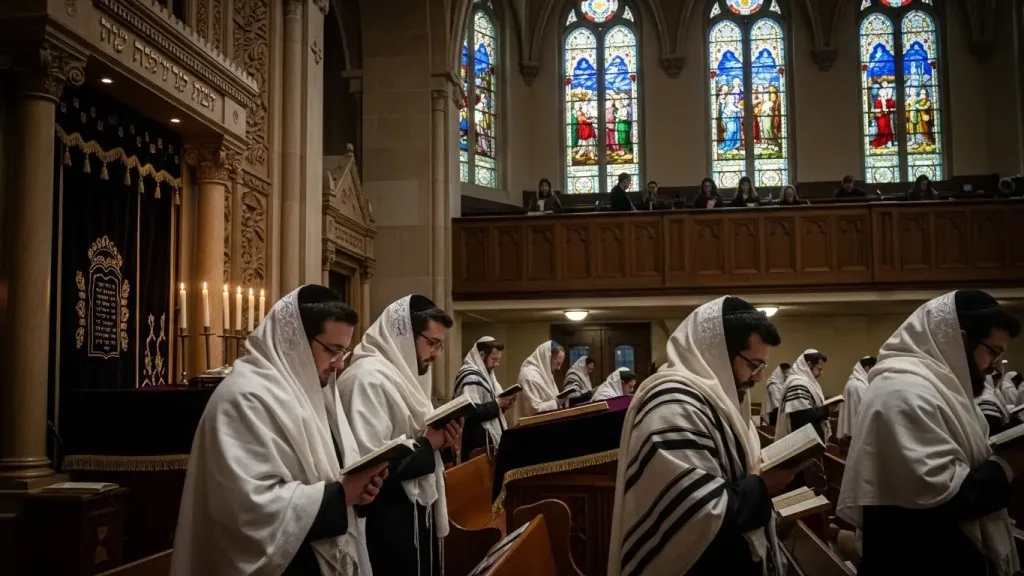
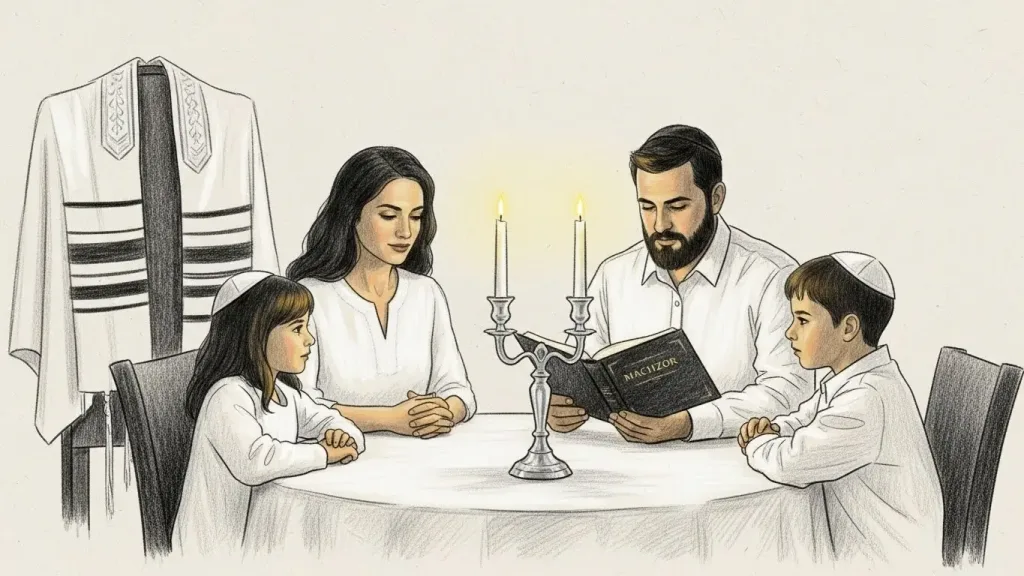
When a modern Jewish family sits in synagogue on Yom Kippur, fasting, praying, confessing sins in communal voice, they believe they are practicing an unbroken tradition stretching back 3,400 years to Leviticus. But this belief contains a profound falsehood.
When tradition claims continuity while meaning completely transforms (image: Abpray)
Modern Yom Kippur is not the same as biblical Yom Kippur. Structurally, theologically, and practically, they are nearly opposite. Yet Jewish communities insist this is “the same tradition.” They are not wrong. They are also not being honest about what sameness means.
What happened in 70 CE was not a minor adjustment. It was a radical reinvention disguised as continuity. Judaism replaced sacrifice with confession, priestly mediation with personal accountability, and a single sacred location with distributed community practice. Every structural element changed. The name remained identical.
This paradox is not unique to Judaism. It is how religions survive catastrophe: they reinterpret foundational practices so completely that the new version becomes unrecognizable, then insist the tradition was always really about the new meaning. Christians did this with animal sacrifice (reframed as spiritual). Muslims did it with prophecy (reframed as scriptural interpretation). Jews did it with atonement (reframed as internal repentance).
Understanding Yom Kippur requires understanding this mechanism—not as deception, but as the actual way living religious traditions navigate rupture while maintaining identity.
Part 1: the biblical foundation: what yom kippuer actually was
Yom Kippur begins in Leviticus 16 as a description of a specific priestly action. This matters because modern Jewish practice bears almost no resemblance to what the text describes.
The biblical ritual occurs like this:
The High Priest enters the inner sanctum of the Temple—the Holy of Holies—alone. This is the only day of the year when anyone enters this space, and the only moment when the High Priest approaches the divine presence directly. The procedure is precise, ritualistic, and focused on purification rather than morality.
Two identical male goats are brought. They are not chosen for moral reasons. They are physically perfect animals. Lots are cast—a random procedure—determining which goat will be sacrificed and which will be designated for a different purpose.
The first goat is killed. Its blood is sprinkled in the Holy of Holies, on the altar, and throughout the Temple sanctuary. This is a blood ritual—a form of purification using the sacrificial animal’s life force.
The second goat—the “scapegoat” (Hebrew: azazel)—remains alive. The High Priest places both hands on the animal’s head and confesses “all the iniquities of the people of Israel” (Leviticus 16:21). The goat is then led into the wilderness, carrying the sins symbolically away from the community.
This is the biblical practice. Note what is absent:
No personal confession by ordinary community members.
No fasting (it is not commanded until Leviticus 23).
No prayer service.
No moral self-examination.
No community gathering for religious purposes.
The entire ceremony is performed by a single priest on behalf of everyone else. The people are essentially passive recipients of ritual action performed on their behalf.
Theologically, the biblical Yom Kippur is about purification and separation—removing ritual contamination, not confronting moral failure. The Hebrew word tahar (pure) appears repeatedly, but moral accountability (teshuva) does not appear in the Leviticus 16 account at all.
The Scapegoat: Competing Interpretations in the Original Text
The scapegoat ritual is often explained as “carrying away sins,” implying moral dimension. But the text is ambiguous about what azazel means.
Some scholars argue azazel is a demon or spirit in the wilderness. The goat is sent as an offering to this entity. The sin is not moralized but mechanically transferred—the goat carries it away into a remote place where the demonic powers reside.
This reading makes the ritual distinctly pre-moral. It is not about the people taking responsibility. It is about removing contamination through a sympathetic magical act: the goat and the sin are united and expelled.
Other interpretations read azazel as simply “the wilderness” or “the place of goats,” and the ritual becomes purely symbolic: sins are publicly acknowledged, then ritually expelled from the community space. But even this reading treats sin as a force to be removed, not a moral condition requiring personal transformation.
The Levitical text never asks: Did the community repent? Did they feel remorse? Will they change behavior? These moral questions are absent from the biblical account.
What Leviticus emphasizes instead is purity—ritual cleansing, separation of sacred from profane, restoration of the Temple’s sanctity through correct procedures.
This is a crucial distinction: Biblical Yom Kippur is primarily about ritual restoration, not moral reform.
Part 2: the catastrophic rupture – 70 CE and the impossible choice
What destroyed more than bricks
In 70 CE, the Roman army destroyed the Second Temple in Jerusalem. This was not a minor loss. It was existential catastrophe.
Yom Kippur was entirely dependent on Temple ritual. Without the Temple, there is no Holy of Holies to enter, no altar to sprinkle, no goats to sacrifice, no priest with authority to perform the ceremony. The entire system ceased to function.
But Yom Kippur was also the holiest day in the Jewish calendar. Discontinuing it was not an option. The community needed atonement. They also needed continuity—evidence that Judaism could survive outside the Temple structure.
Jewish leadership faced an unprecedented problem: How do you keep a ritual alive when the physical conditions that made it possible no longer exist?
The solution was radical, though it was framed as discovery rather than invention: They declared that prayer and confession could replace sacrifice. They claimed that verbal acknowledgment of sin had always been the real purpose, and that the Temple ritual was merely its outward form.
This was not a gradual evolution. It was a deliberate reinterpretation made necessary by destruction.
The evidence appears in the Mishnah (compiled around 200 CE), which codifies post-Temple Jewish practice. The Mishnah discusses Yom Kippur extensively—but almost entirely in past tense, describing what the Temple ceremony was. It then describes the new practice: confession, prayer, fasting, and communal repentance.
Maimonides’ codification: making the rupture invisible
Maimonides (1138-1204), the greatest medieval Jewish philosopher, wrote the definitive legal code for Jewish practice. He faced a problem: How do you codify Yom Kippur when the original ritual no longer exists?
His solution was elegant and deceptive: He organized the laws of Yom Kippur into a system that treated the Temple ritual and the post-Temple practice as if they were the same thing expressed in different forms.
He codified teshuvah (repentance) into four precise steps:
Recognition of wrongdoing
Remorse and emotional processing
Verbal confession (vidui)
Commitment not to repeat the behavior
This four-step structure became the framework for all subsequent Jewish thought about repentance. But here’s the crucial point: This structure appears nowhere in the biblical text. Maimonides invented it by synthesizing Talmudic sources, Kabbalistic ideas, and rational philosophy.
He then presented this invented framework as if it were the clarification of what the Torah always meant.
This is the mechanism of continuity: You reinterpret the tradition so thoroughly that the new meaning becomes canonical, then you erase evidence that reinterpretation occurred. The tradition appears unbroken because you have redefined what “the tradition” means.
Part 3: the modern divergence – how different jewish communities experienced rupture differently
The paradox deepens: Not all Jewish communities experienced the Temple’s destruction the same way, and different communities developed different Yom Kippur practices.
Orthodox Judaism: Preserving Maimonidean Framework While Awaiting Restoration
Orthodox Judaism treats Maimonides’ codification as the authoritative understanding of Jewish law. Yom Kippur is structured around personal repentance, communal prayer, and fasting.
But Orthodox practice contains a strange feature: It frequently references the Temple ritual as if its absence is temporary. The liturgy includes detailed descriptions of the High Priest’s service—maintaining knowledge of the ritual in hope of restoration.
This is peculiar. Orthodox Jews pray for the Temple to be rebuilt, which would mean resuming animal sacrifice on Yom Kippur. This would necessitate discontinuing the confessional prayer-based practice that has been continuous for 2,000 years.
The tension is never resolved. Orthodoxy maintains both the current practice and the memory of what it replaced, treating the gap as a temporary exile rather than a fundamental transformation.
Reform Judaism: explicit reinterpretation as progress
Reform Judaism emerged in 19th-century Germany and deliberately rejected the fiction of continuity. Reformers explicitly stated: Modern Yom Kippur is theologically superior to biblical sacrifice because it emphasizes internal morality over external ritual.
Reform Jews maintain Yom Kippur observance but consciously reframe it. They retain fasting and communal prayer but add explicit ethical dimensions: social justice, human rights, collective responsibility for systemic wrongs. They treat the holiday as focusing on moral accountability, not ritual purity.
Critically, Reform Judaism celebrates this reinterpretation. It does not claim continuity with biblical practice; it claims progress beyond it.
Hasidic Judaism: mystical reinterpretation and emotional intensity
Hasidic communities, particularly in Eastern Europe, developed a different approach. They maintained Maimonidean legal structure but added mystical layers.
Hasidic theology emphasizes that Yom Kippur is a day when the barriers between human and divine dissolve, when even the most wicked person can achieve complete reunion with God. Prayer becomes ecstatic, emotional, almost transgressive in its intensity.
One Hasidic teaching states that on Yom Kippur, even atheists unwittingly serve God through their repentance. This radicalized egalitarianism transformed the holiday from a ritual centered on individual moral accounting into a collective mystical experience.
Hasidic practice maintains the same legal structure as Orthodoxy but infuses it with different spiritual meaning.
Secular/cultural Judaism: maintaining identity without theology
For many secular Jews, Yom Kippur is observed as cultural identity and community gathering, without commitment to theological claims about atonement or divine forgiveness.
Some secular Jews fast and attend services as cultural practice. Others reframe the day entirely: it becomes a moment for personal reflection on failures and aspirations, with no reference to God.
The interesting dynamic: Secular observance abandons the theological claims but often maintains ritual practice with even greater intensity than religious communities. The fasting becomes meditation. The confession becomes psychotherapy. The communal gathering becomes assertion of Jewish identity.
LGBTQ+ Jewish communities: confronting traditional morality
Modern LGBTQ+ Jewish communities have forced another reinterpretation. If Yom Kippur is about confessing moral failures, what does a queer Jew confess?
Traditional Jewish law classifies same-sex relationships as immoral. But many LGBTQ+ Jews understand their identity as not immoral but integral to their wholeness.
The result: LGBTQ+ Jewish communities have reframed Yom Kippur’s moral accounting. They confess real failures—harm they have caused, ways they have failed others—but explicitly reject confessing their identity or relationships.
This creates a new layer of reinterpretation: What counts as “sin”? Who decides? Traditional authorities say sexual orientation is a category of failure. Modern queer Judaism says moral failure is about harm caused, not identity expressed.
Sephardic vs. Ashkenazi traditions: liturgical variation revealing deeper differences
Sephardic (Mediterranean/Spanish) and Ashkenazi (Central/Eastern European) Jewish communities developed different Yom Kippur liturgies and practices.
Ashkenazi tradition emphasizes individual moral examination (vidui, personal confession) and intense emotional catharsis through prayer.
Sephardic tradition places greater emphasis on communal solidarity and includes different prayers, different fasting practices, and different approaches to seeking forgiveness.
These are not merely stylistic differences. They reflect different theological emphases:
Ashkenazi: Yom Kippur as individual conscience Sephardic: Yom Kippur as communal repair
Neither is “more authentic.” They represent different communities’ reinterpretations of the tradition.
Part 4: the mechanism of continuity – how traditions survive rupture
What allows Yom Kippur to be simultaneously:
Unrecognizably different from its biblical form
Claimed as unbroken tradition
Differently practiced across multiple communities
Retained as “the holiest day in Judaism”
The answer reveals something fundamental about how religious traditions actually function.
The core transference: identifying essence vs. form
Jewish communities performed an essential intellectual move: They identified the essence of Yom Kippur as separate from its form.
Biblical form: Priestly sacrifice in the Temple Biblical essence: Atonement, purification, reconciliation
Post-Temple form: Prayer, confession, fasting, communal repentance Post-Temple essence: Same atonement, purification, reconciliation—now internalized and democratized
By identifying essence separately from form, communities could retain the name, the date, the theological weight—and completely transform the practice.
This mechanism allows:
Continuity claims (same essence)
Radical practice changes (different form)
Authority stability (tradition remains authoritative even as meaning shifts)
Innovation within conservatism (reinterpretation happens invisibly)
The textual sleight: retroactive hermeneutics
Jewish interpretive tradition employs a technique that makes reinterpretation invisible: reading new meanings into ancient texts as if those meanings were always there.
When post-Temple Judaism needed to justify that prayer could replace sacrifice, they reread Leviticus through Psalms and Prophetic texts (which emphasize God’s desire for moral behavior over ritual). They claimed these texts revealed what the sacrificial system always really meant.
Psalm 51:16-17 states: “You do not desire sacrifice, or I would give it; You do not delight in burnt offering. The sacrifices of God are a broken spirit; a broken and contrite heart, O God, You will not despise.”
By reading this psalm as interpretive lens for Leviticus, post-Temple rabbis claimed the Bible itself had suggested that interior repentance, not external sacrifice, was the true meaning of atonement.
But this reading was innovative, not discovery. The psalm was composed later than Leviticus. It reflected a different historical moment. Retrofitting it as authoritative lens for earlier texts is hermeneutical reinterpretation presented as textual analysis.
This is how textual traditions survive: not by honoring original meaning, but by discovering new meanings in original texts.
The dual authority: remembering what you’re forgetting
Orthodox and Conservative Judaism maintain both the memory of Temple practice and the current confessional practice. Yom Kippur liturgy includes detailed descriptions of the High Priest’s service—not to mock the past, but to honor it.
This dual authority system is ingenious: You acknowledge what was lost while insisting that what exists now is authentically continuous.
You pray for Temple restoration while practicing prayer-based Yom Kippur. Both remain valid. The contradiction is not resolved but held in tension.
This allows communities to:
Maintain consciousness of rupture
Avoid claiming practices were always as they are
Reserve possibility of future transformation
Acknowledge that tradition is living, not static
The institutional authority problem: who decides what’s authentic?
As Yom Kippur diverged across communities, an institutional question became unavoidable: Who decides what Yom Kippur really is?
Orthodox authorities claimed Maimonidean codification was definitive. Reform authorities claimed their reinterpretation was truer to modern ethics. Hasidic authorities claimed mystical understanding was the deepest layer. Secular authorities claimed cultural continuity was sufficient.
None of these claims can be definitively proven or disproven. Each community’s authorities are internally consistent. They simply prioritize different aspects of the tradition differently.
The result: There is no single “correct” Yom Kippur. There are authorized versions, maintained by different institutional authorities. Some overlap. Some contradict.
Modern Judaism has become effectively post-denominational at local levels—individual Jews maintain relationships with multiple traditions, pick and choose practices, and construct personal observance.
This creates anxiety among authorities. If everyone designs their own Yom Kippur, what preserves tradition? The answer, historically, has been: not agreement about practice, but shared commitment to the same texts and the same date.
Part 5: comparative ruptures – how other traditions solved the same problem
Judaism’s solution to the Temple’s destruction was not unique. Other religions faced similar crises and employed similar mechanisms.
Christianity and animal sacrifice: the perfect reinterpretation
Early Christianity faced an analogous crisis: Jesus’s followers believed he was the Messiah, but the Messiah was supposed to restore the Temple. Instead, he was executed.
The early Church’s solution was radical reinterpretation of sacrifice itself. They redefined Jesus’s death as the final, perfect sacrifice—the one animal sacrifice so complete that no further sacrifices were ever necessary.
This reframing allowed Christians to:
Reject Jewish Temple practice as obsolete
Claim Jesus superseded the entire sacrificial system
Maintain the concept of atonement while eliminating ritual
Insist this was the true meaning all along (claiming Old Testament prophecy had predicted this)
Like Judaism with Yom Kippur, Christianity identified essential meaning (atonement through sacrifice) separate from form (animal victims), then substituted a new form (Christ’s death) while claiming theological continuity.
The violence of this reinterpretation was immense. It enabled Christians to declare Jewish sacrificial practice not just wrong but spiritually inferior and obsolete. Theological reinterpretation became grounds for institutional dominance.
But mechanically, it worked the same way: radical transformation of practice, framed as clarification of essence, enforced through institutional authority.
Islam and prophecy: the prophet, then the book
Muhammad was believed to be the final messenger. Yet the community needed guidance on questions Muhammad never addressed. The solution: treat the Quran and the Prophet’s example (Sunnah) as eternal, sufficient authority.
Islamic jurisprudence then employed qiyas (analogical reasoning) to apply ancient precedents to new situations. This is reinterpretation disguised as extrapolation.
When Islamic scholars decide that riba (usury) applies to modern interest-bearing accounts, they are not discovering what Muhammad always meant. They are applying his principles to new contexts using analogical reasoning that transforms meaning.
Like Judaism and Christianity, Islam maintains theoretical continuity with the Prophet while substantially reinterpreting his teachings through evolving jurisprudence.
Part 6: the structural truth – why traditions need this paradox?
Modern religions are structured on a paradox: They claim to preserve ancient traditions while living in fundamentally different historical moments.
Pre-modern Judaism could perform Temple sacrifice because the Temple existed. Post-Temple Judaism could not. Yet Judaism insists it is “the same tradition.”
This is not possible without what we might call “productive contradiction”—the capacity to hold incompatible truths simultaneously.
Living traditions require this because:
Authority depends on continuity. If you admit the tradition radically changed, your authority to interpret it becomes questionable. Conservative authority requires claiming that “we are doing what the tradition always meant.”
Community depends on continuity. If Jews admitted that modern Yom Kippur is fundamentally different from biblical Yom Kippur, it would feel like rupture, not practice. The psychological benefit of “unbroken tradition” requires narrative continuity.
Meaning-making depends on reinterpretation. Each generation faces new ethical problems, new social contexts, new possibilities. Tradition survives by enabling each generation to read itself into ancient texts. This requires continuous reinterpretation.
But reinterpretation requires invisibility. If a community constantly announces “we’re changing meaning,” it feels like abandoning tradition. Reinterpretation survives by presenting itself as discovery, not innovation.
Therefore: Living traditions must be structured so that radical change appears to be faithful preservation.
This is not deception in a moral sense. It is the actual mechanism by which meaning persists across time.
The structural truth – why traditions need this paradox? (image: Abpray)
Part 7: Yom Kippur today – living the paradox
Modern Jews observe Yom Kippur through multiple frameworks:
Orthodox communities maintain Maimonidean structure while hoping for Temple restoration.
Reform communities explicitly reframe the holiday as moral accountability.
Hasidic communities add mystical dimensions.
Secular communities observe culturally without theological commitment.
Reconstructionist communities treat the holiday as community-created meaning.
LGBTQ+ communities contest whose morality is being accounted for.
Israeli Jews experience Yom Kippur as national cultural moment (public shutdown, collective silence).
Diaspora Jews experience it as religious distinctiveness (private practice).
None of these communities is “correct.” All are legitimate developments of the tradition.
What unites them is not agreement about meaning or practice, but:
Fasting on the same day
Recognition of the day as supremely important
Engagement with Jewish textual tradition (however reinterpreted)
Participation in communal gathering (however structured)
The tradition survives through pluralism, not uniformity. And that pluralism is itself ancient—it is how Judaism survived the Temple’s destruction.
Conclusion: why the paradox is the actual truth?
Yom Kippur demonstrates something essential about religious traditions: They survive not by remaining static, but by continuously reinterpreting themselves while maintaining identity.
The biblical High Priest entering the Holy of Holies with two goats is not the same as a modern Jewish family gathering to fast and confess sins in plural. They are related by:
Shared commitment to atonement
Shared recognition of human failure
Shared belief in possibility of repair
Shared annual cycle of accountability
But the practices are almost unrecognizably different.
This is not failure. This is success. Judaism maintained Yom Kippur’s spiritual essence while abandoning its physical form. It democratized atonement from priestly mediation to communal participation. It transformed sacrifice into confession, ritual purity into moral accountability, and a single Temple moment into a communal annual discipline.
Modern Yom Kippur is not identical to biblical Yom Kippur. It is continuous with it. And that continuity is itself a form of innovation.
The truth Yom Kippur reveals about religious tradition is this: The same tradition cannot mean the same thing across 2,000 years of history. Therefore, for tradition to survive, reinterpretation must be constant, institutional authority must enable transformation, and communities must maintain productive contradiction—the capacity to hold both “this is how we’ve always done it” and “this is completely different from how our ancestors did it.”
That paradox is not a weakness. It is what allows sacred traditions to remain alive rather than become archaeological artifacts.
Yom Kippur remains the holiest day in Judaism not because its practice has remained identical, but because Jewish communities have continuously reimagined its meaning while preserving its heart. That act of reimagination—happening invisibly, authorized by institutional authority, enabled by textual reinterpretation—is itself the deepest expression of Judaism’s living tradition.
The day endures because we keep changing it while insisting we’re preserving it.
And that lie, paradoxically, is the deepest truth about how tradition actually works.