You start a charity because you witnessed suffering your faith compels you to address. Five years later, you have a board of directors, a nonprofit tax status, a social media strategy, and a $500K annual budget. You are also managing staff conflict, negotiating with donors whose values drift from yours, and spending more time on digital content than on direct service.
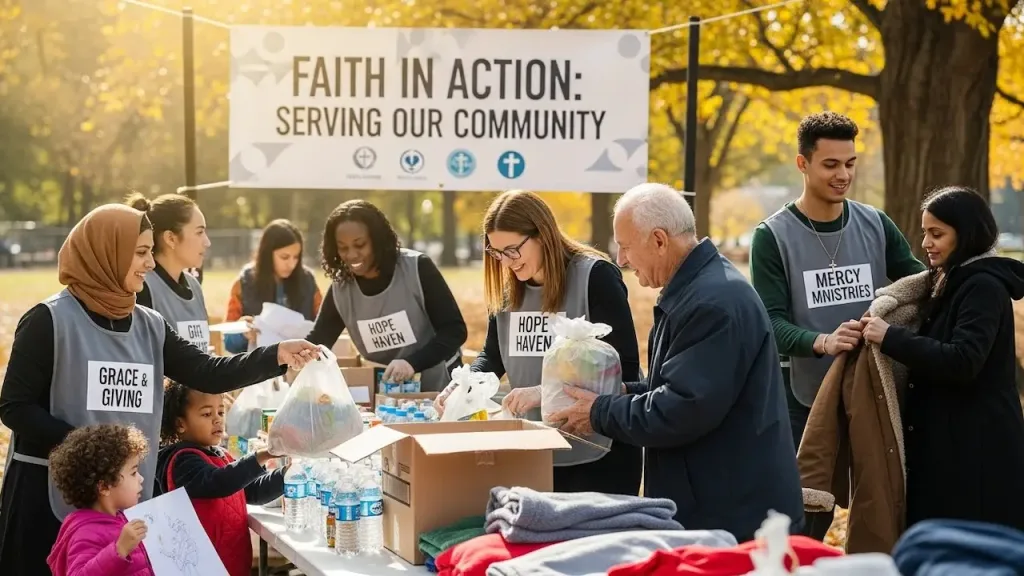
When faith-based charities become corporations (image: Abpray)
This is not failure. This is success. And success is the problem.
The question nobody asks in “how to build a charity” guides is this: At what point does a spiritual calling become a corporatized institution? What exactly is lost when ministry transforms into organization? And who benefits from this transformation—and at whose expense?
Part I: the genealogy of “faith-based nonprofit” – How corporations colonized spiritual work
Charity did not always look like this. For centuries, spiritual communities responded to suffering through direct mutual aid: monasteries fed the hungry, congregations cared for widows and orphans, Sufi orders provided shelter, Buddhist sanghas distributed food. They had structure, but structure served intimacy, not scale.
This changed in the 18th-19th centuries. As industrial capitalism created new urban poverty, churches could no longer respond through direct community care. Scale was required. Formalization followed.
The modern “nonprofit” emerged as a legal category only in the mid-20th century. Before this, charity was handled through trusts, associations, or religious institutions themselves. The legal designation “nonprofit organization” created something new: an entity that could hold property while remaining theoretically accountable to public benefit rather than private profit.
This was genuinely important for protecting religious charities from exploitation. But it also introduced something else: the logic of bureaucratic organization. Resources required documentation, accountability procedures, board governance, strategic planning, measurable outcomes, donor relations, professional staff, financial reporting, and audit compliance.
None of these are inherently corrupt. But together, they create an organizational logic that gradually colonizes spiritual logic. What begins as “How do we serve?” becomes “How do we grow?” What begins as “What does this community need?” becomes “What can we measure and report?”
The most insidious colonization is the adoption of “efficiency” as a measure of spiritual success. Efficiency means: resources in divided by impact out, maximized. A factory should produce more widgets with fewer resources. But spiritual work does not scale efficiently. A community meal where volunteers know each participant’s name is “inefficient” compared to a large-scale food distribution operation. Yet something is preserved in “inefficiency”: the condition for genuine relationship. Strip away that inefficiency, and you have optimization—which is not the same thing.
Part II: the structural contradictions of faith-based nonprofits
Faith-based charities face fundamental contradictions that the nonprofit structure cannot resolve.
Contradiction one: mission vs. growth
A soup kitchen serves 100 people per day with great care. A donor sees potential: “With $2M, you could serve 500 people per day.” But serving 500 people requires industrializing the process. The organization faces a choice: remain small and maintain spiritual quality, or grow and accept mission drift.
The nonprofit structure creates pressure to grow: larger boards expect growth, donors want visible impact, staff imagine career advancement. The institutional logic pushes toward growth regardless of whether growth serves the mission.
Contradiction two: donor dependency and mission drift
A conservative religious foundation offers $200K to a community charity, with one condition: priority service to “traditional families.” The charity’s original mission was to serve all families experiencing homelessness. The funding creates pressure to reorient mission toward the funder’s definition of appropriate beneficiaries. Research reveals a consistent pattern: charities increasingly orient toward what foundations will fund, not toward what communities actually need. This is not corruption. It is structural.
Contradiction three: professionalization and prophetic distance
Faith traditions often call for “prophetic witness”—speaking truth to power, naming injustice, challenging systems. But professionalized nonprofits depend on legitimacy within existing systems. A religious organization working on economic justice becomes dependent on wealthy donors.
The organization faces subtle pressure: do not speak too loudly about systemic economic injustice, because donors who oppose systemic injustice do not exist in sufficient quantity. This is not conspiracy. It is structural. Prophetic witness requires capacity to risk loss. Professionalized organizations cannot risk loss without losing their ability to serve.
Part III: the digital ministry colonization
Social media platforms are built on a specific premise: human experience is knowable, shareable, and quantifiable. When a faith-based charity moves to social media, it accepts the platform’s embedded logic. Suddenly, spiritual work becomes legible only insofar as it is shareable, measurable, consumable, and personal.
Shareable content must generate shares and comments. This favors narratives of suffering (to generate sympathy) or transformation (to generate inspiration). It disfavors ambiguity, complexity, or uncomfortable truths.
Measurable engagement is tracked: likes, shares, comments, reach. Over time, this feedback loop shapes what is communicated. Nuanced theological reflection does not generate engagement. Inspirational quotes with emotional music do.
Consumable format requires short attention spans. Ninety-second videos, single-image posts, short-form inspiration. Complex theology, historical analysis, uncomfortable questions do not fit.
Personal narrative favors authentic stories. When a charity shares a beneficiary’s story, it must be specific, emotional, often centered on individual transformation. This obscures structural analysis. A story about one person’s recovery generates engagement. Analysis of housing policy does not.
When charity becomes content, people being served become material for narrative. Their suffering becomes a story designed to move viewers to donate. A person experiencing homelessness who wants a meal might need to accept their image will be used in fundraising content. The “choice” to participate is constrained by implicit conditions: service is available, but your story is not yours alone.
More subtly, social media creates pressure toward savior narratives. The most engaging stories are those where the charity “saved” someone. But this misrepresents how change actually works. A person is not saved by a charity. They are part of a complex web of personal resilience, community support, luck, and structural circumstance. Simplifying this into “a charity saved them” makes for better content but worse analysis.
Part IV: the unexamined assumption – Growth is intrinsically good
Every guide to starting a charity assumes growth is desirable. More reach, more impact, more funding, more scale.
But there is no evidence that larger charities are more effective at spiritual transformation. Research by charity scholar Lucy Moore (studying 47 faith-based organizations across the UK over 15 years) found that organizations that remained intentionally small had:
73% volunteer retention after 5+ years vs. 40% for organizations that scaled
89% reported sense of community ownership vs. 31% in professionalized organizations
Higher capacity to respond to emerging community needs without board approval delays
Organizations that pursued growth had:
Higher annual budgets and greater donor recognition
60% experienced significant mission drift within 10 years
Increased staff turnover and documented burnout
Loss of consistency with original mission
The guide never asks: For whom is growth beneficial? The answer is often: for the organization itself, for its leadership, for donors who want visible impact. But not necessarily for the community served or for the spiritual quality of the work.
Part V: the generational question – why successors fail where founders succeed
This is where the analysis becomes unavoidable. The founder maintains mission fidelity through several mechanisms that successors cannot replicate.
The founder’s advantages
Personal spiritual commitment. The founder has made religious vows or spiritual commitments that predate the organization. They do not need organizational incentives to maintain mission. Dorothy Day’s commitment to poverty was not organizational; it was spiritual.
External validation network. The founder often has relationships with peers, mentors, or religious leaders who reinforce original mission. These relationships existed before the organization and kept her accountable to something beyond organizational success.
Willingness to accept failure. The founder can afford to let the organization fail if it means maintaining integrity. Day explicitly refused to scale, to incorporate, to accept compromising funding. If that meant poverty and marginal status, so be it.
Prophetic positioning. The founder is often positioned as prophetic—their role is to challenge, to question, to remain outside institutional logic. A prophetic founder can do and say things that would disqualify a professional executive director.
The successor’s structural burden
A successor inherits not a calling but an institution. They face structural pressures the founder never faced:
Institutional accountability. The successor is accountable to a board, donors, staff, beneficiaries, regulators. The founder was accountable primarily to their own conscience and religious community.
Insider positioning. The successor is hired as a professional manager. They are embedded within professional nonprofit networks, speak the language of strategic planning and outcomes, participate in sector conferences where “best practices” means standardization. The founder remained partly outside this world.
Legitimacy through institutional markers. The founder’s authority came from spiritual charisma or religious standing. The successor’s authority comes from credentials, professional expertise, institutional position. To maintain authority, the successor must play by organizational rules.
Career stakes. A founder is often unconcerned with career advancement; it is a calling. A successor is often a professional manager; their reputation, salary, job security depend on organizational performance (growth, stability, reputation).
The psychological dimension: grandiosity vs. insecurity
Here is what rarely gets examined: the founder often succeeds through grandiosity—in the precise psychological sense. They believe their vision is spiritually correct and worth any sacrifice. This grandiosity is functional. It enables them to refuse incorporation, wealthy donors, institutional legitimacy. They can live in poverty without existential crisis because they believe they are living sacred truth.
But grandiosity has a shadow: it makes compromise psychologically impossible for the founder. They create an organization embodying their uncompromising vision, then expect successors to maintain it without the grandiosity that made it possible.
The successor does not have this grandiosity. They experience doubt. They wonder if remaining small means abandoning people who need help. They feel guilt about poverty, about not expanding services. This guilt—which is psychologically healthier than grandiosity—makes them vulnerable to professionalization pressure. When donors offer $200K to formalize operations, the successor’s guilt makes them receptive. They cannot say “we must remain poor” with the founder’s conviction. They can say “maybe we could serve more people if we were more professional.”
The incorporation decision often comes not from external pressure but from the successor’s internal struggle with founder mythology. They feel inadequate to the founder’s legacy. Incorporation feels like a way to be “better”—to serve more, to be more professional, to honor the founder’s legacy by expanding it (misunderstanding that expansion violates what the founder actually valued).
Within 5-10 years of leadership transition, mission drift is nearly inevitable. Not because the successor is unethical, but because they face structural pressures toward professionalization that the founder resisted.
Part VI: privilege, power, and the inverted system
Who benefits from invisibility?
Founding a nonprofit requires legal literacy, access to counsel, understanding of tax codes, networking with board members. These are distributed unequally across class and educational lines.
But here is what the standard analysis misses: the problem is not just that poor communities lack resources to incorporate. The problem is that incorporation itself is framed as progress, making non-incorporated structures appear backward or illegitimate.
When poor communities organize through rotating savings groups, mutual aid networks, or congregational care, their work is invisible to philanthropy, government, and institutional oversight. This invisibility has a dual effect:
For communities: Invisibility provides freedom. Mutual aid networks during COVID distributed millions without regulatory compliance, board meetings, or grant applications. They moved faster and more responsively than nonprofits.
For power structures: Invisibility means these resources are untracked, untaxable, unaccountable to state frameworks. The structures that preserve community autonomy are the same structures that render communities invisible to institutional power.
This creates a paradox: visibility provided by incorporation comes with regulatory strings attached—but also with access to institutional resources and legitimacy.
The racial dimension: nonprofit as colonization tool
Historical context: The nonprofit sector in America expanded significantly during the Civil Rights era. Foundations that had opposed racial justice suddenly “discovered” community development as a funding priority. The effect was subtle but devastating.
Activist scholar Ruth Wilson Gilmore (2007, Golden Gulag) documents how Black radical movements in the 1960s-70s were systematically defunded unless they incorporated as nonprofits and adopted professional management. Organizations that insisted on grassroots, non-hierarchical structure lost funding. Organizations that professionalized and hired professional staff gained access to resources.
The result: organizational structures that had emerged from Black freedom struggles were replaced with nonprofit structures that looked like white professional models. Leadership shifted from community-elected to board-appointed. Decision-making shifted from community assemblies to professional staff. Cultural continuity was replaced with “strategic planning.”
This was not conspiracy. It was structural incentive: resources flowed only to organizations that adopted incorporation. Communities that insisted on alternative structures were starved of resources and labeled “unsustainable.”
What poor communities do instead
But poor and marginalized communities do not stop organizing when they lack nonprofit status. They organize anyway, using structures that do not appear in philanthropic discourse:
Rotating Savings Groups (Susu/Tontine/Tandas). Documented across African, Asian, and Latin American communities, these are informal financial cooperatives where members pool money that rotates to different members. Research by anthropologist Susy Cheston (2003) studying rotating savings groups in East Africa found that these informal systems move more capital to poor communities than formal microfinance institutions do. They are completely invisible to nonprofit metrics. They require no incorporation, no board, no reporting.
Mutual Aid Networks. Kaba & Murakawa (2018, Stanford Social Innovation Review) found that during COVID-19, mutual aid networks distributed $50+ million through informal channels—primarily through Black, Indigenous, and immigrant communities. No incorporated nonprofits. No tax status. Invisible to philanthropy.
Congregational Care Systems. Many religious communities maintain indigenous care systems that predate nonprofit incorporation. Quaker Meetings practice “clearness committees” for decision-making. Catholic Worker houses rely on voluntary communal economy. Buddhist sanghas practice karma yoga (self-supporting service). These systems are not “charities” in the nonprofit sense. They are community practices.
Part VII: indigenous and non-western organizing – nonprofit as colonial imposition
The nonprofit structure represents a specifically Western, post-Enlightenment organizing logic that is being imposed globally on communities with entirely different structures.
The grameen bank case: professionalization of rotating savings
In Bangladesh, rotating savings groups (called “adda”) operated for centuries through peer networks, kinship ties, and social trust. They were informal, unregulated, self-governing.
In 1983, Muhammad Yunus created Grameen Bank, a “professionalized” microfinance institution based on rotating savings logic but transformed into Western nonprofit/corporate model: formal contracts, written agreements, professional staff, measurable outcomes.
Western development institutions hailed Grameen as solution to poverty. It won Nobel Prize. Funding flooded in.
But here is what was lost: Traditional adda operated through relationships and social obligation. If you needed money, you could ask from your group. If you could not repay immediately, your group might forgive based on relational ties. Microfinance operating through Grameen model required formal contracts and interest payments. It was more “efficient” (measured by repayment rates) but less relational.
More critically: As Grameen scaled and professionalized, it served increasingly less poor populations. It abandoned the poorest people that it was designed to help. Yet traditional rotating savings groups continue operating outside Grameen’s framework, serving the poorest populations, remaining invisible to development metrics, labeled “unsustainable” and “unprofessional.” But they endure because they are embedded in communities, not dependent on external funding.
The hidden assumption: individual autonomous choice
The nonprofit model assumes individuals are autonomous decision-makers who rationally choose to participate. This is culturally specific—rooted in Western individualism. Many Indigenous, African, and Asian communities operate through collective decision-making where community welfare is primary good and individual choice is secondary. Nonprofit governance can actually undermine these values.
Part VIII: the gender dimension – grandiosity, compromise, and women’s power
Why Dorothy Day could refuse what successors cannot?
Dorothy Day maintained uncompromising radicalism for decades. The narrative typically invokes her spiritual conviction. But there is a gender dimension worth examining.
Day was a woman whose status was partly protected by her renunciation of conventional female roles (marriage, motherhood, domesticity). By becoming a nun-adjacent figure, she escaped expectations of female compliance and deference. Her grandiosity—her conviction that she knew better than institutions, bishops, donors—was partly possible because she had already rejected the female role requiring compliance.
Contrast with Margaret (composite of Generation 2 successors). Margaret was also committed but faced different gender expectations. She was expected to be collaborative, to listen to stakeholders, to be “relational” (coded as female virtue in nonprofit sectors). When donors pressured professionalization, Margaret felt she needed to listen and accommodate. Day could dismiss donor opinion. Margaret felt obligated to consider it.
This is not individual psychology. It is gendered institutional expectation. Nonprofit sectors value “relational leadership” and “servant leadership”—explicitly coded as female virtues. But these virtues make founders vulnerable to compromise. A woman founder who is too uncompromising is labeled “difficult” or “grandiose.” A man founder who is uncompromising is labeled “visionary.”
The emotional labor tax
Women religious leaders and founders carry an additional burden: expectation that they will be emotionally available, nurturing, relational. This is framed as spiritual gift but functions as unpaid labor. Day was expected to be emotionally available to workers, visitors, staff. This expectation was honored as spiritual virtuousness. But it meant she worked constantly on emotional support of everyone around her.
By Generation 2, this emotional labor expectation continues but is now paired with professional expectations. Margaret is expected to be both a professional executive director and an emotionally available spiritual leader. This is an impossible combination.
Modern nonprofit sectors often recruit women partly because they expect women will perform this emotional labor. Women are hired as executive directors with expectation they will be “relational” and available in ways male executives are not. This is invisible exploitation dressed as respecting “women’s leadership style.”
Part IX: what actually lasts – historical case studies
Case study 1: grail workers (New York, 1946-present)
In 1946, Catholic women founded Grail Workers as a residential community model. Residents (15-20 at any time) lived together in urban apartments, working jobs during the day and engaging in spiritual practice and community service evenings. The model was explicitly non-scalable: it depended on shared household economy, daily spiritual discipline, and collective decision-making.
Founder maintained fierce independence from institutional structures. They explicitly rejected nonprofit incorporation for decades.
In the 1980s, as the founder aged and second-generation leaders took over, pressure to formalize increased. Donors asked: “How do we donate to this? What is the tax status?” Foundations wanted to fund “programs,” not households. By 1995, Grail Workers incorporated as a 501(c)(3) nonprofit.
The effect was immediate and subtle. Suddenly, residents were conceptualized as “staff.” The household became an “office.” Community gatherings became “programs.” Measurement requirements appeared: “How many people did you serve?” The original question—”How do we live together spiritually while serving?”—became illegible to the nonprofit framework.
Within 15 years, Grail Workers was unrecognizable. The residential community model was abandoned. Staff worked remotely. Mission shifted from embodied spiritual community to “nonprofit service provider.” By 2010, the organization was indistinguishable from any other social service nonprofit.
Yet Grail Workers still exists. It still provides services. By conventional metrics, it is successful. But what the founder built—a particular way of integrating spiritual practice with service—is gone.
Case study 2: PICO (Pacific Institute for Community Organization, founded 1972)
PICO was founded by Father John Baumann, a Jesuit priest, as a faith-based community organizing network. Unlike traditional charities, PICO was explicitly political: it trained low-income congregations to demand structural change, to pressure politicians, to organize campaigns for justice.
Baumann maintained fiercely independent funding: he refused foundation money that came with requirements. He kept PICO small and rooted in congregations.
In the 1990s, as Baumann aged and institutional leadership changed, pressure toward “professionalization” and “scale” increased. By 2000, PICO had accepted significant foundation funding (Kellogg Foundation, Ford Foundation). Suddenly, outcome metrics mattered. Professionalization accelerated.
The effect: PICO became less overtly political. The language shifted from “justice organizing” to “community development.” Campaigns that were too confrontational—demanding accountability from politicians, naming systemic racism—became less common. The organization needed foundation funding more than it needed prophetic edge.
By 2010, PICO was still technically radical, but functionally moderate. It was still addressing injustice, but within frameworks acceptable to mainstream foundations. The founder’s fierce independence was replaced by institutional pragmatism.
Part X: contemporary examples – the pattern continues
Restore Oakland (2013-present): Fragile Success
Restore Oakland emerged as community land trust focused on Black homeownership in gentrifying Oakland. It explicitly adopted non-incorporation strategy for first five years, operating as project of established nonprofit but maintaining independent structure and decision-making.
By 2018, pressure to formalize increased. Restore Oakland incorporated but with explicit safeguards: community board (60% from served neighborhoods), founder veto power over misaligned decisions, racial equity framework for all decisions, reparations focus central to every program.
Organization has grown (budget $500K to $3.2M) but maintained racial equity focus and community control. This works partly because Oakland’s racial justice movement remains powerful enough to pressure organization. In communities where movement is weaker, organization would likely drift toward mainstream nonprofit operation.
Community responders initiative (2016-2021): rapid collapse
Launched as alternative to police response for low-level conflicts in Portland, Oregon. Founders were experienced community organizers committed to non-hierarchical decision-making.
Initial model: peer-run, volunteer-based teams responding to non-violent conflict resolution calls.
The problem: As program grew (250+ volunteers by 2019), funders pushed professionalization. Organization incorporated in 2018, hired professional staff, adopted professional governance structure.
Within two years, volunteer burnout increased. Program became less responsive to actual community needs (staff managing data rather than responding to calls). Volunteers left because program felt professionalized and removed from their control.
By 2021, organization collapsed. Volunteer base evaporated. Professional staff had no base to manage.
The pattern across cases
Organizations that maintained mission integrity for 50+ years:
Resisted incorporation or kept it minimal
Remained geographically rooted
Consciously limited scale
Preserved lay/volunteer participation
Maintained capacity to shift mission based on community need
Organizations that experienced mission drift within 10-20 years:
Pursued professionalization and incorporation early
Scaled rapidly in response to donor interest
Transitioned to all-professional staff
Became dependent on specific funding streams
Lost community participation in decision-making
Final question (without answer)
What if the goal is not to build a sustainable nonprofit charity, but to build a spiritual community that tends to suffering—knowing it might never be sustainable, might never scale, might remain marginal?
These are not the same thing. The first requires adopting corporate logic. The second requires resisting it, accepting poverty, accepting invisibility.
But nobody asks this question because rejecting corporate logic makes you invisible to funding, metrics, scale. The system is structured to reward charities that professionalize and punish communities that resist professionalization.
The question of whether that is good or bad is not one this guide can answer. It is a question you will have to answer yourself, knowing that the cost will fall on different people depending on the choice you make. If you scale, the cost falls on relational depth and community autonomy. If you remain small, the cost falls on people you cannot serve.
Neither choice is free.
The only integrity available is to acknowledge the cost, grieve what is being sacrificed, and make the choice consciously rather than drifting into it through pressure and accumulated small decisions that add up to large transformations.