For the Amish, language is far more than a simple tool for communication; it is a vital “fence” that preserves their community from the secular world (whom they call the English) and a “bridge” that connects them to their 18th-century European ancestors.
Most Amish people practice a sophisticated form of trilingualism, navigating between Pennsylvania Dutch, High German, and English. Each language occupies a specific “domain” of their life, ensuring that their cultural identity remains distinct even while they participate in the modern economy.
1. Pennsylvania Dutch: the heartbeat of daily life
Pennsylvania Dutch (or Deitsch) is the primary language spoken in Amish homes and within the community. Despite the name, it is not “Dutch” from the Netherlands; rather, “Dutch” is a corruption of the word Deitsch (German), specifically referring to the people of German-speaking lands.
Historical Origins: It is a descendant of the Palatine German dialects spoken by 17th and 18th-century immigrants from the Holy Roman Empire—specifically the Palatinate region of modern-day Germany, as well as Switzerland and Alsace (France). These groups merged their dialects into what we now recognize as Pennsylvania Dutch.
A First Language: In traditional Amish settlements, Pennsylvania Dutch is the only language children hear until they enter school at age six. It is the language of emotion, family bonding, farming, and casual play.
The Oral Tradition: One of the most unique aspects of Deitsch is that it is primarily an oral language. While scholars have created dictionaries, the Amish rarely read or write in it. This oral nature helps keep the language exclusive to those born into the faith, reinforcing their separation from the world.
Regional Dialects: Just as English varies between London and New York, Pennsylvania Dutch has regional variations. The dialect heard in Lancaster County, Pennsylvania, may differ slightly in cadence and vocabulary from the Deitsch spoken in Holmes County, Ohio, or Northern Indiana, often due to the specific mix of Swiss vs. German ancestors in those areas.
2. High German: the sacred language of worship
While Pennsylvania Dutch is perfect for the barn or the kitchen, the Amish consider it too informal—and perhaps too “worldly”—for the sacred nature of a religious service. For worship, they turn to High German (Hochdeutsch).
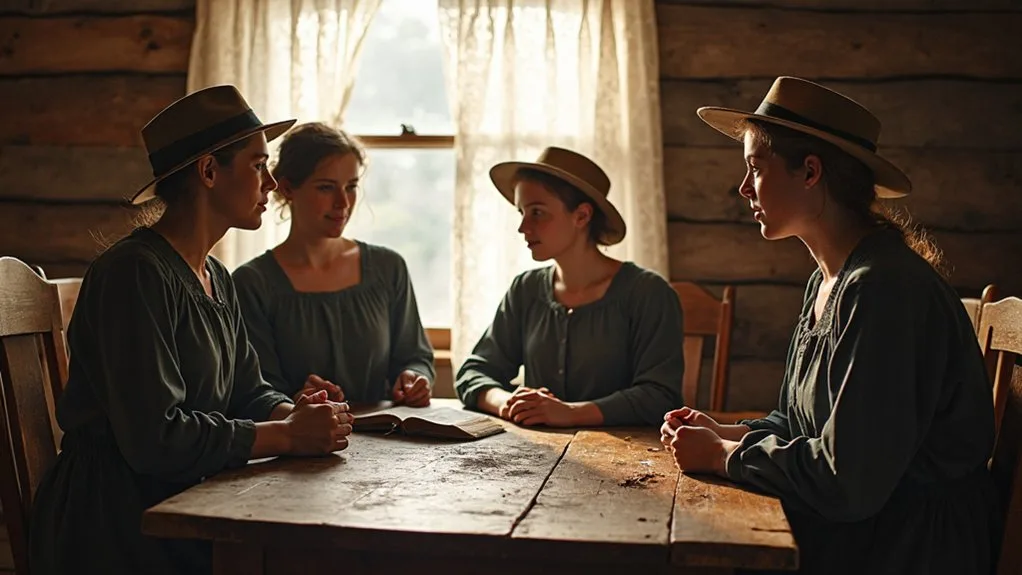
Scriptural Connection: During an Amish church service, which is held in a member’s home or barn, the Luther Bible (translated by Martin Luther) is the central text. When an Amish leader reads scripture or when the congregation sings from the Ausbund (the oldest Protestant hymnal still in use), they use High German.
Archaic Form: It is important to clarify that the Amish do not speak modern, standard German (like what you would hear in Berlin today). Instead, they use a formal, archaic version of the language found in 18th-century texts. This creates a solemn, liturgical atmosphere.
The “Hybrid” Sermon: In a typical three-hour service, the languages blend in a specific way: the Bible is read in High German, the hymns are sung in High German, but the sermon (preaching) is delivered in a mix of High German and Pennsylvania Dutch. This ensures that the message is both grounded in ancient scripture and understood by the modern congregation.
3. English: the necessary bridge to the world
English is the primary language used to communicate with “the outside.” The Amish refer to all non-Amish people—including Germans, Latinos, or Asians—as “the English.”
Education: Amish parochial schools are taught primarily in English. This is a pragmatic choice; the community recognizes that to navigate legal matters, health systems, and business trades, their children must be fully literate and fluent in English.
Business and Trade: As the Amish have moved away from purely agrarian lifestyles and into carpentry, manufacturing, and retail, English has become their “business language.” It is used to speak with customers, suppliers, and government officials.
The Social Boundary: While fluent, the Amish rarely use English among themselves. Using English in a private setting is often seen as an act of “putting on airs” or showing a desire to be more like the secular world.
Language use by context: a comparison table
Language
Primary Domain
Written/Oral?
Function
Pennsylvania Dutch
Home, Farm, Community
Oral
Informal, Emotional, Secret
High German
Church Service, Hymns
Written (Read)
Sacred, Liturgical, Traditional
English
School, Business, Neighbors
Both
Pragmatic, External, Educational
The evolution of “Amish English”
Because Pennsylvania Dutch is their first language, Amish speakers often have a distinct accent when speaking English. This has created a unique dialect known as “Amish English.” It features specific syntax and direct translations from German logic.
Syntax Examples: You might hear an Amish person say, “Throw the horse over the fence some hay” (meaning throw some hay over the fence to the horse) or “It wonders me” (meaning I wonder about that).
Loanwords: Occasionally, Deitsch words migrate into their English, or vice versa. This linguistic blending is a fascinating area of study for sociolinguists, as it shows how a community can maintain its core language while adopting the tools of the majority culture.
The impact of modernization
Modernization is a double-edged sword for Amish language practices. On one hand, the increased interaction with non-Amish businesses forces more frequent use of English. On the other hand, many Amish communities are doubling down on Pennsylvania Dutch education at home to prevent “assimilation.”
The younger generation, while comfortable in English, remains largely committed to the family’s native tongue. For an Amish person, losing Deitsch would mean losing their membership in the community. As long as the Amish continue to hold church services in their homes and raise children on their farms, Pennsylvania Dutch and High German will remain at the center of their world.
Conclusion
The languages spoken by the Amish at home and in church are a living testament to their history and their religious resolve. By speaking Pennsylvania Dutch at home, they preserve their family bonds and keep a private space for their community. By using High German in church, they honor the spiritual martyrs of the 1500s and 1600s. And by utilizing English, they intelligently manage their lives as citizens in a modern nation.
This trilingual balance is not an accident; it is a calculated, centuries-old strategy to remain “in the world, but not of it.” Their languages truly keep their community connected, their borders secure, and their heritage alive for the next generation.