Published on January 12, 2026 at 4:07 PMUpdated on January 12, 2026 at 4:07 PM
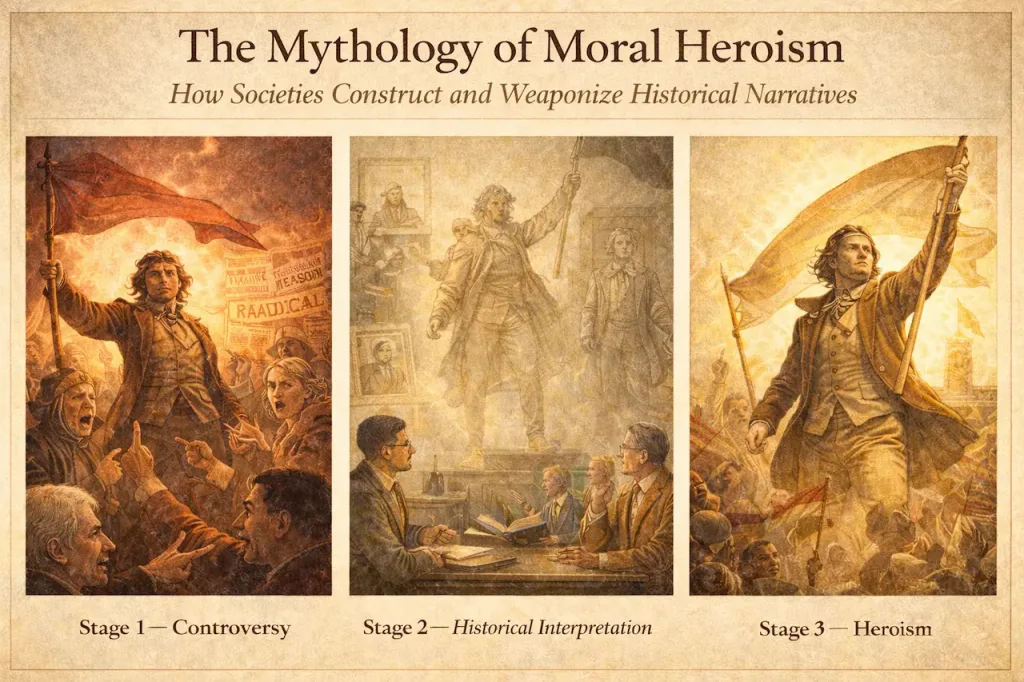
When we speak of inspiring figures in history, we are not simply recounting factual events. We are engaged in an act of collective mythology—a process through which complex, contradictory human beings are flattened into archetypal symbols that serve specific cultural functions.
The mythology of moral heroism (image: Abpray)
This distinction matters profoundly. The Gandhi we celebrate is not the man who harbored troubling views on sexuality and caste. The Martin Luther King Jr. we remember is not the figure whose economic critiques alarmed corporate America. Mother Teresa’s canonization obscures uncomfortable questions about her medical practices and her theology of suffering. And Malala, despite her genuine advocacy, has become a symbol deployed by Western institutions in ways that often contradict her actual intellectual positions.
The question is not whether these figures were courageous—many were. The question is: Why does cultural memory systematically erase the parts of their legacies that complicate our narratives? What function does this simplification serve? And who benefits from it?
Part I: the structural logic of heroic canon formation
How mythology replaces historical complexity?
Historical memory operates according to what we might call the “principle of narrative coherence.” Societies require their heroes to embody unified moral positions that align with contemporary values. When a historical figure lived across decades of shifting personal beliefs, institutional pressures, and contradictory actions, the canon-building process selects which moments, statements, and achievements will be preserved and which will be archived away in the footnotes of academic texts.
This is not accidental. It is structural.
Consider Gandhi’s evolution: the man who in his South African years supported British imperial military efforts; who advocated for a hierarchical caste system; whose views on female sexuality and brahmacharya (celibacy) reflected doctrines that some scholars argue were psychologically coercive. Yet the global Gandhi—the figure commemorated in monuments, textbooks, and popular memory—is the ascetic saint of non-violence. The earlier, more complicated Gandhi is preserved only in dense scholarly monographs that reach perhaps thousands of readers globally.
The process of heroic canonization functions as a form of cultural distillation. Raw human complexity is heated, condensed, and crystallized into a symbol pure enough to inspire, simple enough to teach in schools, and politically safe enough that it offends no significant institutional interest.
Martin Luther King Jr. provides an equally instructive case. The King who emerges in mainstream American memory is a dreamer of racial harmony, a man whose ultimate vision was inclusion within the existing democratic structure. But the historical King—particularly in his final years—was radicalizing. He was connecting racism to economic exploitation, linking Vietnam War spending to domestic poverty, and developing a critique of capitalism itself that would have positioned him as a dangerous radical by contemporary standards. His last book, Where Do We Go from Here, articulates positions that would make him controversial today across mainstream American discourse.
When King is invoked in corporate diversity initiatives or government rhetoric, it is the sanitized King—the one whose radical economic critique has been surgically removed.
The Pattern: temporal flattening and moral purification
There is a recognizable pattern across heroic canonization:
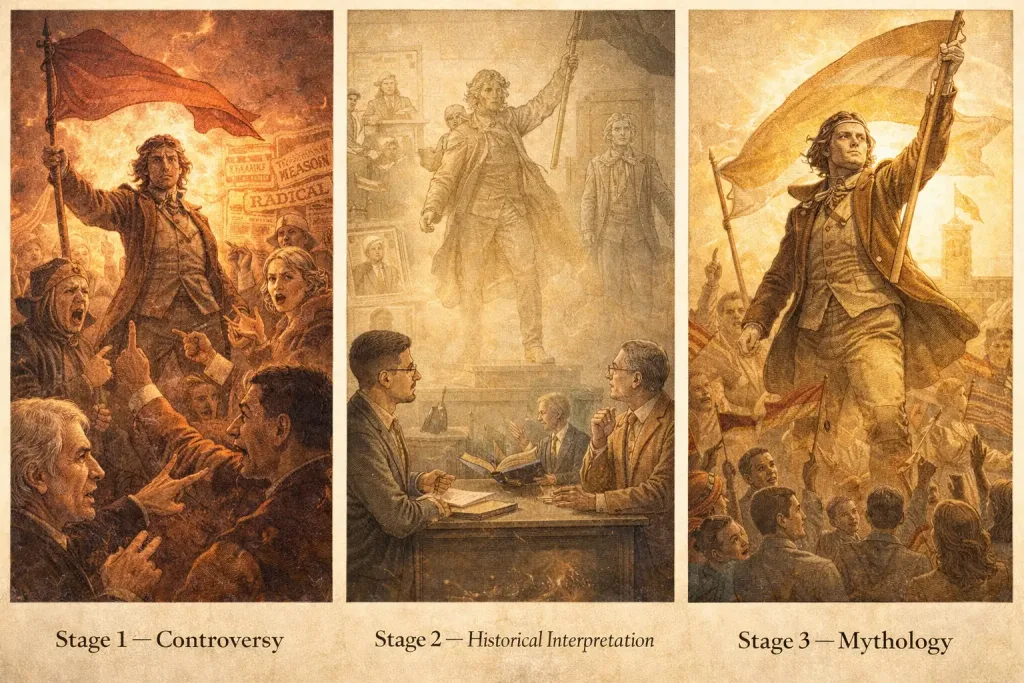
The Pattern: temporal flattening and moral purification (image: Abpray)
Stage 1 (Life and Immediate Aftermath): The figure is controversial, complex, often condemned by significant portions of society. Contemporaries argue about their methods, their beliefs, their personal conduct.
Stage 2 (Generational Transition): As direct witnesses die, the figure becomes subject to historical interpretation rather than lived memory. Scholarly debates continue, but cultural memory begins to simplify.
Stage 3 (Mythological Integration): The figure is integrated into the nation’s or culture’s founding mythology. Contradictions are smoothed. Inconvenient facts are backgrounded. A unified narrative emerges.
This pattern repeats across cultures and centuries. Joan of Arc transforms from a girl with auditory hallucinations (potentially schizophrenic by modern diagnosis) who led military campaigns into a symbol of pure patriotic virtue. Nelson Mandela, who spent decades as a strategic militant willing to authorize bombings, becomes the face of universal reconciliation and forgiveness. Malcolm X, whose actual positions on gender, sexuality, and political alliances shifted significantly, becomes frozen at a particular moment of his ideological development.
The mythologization serves a function: it makes these figures safe. A Gandhi who challenged the foundations of economic inequality is dangerous. A Gandhi who symbolizes “being the change you want to see” is manageable.
Comparative Analysis: Different Cultures, Parallel Structures
The structural logic of heroic mythology transcends individual cultures. What changes is not the process but the values around which mythology crystallizes.
In the Indian imaginary, Gandhi’s non-violence becomes the defining national characteristic—a narrative that conveniently obscures the violent communal conflicts of Partition and the Indian state’s ongoing militarism. In the American imaginary, King’s dream of racial harmony becomes a tool for arguing that racism has been solved and that further structural change is unnecessary. In the Pakistani imaginary, Malala’s advocacy for education becomes a symbol deployed by Western institutions in ways that often serve geopolitical interests rather than feminist ones.
What is constant is this: heroic narratives are functional. They do work. They resolve cultural contradictions by embodying ideals that make societies feel coherent.
Compare how three different societies remember three different figures:
Gandhi in India: Symbolizes national soul-force and spiritual superiority over Western materialism. His caste conservatism and early support for British imperialism are rarely discussed. His vision becomes conflated with Hindu nationalism in ways that contradict his actual pluralist commitments.
Gandhi in the West: Symbolizes the possibility of non-violent change and moral suasion. His actual critiques of colonialism and capitalism are deprioritized. He becomes a symbol for conflict resolution divorced from power analysis.
Martin Luther King Jr. in American Official Memory: The dreamer of harmonious integration, proof that the system can be reformed from within. His economic radicalism, his anti-war stance, his questioning of American imperial power are muted or omitted.
Martin Luther King Jr. in Black Radical Traditions: Remembered as a figure in evolution, moving toward more systemic critiques, whose assassination cut short a radicalization that threatened power structures.
These are not the same figure. Yet they share a name and are claimed by different narratives as evidence for contradictory positions.
Part II: the hyperspeicific mechanisms of narrative distortion
Why certain stories disappear entirely
The canonical four figures you present—Gandhi, Mother Teresa, King, and Malala—share a remarkable commonality: they are all figures whose work can be depoliticized. Their legacies can be abstracted from the specific material struggles they engaged in and transformed into universal moral platitudes.
This is not true of all historical resisters. Consider why Nat Turner does not occupy the same canonical space as Martin Luther King Jr., despite his significance in American resistance history. Turner led an actual armed rebellion. He killed white slaveholders. His uprising was brutally suppressed, and he was executed. Importantly, his legacy cannot be easily domesticated. You cannot invoke Nat Turner in a corporate diversity seminar or a government ceremony without risking discomfort about the legitimacy of violent resistance.
Or consider Frantz Fanon, whose theoretical work on colonialism and violence remains far more intellectually rigorous than most accounts of non-violent resistance, yet whose prominence in academic discourse does not extend to popular cultural memory. Why? Because Fanon’s analysis—that violence is sometimes a necessary and psychologically liberating response to systemic dehumanization—cannot be smoothly integrated into narratives about peaceful progress and human goodness.
Similarly, figures like Sylvia Rivera, a transgender Latina activist at the forefront of the Stonewall uprising, remain marginal to LGBTQ+ historical memory because her actual life—marked by poverty, sex work, mental health struggles, and radical class politics—does not fit the sanitized narrative of “progress” that institutions prefer to tell.
The mechanism is subtle: figures whose lives can be abstracted into universal moral lessons are promoted. Figures whose lives demand engagement with systemic power, material inequality, and the messy specificity of struggle are archived.
The case of mother teresa: canonization as erasure
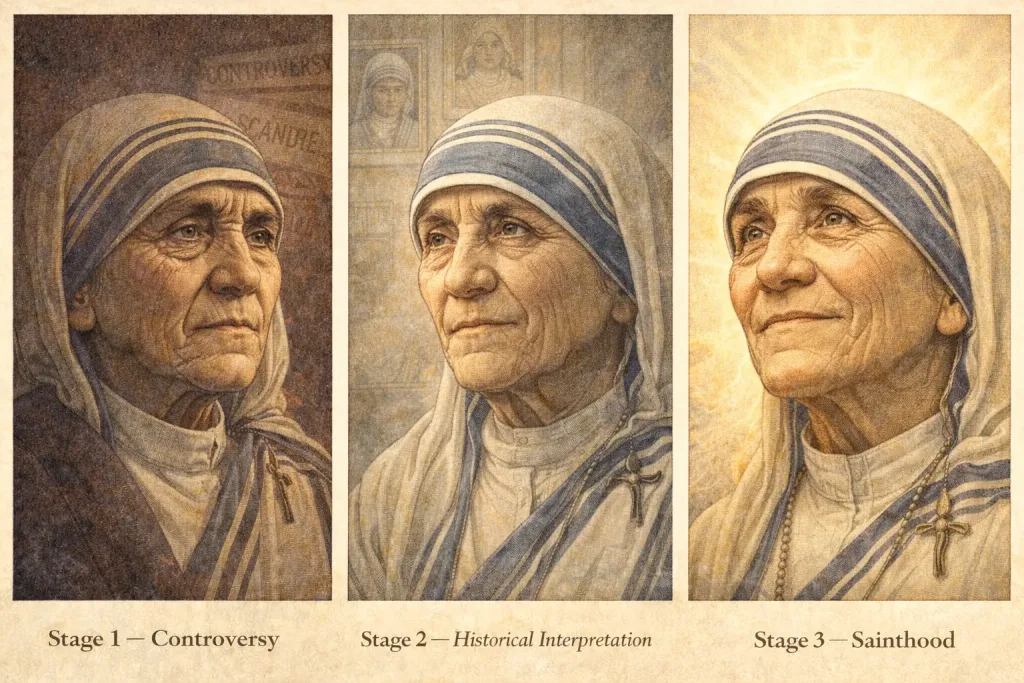
Mother Teresa illustrates this mechanism with particular clarity. Her official hagiography presents her as a figure of pure compassion, motivated by religious faith to serve the poorest of the poor. The reality was more complicated and, in some ways, more troubling.
Christopher Hitchens’s The Missionary Position remains essential here not because Hitchens is infallible, but because he documented a crucial fact: Mother Teresa’s organization, the Missionaries of Charity, operated hospices that provided minimal medical care and pain relief. The theology underlying this choice was explicit: suffering was spiritually redemptive, and alleviating it might interfere with spiritual transformation. Patients in her facilities often lacked basic antibiotics, surgical interventions, or even adequate anesthesia—not due to lack of funding (her organization was extraordinarily wealthy), but due to ideological commitment to the spiritual value of suffering.
This is not a minor biographical detail. It is central to understanding what her work actually accomplished and whom it served.
Yet in global memory, Mother Teresa becomes the symbol of compassionate service. Her canonization by the Catholic Church was accelerated through testimonies of miraculous healings—a theological process that further enshrines her as a figure beyond critical examination.
Why does this particular narrative persist? Because a Mother Teresa who challenges our comfortable relationship with suffering is dangerous. A Mother Teresa who symbolizes “love and service” in the abstract is manageable.
Malala: the instrument and the activist
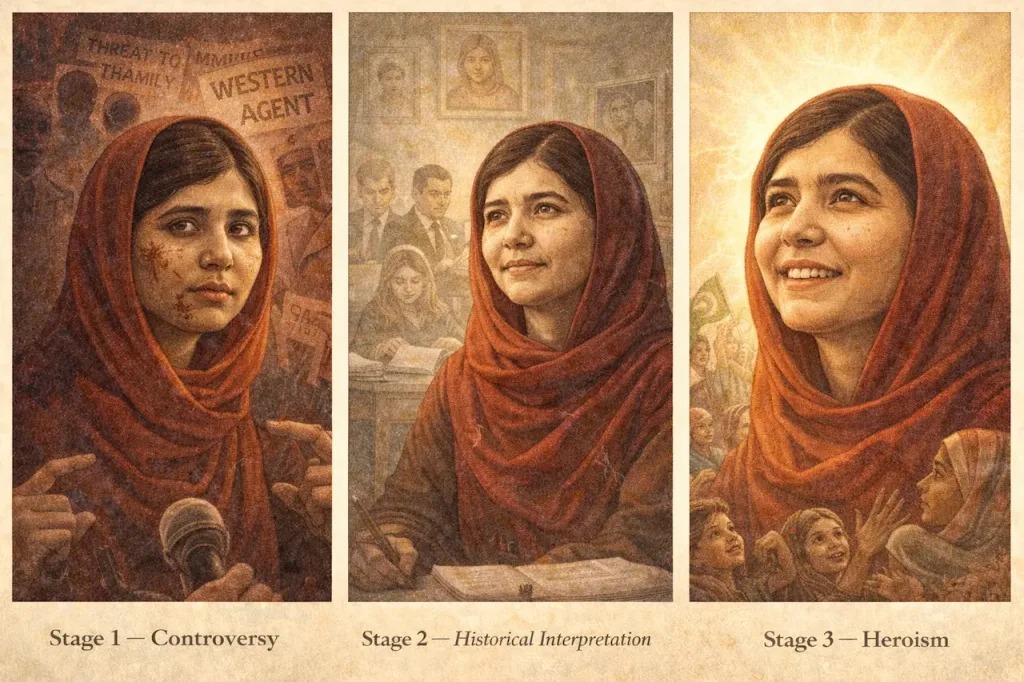
Malala Yousafzai presents a contemporary case study in real-time canonization. Her story—a young girl shot by the Taliban, surviving to become a global advocate for education—contains genuinely heroic elements. Her courage is not fictitious.
Yet her transformation into a global symbol reveals the mechanics of modern mythmaking with unusual transparency.
Within months of her shooting, Malala’s narrative was integrated into specific geopolitical projects. Her advocacy became evidence for Western military interventions in Pakistan. Her story was deployed by institutions that have no commitment to global educational equity but have substantial interest in justifying military presence in Central Asia. She appeared in contexts where her actual analysis was subordinated to broader institutional narratives.
Malala herself has pushed back against this instrumentalization. In interviews and her subsequent writings, she has insisted on her right to complexity—to be both a survivor of Taliban violence and a critic of Western imperialism, both an advocate for girls’ education and a young woman entitled to a private life and evolution beyond her trauma.
Yet the global narrative—the one that reaches billions through simplified media representation—fixes her as a symbol. A symbol does not evolve. A symbol does not contradict itself. A symbol serves functions determined by those who deploy it.
The hyperspeicific challenge Malala faces, one that earlier heroic figures did not face with such visibility, is that her canonization occurs while she is still alive and developing. The mythology hardens around her while she is still becoming. This creates a unique form of violence: her life is conscripted into narratives that may serve others’ interests at the expense of her own intellectual and spiritual development.
Part III: the question of silence – what disappears when we tell these stories
Structural invisibility: the power of what is not said
When we elevate certain figures as the primary exemplars of resistance, justice-seeking, or moral courage, we simultaneously obscure alternative traditions, different strategies, and suppressed possibilities.
The dominance of the non-violence frame in global memory, crystallized around Gandhi and King, has consequences. It establishes non-violence as the morally superior mode of resistance. This has real effects: it makes armed resistance movements appear immoral by comparison, even when they are responding to systematic violence. It suggests that the fault for failed non-violent movements lies with the movements themselves rather than with the intransigence of power structures. It implies that historical victories won through combinations of negotiation, legal pressure, and threat of escalation were somehow less morally pure than they would have been had they been achieved through purely peaceful means.
Yet the historical record complicates this. The desegregation victories of the Civil Rights Movement occurred not in a vacuum of moral persuasion but in a context where urban uprisings made continued segregation economically costly. Labor movements achieved the 8-hour workday and workplace safety standards through combinations of strikes, legal maneuvering, and sometimes violent confrontation. The narrative that moral clarity alone produces change is not supported by historical analysis.
What disappears when King becomes the sole representative of Black American resistance? The traditions of Black radical thought that understood structural transformation as requiring sustained political organization and material power. The women whose organizing work made King’s public campaigns possible, yet whose names appear in historical texts with far less frequency. The rural organizing traditions of the South that predate the Civil Rights Movement and continue after it. The intersectional analysis that understands racial justice as inseparable from economic justice and gender justice.
Similarly, when Gandhi’s non-violence becomes the primary symbol of anti-colonial resistance, what becomes invisible? The militant wings of independence movements that created the conditions in which negotiation became possible. The women freedom fighters—Rani of Jhansi, Kalpana Dutt, Usha Mehta—whose contributions are archived in footnotes. The Islamic, Sikh, Christian, and secular traditions of resistance that were synthesized into a narrative retrospectively unified as Gandhian.
The question of intent: who benefits from these narratives?
This is the metatextual question that scholarship on heroic memory rarely engages directly: cui bono? Who benefits from particular narratives of heroism?
Institutions benefit. Governments benefit from narratives of heroic resistance because such narratives suggest that the system, while flawed, is fundamentally capable of reform and self-correction. The existence of King proves that America’s conscience can be appealed to. The existence of Gandhi proves that colonialism can be overcome through moral pressure. These narratives reassure populations that change is possible and that the basic structures of institutional power need not be fundamentally reimagined.
Radical alternative narratives—ones suggesting that power yields only to organized material pressure, that institutions resist change structurally and that fundamental transformation requires sustained, organized confrontation—are far more threatening to institutional stability. Therefore, these narratives are not canonized. They remain in the archives, cited in specialized scholarship, but not incorporated into the primary cultural memory.
Capitalism benefits from narratives of heroic individualism. King and Gandhi and Malala are all framed as individuals whose moral clarity and personal courage drove change. This narrative obscures the collective organizing work, the institutional structures, the organized movements that made their work possible and meaningful. An emphasis on individual heroism suggests that you, the reader, need only achieve sufficient moral clarity and personal courage, and you too can change the world. This is comforting but false. It absolves structures of accountability and places responsibility on individual conscience.
Religious institutions benefit from narratives that frame struggle through spiritual or moral vocabulary. Mother Teresa’s canonization serves the Catholic Church’s interests in demonstrating its commitment to the poor while avoiding scrutiny of its actual institutional practices and positions on issues like contraception and divorce that directly affect poor communities’ material conditions.
Nations benefit from narratives that reflect their own self-image. India benefits from the Gandhi narrative because it positions India as the source of spiritual wisdom superior to Western materialism. The United States benefits from the King narrative because it positions America as fundamentally democratic and self-correcting, capable of addressing injustice through existing mechanisms.
What unites all these beneficiaries is that they all benefit from narratives that suggest existing structures are capable of reform, that change is possible within existing frameworks, and that you do not need to fundamentally reimagine the distribution of power, resources, and authority.
Institutional deployment and contemporary p0olitics
The contemporary deployment of these figures reveals their functionality with unusual transparency.
Malala is invoked by NATO member states to justify military interventions. King is invoked by corporations to justify diversity initiatives that do not disturb hierarchical structures. Gandhi is invoked to suggest that moral clarity and individual transformation are sufficient responses to systemic injustice. Mother Teresa is canonized to demonstrate the Church’s alignment with the poor despite the Church’s actual institutional positions on poverty alleviation.
In each case, the figure is deployed as a symbol that resolves a contradiction inherent in the deploying institution. The contradiction is this: the institution claims to value justice, compassion, and human dignity, yet its actual operations perpetuate injustice, indifference, and systemic dehumanization. The heroic figure, emptied of historical specificity and transformed into a symbol, allows the institution to claim alignment with justice without examining its own actual practices.
This is not conspiracy. It is not deliberate dishonesty. It is how institutional memory works. Institutions naturally gravitate toward narratives that resolve their internal contradictions and present themselves as fundamentally sound while acknowledging the need for incremental improvement.
Part IV: alternative possibilities – toward a more honest historical memory
What would it mean to remember these figures differently?
What if we approached historical memory not as a process of mythmaking but as an ongoing wrestling with contradiction?
A more honest account of Gandhi would hold simultaneously that he was a remarkably strategic political organizer whose understanding of power dynamics and social psychology was sophisticated, AND that his personal practices and ideological commitments on sexuality, caste, and gender were limiting and sometimes harmful. It would recognize that his strategies were developed in specific contexts and had specific limitations. It would examine which of his actual practices—not symbolic principles, but actual organizing methods—remain instructive today, and which do not. It would avoid collapsing his entire life into either celebration or condemnation.
A more honest account of King would recognize him as a figure in intellectual evolution, moving during his lifetime toward more systemic critiques of American power. It would highlight the actual organizing networks and institutional structures that made his public work possible. It would include the women organizers whose work was essential and the local organizing that predated his national prominence. It would engage seriously with his actual economic analysis, not domesticate it into universal platitudes.
A more honest account of Mother Teresa would acknowledge the genuine commitments that animated her work while critically examining the theological framework that led to inadequate medical care for the dying. It would ask what models of service and justice we might develop that do not require suffering as spiritually redemptive.
A more honest account of Malala would recognize her as a young woman in process, entitled to development and contradiction, whose actual analytical positions may diverge from how her image is deployed by institutions. It would engage with her actual writing and thinking rather than treating her as a symbol.
This is more complicated than heroic narrative. It is also more true.
The value of complexity
There is a question beneath these considerations: Why do we require heroes? What function does heroic memory serve that we cannot find through other means?
Part of the answer is psychological. Heroic figures provide models. They suggest that transformation is possible, that one person’s commitment can matter. In a world of institutional enormity and individual apparent powerlessness, heroic narratives offer something psychologically necessary.
But we might ask whether we need mythologized heroes or whether we might benefit more from honest historical engagement with complex figures.
Honest engagement does not remove the courage from these histories. It intensifies it by locating courage in actual choices made in actual contexts with actual constraints, rather than in abstract moral principles. It becomes more moving to know that King faced specific people in specific locations with specific power—not to read about abstract confrontations with evil.
Honest engagement also opens possibilities for learning that mythological narratives foreclose. If we mythologize King’s approach to power, we cannot learn from his strategic errors. If we mythologize Gandhi’s relationship with hierarchy, we cannot develop alternatives. If we mythologize Mother Teresa’s approach to suffering, we cannot imagine different frameworks for service.
Conclusion: living the question rather than accepting the answer
The figures presented at the beginning of this text—Gandhi, Mother Teresa, King, Malala—deserve engagement. Their lives and work contain genuinely instructive material. Their courage was real. Their impact mattered.
But their impact becomes clearer when we refuse the mythological frame. When we see them not as symbols that resolve our contradictions but as human beings who worked within constraints, made choices with consequences, and left legacies that are neither purely redemptive nor purely problematic but genuinely complex.
The deeper question that emerges is not “What can we learn from these heroes?” but rather “How do societies construct narratives of heroism, and what functions do those narratives serve?” The answer implicates all of us. We participate in these narratives. We deploy them. We benefit from their simplifications.
The invitation, then, is not to find new heroes to replace old ones, but to develop a more honest relationship with historical complexity—one that honors genuine courage and commitment while remaining alert to how institutions transform history into mythology.
This is more demanding than hero worship. It is also more honest. And honesty, in the end, is a form of respect more genuine than canonization.