Published on January 5, 2026 at 4:00 PMUpdated on January 5, 2026 at 4:00 PM
I arrived at the monastery on a Thursday in October, carrying the romantic image of Buddhist monks that most of us inherit from documentaries and coffee table books. Within seventy-two hours, that image had fractured.
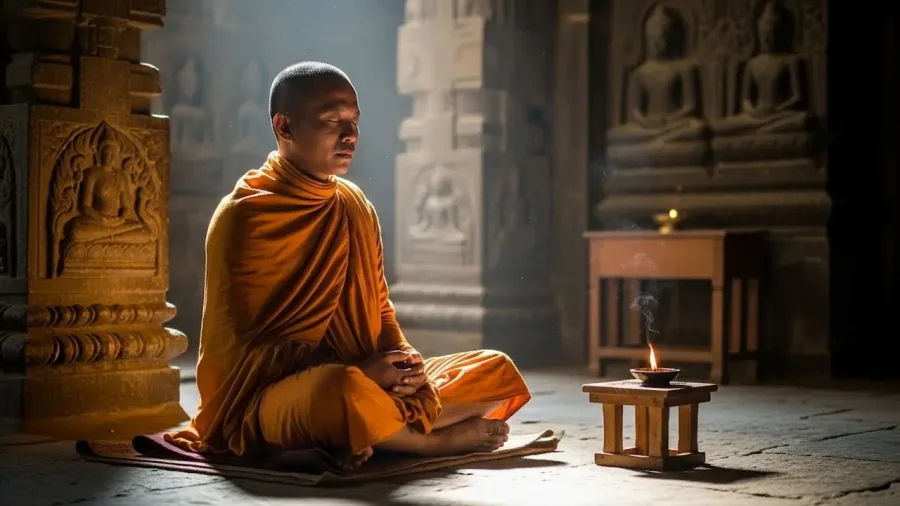
Buddhist Monk. (Image: ABPray)
The abbot, a man in his seventies with reading glasses hanging from a cord, asked me directly at breakfast: “You came here expecting enlightenment, yes? Or at least peace?” I hadn’t said anything about my expectations. He smiled and returned to his rice porridge. “Everyone does. That’s the first thing we tell you.”
This is what nobody tells you about monastic life: the spiritual ideal and the human reality live in such profound tension that understanding one requires understanding the other. The moment you glimpse how monks actually exist, not how they’re supposed to exist, you stumble into something far more interesting than any guidebook admits.
The architecture of discipline: theory meets Tuesday morning
When we talk about monastic rules, we’re usually discussing the Vinaya, the ethical framework that governs communities across Buddhist traditions. For Theravada monks in Southeast Asia, this means adhering to 227 precepts. Zen monks in Japan navigate a different framework. Tibetan monastics work within yet another structure. These aren’t minor variations. They’re fundamentally different philosophies encoded as daily behavior.
The Vinaya assumes something radical: that the mind can be trained through bodily constraint. No eating after noon. No listening to music. No handling money. No sleeping on high or soft beds. The logic is elegant, restrict the senses, starve the desires, and what remains is clarity.
What the texts don’t mention is what I observed on my second morning: a monk named Phrom, roughly sixty, struggling to stand from his meditation cushion. His knees had deteriorated over forty years of kneeling. Another monk, younger, brought him tea in a way that suggested this happened daily. The conversation was wordless and practiced. There was no enlightenment in that moment, only the quiet acknowledgment that the body has its own timeline, independent of spiritual aspiration.
Monastic discipline works beautifully in theory and collapses predictably under the weight of aging, illness, and the simple fact that humans aren’t machines.
The hyperespecific fracture, emerges when you ask: Which rules actually get broken, and in what sequence?
In Theravada communities I studied, the hierarchy of rule-breaking follows a pattern. The precepts about killing or stealing remain sacrosanct. The precepts about eating schedules? Those erode first. I watched a senior monk Pah Nanachat in Thailand receive a visitor in the afternoon, and after the visitor left, food appeared. Nobody acknowledged it. The rule about not eating after noon had a shadow life, monks who were ill, monks doing heavy physical labor, monks whose digestion required it. The rule existed as law, but its enforcement existed as a negotiation.
What shocked me was the consistency of this across traditions. A Zen monastery in Kyoto operated identically. The precepts about conduct toward the teacher? Flexible enough to accommodate human complexity. Rules aren’t monolithic. They’re a hierarchy of enforcement that mirrors, strangely, the values of the broader culture each monastery inhabits.
The daily rhythm: where the schedule meets resistance
Most accounts of monastic life present the daily schedule as a kind of poetry: 4 a.m. wake, meditation, chanting, work, meals, more meditation, sleep. It’s presented as harmonious, as though the body naturally aligns with this rhythm.
I experienced it differently.
The 4 a.m. wake, in practice, meant: some monks woke at 3:50 and sat alert on their cushions. Others stumbled in at 4:15, still half-asleep. One elderly monk in the Theravada tradition I visited had negotiated a 5 a.m. start for medical reasons. The schedule was both absolute and negotiable, depending on your age, health, and relationship to authority.
The meditation sessions, typically ninety minutes, revealed the most interesting friction. The ideal is rapt attention, the progressive dissolution of the self into awareness. The reality includes:
Monks falling asleep (I counted. It happened roughly once per fifteen monks per sitting);
Monks shifting position every eight minutes due to pain;
One young monk in Kyoto clearly daydreaming about something, his eyes had that distant quality that suggested his mind was anywhere but the present moment;
The abbot knowing all of this and saying nothing, because enforcing perfect attention would require policing consciousness itself.
Here’s what I realized by the second week: the schedule isn’t designed to eliminate struggle. It’s designed to contain it. By structuring every hour, the monastery creates a container where the mind’s resistance has nowhere to hide. You can’t distract yourself with Netflix. You can’t escape into work. You’re left alone with the mechanical, repetitive nature of your own consciousness. That’s not peaceful. That’s intense.
Different monastic traditions have radically different approaches to this tension. Zen deliberately maintains an edge, the schedule includes physical work (gardening, cleaning, repairs) that keeps monks engaged with the material world and prevents the narcissism of pure introspection. Theravada tends toward greater separation from worldly activity, which means more pure meditation but also more psychological pressure when the mind refuses to cooperate. Tibetan monasticism includes study and debate, intellectual stimulation that Western monasticism sometimes lacks, which creates a different quality of mental engagement entirely.
A Zen abbot told me: “We keep monks busy because enlightenment isn’t found in the head. A hand in soil teaches more than a mind in stillness.” A Theravada elder contradicted this entirely: “The world is the problem. Withdrawal is the medicine.” These aren’t small disagreements. They reflect fundamentally different theories about what the mind needs, and they produce monks with visibly different psychological profiles.
The economic skeleton nobody discusses
Here’s something that fundamentally changed how I understood monastic life: I asked a nun at a temple, point-blank, “How does money work here?”
She looked around, then explained that the temple received donations, some from daily visitors, some from devoted patrons, some from government support (which varies by country). This money purchased food, maintained buildings, and paid for medicine. But here’s the part that matters: monks hold a vow of poverty, but the monastery requires capital.
This creates a specific, rarely-discussed form of cognitive dissonance. A Zen temple in Japan I visited had recently undergone renovations. The head monk had quietly solicited donations from wealthy patrons. This is technically acceptable, the monk takes no money personally, but the result is that monastic communities with better fundraising infrastructure live in better conditions. A poor temple means harder living. A well-connected abbot means better food, better heating, better medicine.
What this means in practice: monastic life isn’t uniformly austere. It’s austere according to the temple’s prosperity. A young monk at a wealthy Kyoto temple told me (carefully, aware he was breaking some unspoken code) that he lived better than his secular brother in Tokyo. The food was better. The medical care was available. The living space, while sparse, was clean and maintained.
A monk at a rural Thai temple lived with concrete floors, no electricity in the sleeping quarters, and medicine that arrived months late. The vows were identical. The lived experience was almost incomparably different.
This economic disparity creates an unspoken hierarchy. Senior monks often gravitate toward wealthy temples. Young monks remain in poor temples. The most dedicated or the most trapped, stay in conditions that would shock Western practitioners. Nobody discusses this because it contradicts the narrative of equanimity and detachment.
Where the traditions contradict each other (and themselves)
This is where it gets genuinely interesting, because the different Buddhist traditions don’t actually agree on what monasticism is for, and this disagreement reveals something essential about Buddhism itself.
Theravada Buddhism, dominant in Southeast Asia, treats monasticism as a specialized path toward individual liberation. The monastic life is superior to lay life because it removes obstacles to enlightenment. The implication is clear: if you’re serious about awakening, you ordain. Lay people are doing something lesser.
Zen Buddhism, particularly as it developed in East Asia, inverted this. Enlightenment isn’t reserved for monastics. A farmer practicing zazen might be further along than a monk practicing out of habit. The monastery isn’t a refuge from the world, it’s a place to see through the illusion that the world can be escaped. This produces monks with a fundamentally different psychology. They’re less likely to see their practice as superior, more likely to see it as one path among many.
Tibetan Buddhism complicates this further by maintaining both monasticism and an intensive lay tantric practice. The monastery isn’t the only serious path. A dedicated layperson doing tantric practice might engage more intensely with the teachings than a monk. This creates a unique situation where monastics aren’t automatically at the apex of the spiritual hierarchy.
What I observed: these differences matter. A Theravada monk carries a certain psychological weight, the sense that he’s chosen the “right” path. A Zen monk carries a different weight, the sense that all paths are equally valid and equally problematic. A Tibetan monk operates within a framework where his monastic status is important but not determinative.
If the traditions disagreed about monasticism’s purpose, how could the specific rules be universally binding? How could you take vows that meant something entirely different depending on your tradition’s philosophy?
The answer, I learned, is that they don’t. They can’t. The monasticism of a Theravada forest tradition and a Zen training hall are fundamentally different projects wearing the same robes.
The unspoken hierarchies
Nothing in Buddhist philosophy explicitly teaches that some monks are more enlightened than others based on lineage, education, or social background. Yet every monastery I visited had clear, unspoken rankings that had nothing to do with spiritual attainment.
The abbot held power, not through doctrine but through control of resources, daily schedules, and interpretive authority. Senior monks had privileges (better sleeping quarters, first choice of meals, reduced work requirements) justified by their experience. Young monks did the heavy physical labor and had the least autonomy.
This mirrors secular hierarchies so perfectly that it’s almost embarrassing. The vows of equality collapse predictably under the weight of human nature. We organize ourselves into dominance hierarchies. The monastery doesn’t transcend this. It just dresses it differently.
What was striking: the monks knew this. There was no delusion about it. The hierarchy was spoken about obliquely, negotiated informally, and accepted as inevitable. The interesting part was watching how this affected practice. A young monk eager to rise in status practiced harder, meditated longer, followed rules more strictly. An older monk who’d achieved his position could afford to be more relaxed. The structure created exactly the kind of striving that Buddhist philosophy claims to overcome.
Leaving and Returning
Most accounts of monastic life present ordination as a significant commitment. What they don’t mention: many monks spend their entire lives figuring out if they should stay.
I met monks with anywhere from one month to forty years in robes. The reasons for staying varied wildly. Some spoke with genuine clarity about their practice. Others had stayed because they’d invested too much to leave, or because life outside seemed more difficult, or because they’d built a role they understood within the community.
One young monk told me, carefully, because he knew this was borderline heretical, that he stayed because he had no money, no job history, no secular education. The monastery was stable. Safer than the alternatives. He might find enlightenment. He’d definitely have dinner.
The abbot, when I asked directly about this, didn’t deny it. “Some come for the truth. Some come for the meal. Some come running from something. Some stay because they’re afraid to find out who they are without the role.” He paused. “All of these are honest reasons. I don’t separate them.”
But the structure doesn’t accommodate nuance. You’re either ordained or not. You’re either committed or failing. There’s no official space for “I’m here because I’m genuinely uncertain and the uncertainty is valuable.”
This creates a specific phenomenon: the psychological cost of maintaining the identity. A monk who stays out of pragmatism must, at some level, practice as though he’s there for enlightenment. The gap between the honest reason and the required reason creates a kind of dissociation that I watched manifest as depression, irritability, or a kind of flat compliance that looked nothing like spiritual peace.
The Moment the Ideal Breaks
On my final morning, I sat with a monk who’d been in practice for thirty-two years. He was meditating, genuinely, not performing, when I arrived. I waited. After an hour, he opened his eyes and looked at me directly.
“You want to know if it works,” he said.
I hadn’t asked anything.
“Sometimes. Not the way you hope. I’m not enlightened. I might never be. But I’m different than I would have been. Whether that difference justifies this life…” He gestured vaguely at the temple. “I still don’t know.”
He stood slowly, his knees crackling audibly. “The books say we transcend suffering. The truth is more complicated. We sit with it. We don’t become indifferent to it, we become less panicked by it. That’s closer to enlightenment than most people get, but it’s not the transcendence we advertise.”
This is the real thing happening in monasteries: not the transformation of suffering into wisdom, but the transformation of the relationship to suffering. The distinction matters completely, and it’s almost never stated clearly.
The ideal, perfect discipline, perfect detachment, perfect enlightenment, lives in the texts. The reality, negotiated rules, aging bodies, economic constraints, unresolved psychology, and the quiet determination to keep practicing anyway, lives in the halls.
Both are true. Understanding monastic life requires holding both simultaneously, without resolving the tension between them.