Published on December 5, 2025 at 4:00 PMUpdated on December 5, 2025 at 4:00 PM
I was in a small Orthodox church in Athens, watching an elderly woman touch her forehead to an icon of Mary, the Theotokos, as Orthodoxy calls her, whisper something in Greek I couldn’t hear, and leave a candle burning. A few pews back, a Protestant woman watched with visible discomfort. During coffee hour afterward, she asked me directly: “Is she praying to Mary? Because that’s idolatry.”
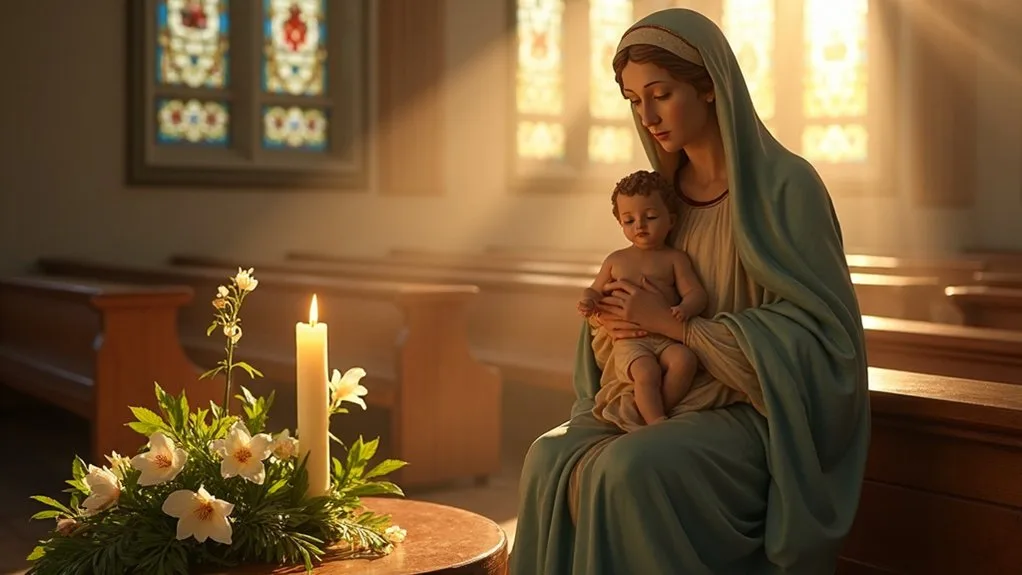
Belief in Mary. (Image: ABPRay)
The Orthodox woman, when I asked her about it later, looked confused by the question. “I’m not praying to Mary. I’m asking Mary to pray with me. There’s a difference.”
The Protestant insisted there wasn’t. “If you’re asking her to intercede, you’re treating her as divine. You’re attributing power to her that only God has.”
The Orthodox woman said: “We attribute no power to Mary except what she has by virtue of being the Mother of God. We venerate her, not as we adore God, but as we honor any saint, asking for their intercession, their spiritual companionship.”
In that exchange, I encountered something that scholarly work on Mariology often misses: the disagreement isn’t fundamentally about doctrine. It’s about a semantic collapse, a failure to distinguish between three radically different attitudes toward Mary (and toward saints generally) that Christian traditions treat as distinct but which most people conflate into a single category: “belief in Mary” or “prayer to Mary.”
I spent the next two years examining this question across Catholic, Orthodox, and Protestant traditions. I attended Marian devotions in a Spanish cathedral. I participated in Orthodox liturgy where Mary was venerated. I attended Protestant churches where Mary was barely mentioned. I interviewed theologians, priests, monks, and ordinary practitioners. And what emerged was far more complex and far more revealing than simple doctrinal disagreement.
The real issue isn’t whether Christians believe in Mary. It’s that “believe in” means completely different things depending on which Christian tradition you’re in, and the semantic confusion between veneration, intercessory prayer, and adoration has created a pseudo-disagreement that masks deeper theological fractures about the nature of holiness, divine feminine energy, and the relationship between Christ and the church.
The semantic disaster: three categories collapsed into one
Let me start with the semantic problem itself, because it’s where everything goes wrong.
When a Protestant hears “Catholics venerate Mary,” the Protestant translates this as “Catholics worship Mary.” When the Catholic clarifies “We don’t worship Mary; we venerate her,” the Protestant hears “You give her a lesser form of worship,” which sounds to the Protestant like splitting hairs on the way to idolatry.
What’s actually happening is a category error. Veneeration, intercessory prayer, and adoration are three completely different theological acts, and they’re being conflated because we lack precise English language to distinguish them.
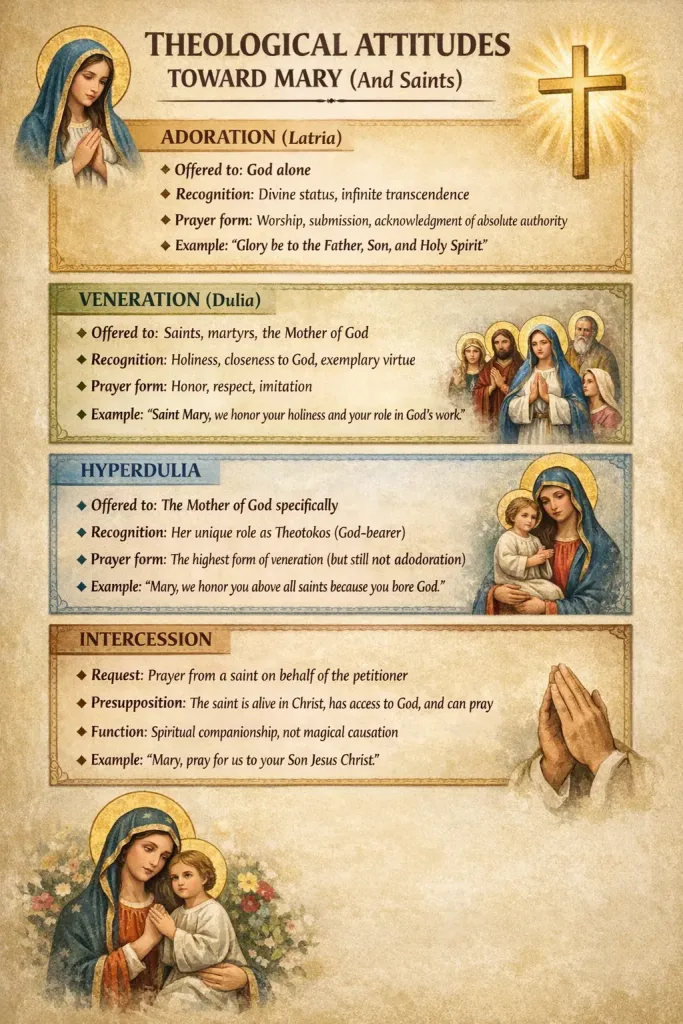
Adoration (latria in Latin theology) is the worship offered to God alone. It acknowledges absolute dependence, infinite transcendence, and supreme authority. When you adore God, you’re making a claim about God’s metaphysical status, that God is the ultimate reality, the source of all being, worthy of absolute submission and praise.
Veneration (dulia in Latin theology) is the honor given to creatures, saints, martyrs, the Mother of God, in recognition of their holiness and their closeness to God. It’s not worship. It’s not claiming any divine status for the person being venerated. It’s recognizing their sanctity and their role in God’s purposes.
Intercessory prayer is the act of asking a saint, whether living or deceased, to pray on your behalf, to present your needs to God. It presupposes that the saint has spiritual power and access to God’s presence and that the saint’s prayer has efficacy.
Now here’s the problem: in English, all three of these can be described with the same word: “worship,” “prayer,” or “belief.” So when a Catholic says “We pray to Mary,” a Protestant hears “worship,” when what the Catholic means is “ask for intercession.” When an Orthodox practitioner says “We venerate Mary,” a Protestant might hear “we give her a form of worship,” when what’s meant is “we honor her with a specific kind of reverence that’s categorically different from adoration.”
I sat with a Catholic theologian who tried to clarify this to a Protestant minister. She drew a diagram:
Theological attitudes towards Mary and saints. (Image: ABPray)
The Protestant minister looked at this and said: “But this distinction, between veneration and adoration, it’s artificial. You’re praying to Mary. You’re asking her for something. How is that not treating her as divine?”
The theologian said: “Because the request is not for Mary to do something divine. It’s for Mary to pray for you. You’re not claiming Mary has divine power. You’re claiming Mary has intercessory power, the power to pray on your behalf, which any living Christian has. We’re simply extending that to the communion of saints.”
The minister: “But Mary is dead. How can she pray? Doesn’t prayer require consciousness? Doesn’t it require the person to be aware you’re asking?”
And here the conversation moved from semantics to metaphysics. Because the disagreement isn’t really about whether prayer to Mary is appropriate. It’s about whether the dead are alive in Christ in a way that permits them to be aware of and responsive to prayer.
The historical contingency: how did Mary become so central?
To understand the real disagreement, we need to understand how different Christian traditions ended up with different attitudes toward Mary, and the answer is historical, not theological.
In the earliest centuries of Christianity, Mary received minimal attention. Paul mentions her once, in passing. The Gospels mention her, but often in ways that suggest distance or misunderstanding. Mark’s Gospel portrays Jesus’s family (including Mary) as not understanding his mission. John’s Gospel portrays Mary passively present but rarely active. Luke and Matthew give Mary more prominence through the infancy narratives.
But there’s nothing in the New Testament suggesting prayer to Mary or veneration of Mary. Mary is honored as the mother of Jesus, but she’s not depicted as an object of religious devotion.
This changed dramatically in the 4th and 5th centuries, for reasons that had as much to do with culture and psychology as with theology.
In the Mediterranean world of late antiquity, mother goddesses were central to religious practice. Every major religion in the Roman world, Egyptian, Greek, Syrian, had a powerful divine mother figure. There were sanctuaries dedicated to Isis as the eternal mother. There were cults of Demeter, Hera, Venus. The archetype of the divine mother was embedded in the religious psychology of the culture.
Christianity, when it arrived in this world, offered something radically different: a masculine God, a divine son, but no divine mother. There was the church as the bride of Christ, but no female divinity, no mother-goddess to correspond to the cultural expectation.
Now, I’m not claiming and historians mostly don’t claim, that the veneration of Mary is simply the veneration of pagan mother goddesses repackaged. That’s too simplistic. But I am claiming that the timing and the form of Mary’s elevation to prominence correspond suggestively to a cultural need for divine feminine symbolism.
The Council of Ephesus in 431 CE declared Mary the “Theotokos”, the God-bearer, or, in later translation, the “Mother of God.” This was not primarily a decision about Mary. It was a christological decision. The council was trying to protect the doctrine that Jesus is fully God, that God Himself was born of Mary, not just that God the Word united with Jesus at some point. By calling Mary the Theotokos, the council was defending the doctrine of the incarnation.
But the practical effect was to elevate Mary dramatically in the church’s consciousness. If Mary is the Mother of God, then Mary is not just an ordinary human. Mary is someone who gave birth to divinity. Mary stands in a unique relationship to the divine.
From this point forward, Mary’s significance grew. By the medieval period, Mary had become central to Western Christian devotion. There were pilgrimage sites dedicated to Mary. There were prayers to Mary. There were images of Mary. Christian sources. They developed over centuries through theological reflection, church tradition, and ecclesiastical decision.
The christological connection: why Mary matters to Jesus
Here’s something crucial that gets missed in the Protestant-Catholic debate about Mary: the veneration of Mary is not fundamentally about Mary. It’s fundamentally about Christ.
The different Christian traditions’ approaches to Mary correlate directly with different understandings of Christ’s nature and significance.
If Christ is God become human, if the incarnation means that divinity was literally born of Mary, then Mary’s status is derivative but real. She is the mother of God. That’s not ordinary motherhood. That’s a unique role in salvation history.
If Christ is God’s son but not God Himself, if Christ is a divine being but not the second person of the Trinity, then Mary is the mother of a divine being, but not the mother of God in the fullest sense. Her status is different.
If Christ’s divinity is something he possessed from eternity and merely assumed human nature, if the incarnation is God entering a human body rather than being born into humanity, then Mary’s role is important but less central. She’s the womb through which God entered the world, but she’s not the source of Christ’s humanity in the full theological sense.
These christological differences produce different Mariologies:
Catholic Christology and Mariology
The Catholic tradition affirms that Jesus is fully God and fully human, that the Word (the second person of the Trinity) assumed human nature from Mary. This means:
Mary is truly the Theotokos, the Mother of God
Mary’s role in the incarnation is not merely physical but theological, she participates in God’s work of salvation by providing the flesh through which God enters the world
Mary’s dignity reflects her unique role in salvation history
Mary can be venerated (not adored, but venerated) because of her extraordinary closeness to Christ and her participation in the work of redemption
The Catholic tradition developed a specific theology: Mary’s faith, her obedience, her “fiat” (“let it be unto me according to thy word”) represents the archetypal human response to God. Where Eve disobeyed and brought sin into the world, Mary obeyed and brought salvation into the world. Mary becomes the new Eve, the reversal of fallen humanity’s rejection of God.
This theology has a certain logic: if the incarnation is God entering into human history through a woman, and if that woman represents the reversal of original sin, then that woman (Mary) takes on a significance that extends beyond her individual role.
Orthodox Christology and Mariology
Orthodox theology shares with Catholicism the affirmation that Jesus is fully God and fully human, born of Mary. The Theotokos title is affirmed with even more emphasis in Orthodox tradition.
But Orthodox Mariology diverges from Catholic Mariology in significant ways. While Catholicism developed the doctrine of the Immaculate Conception (Mary was conceived without original sin), Orthodoxy rejected this. Orthodox theology affirms that Mary was fully human, subject to human limitations, not exempt from human nature through special protection.
This produces a different understanding of Mary’s significance. For Orthodoxy, Mary’s holiness is not due to metaphysical exemption from human condition (immaculate conception) but to her full response to grace despite her full participation in human nature. Mary becomes the icon of what human nature can become through grace, not because she was specially protected, but because she responded perfectly to God’s grace while being fully human.
The Orthodox venerate Mary with “hyperdulia”, the highest form of veneration, but the veneration points not to Mary’s unique metaphysical status but to Mary’s perfect realization of human potential. Mary is the example, the icon, the living proof that humans can respond to God perfectly.
Protestant Christology and Mariology
Protestant theology, while affirming that Jesus is God, often understands the incarnation differently. For many Protestants, Christ’s divine nature is so emphasized that his human nature becomes almost secondary. The focus is on God becoming human for our salvation, not on the process of birth and embodiment.
This produces a specific approach to Mary: she is honored as the mother of Jesus, but her significance is limited. Mary is important historically, she gave birth to Jesus, but she’s not important theologically or devotionally. She doesn’t participate in salvation; she’s the channel through which salvation enters the world.
Early Protestantism even developed a specific criticism: that Catholic and Orthodox veneration of Mary diminishes Christ. “If you’re asking Mary to intercede,” the Protestant argument goes, “you’re implicitly suggesting that Christ is not directly accessible, that you need a mediator. But Christ is our only mediator. Asking Mary to intercede is unnecessary and potentially idolatrous.”
This criticism makes sense from within a specific theological framework, one that emphasizes Christ’s unique mediatorial role and the believer’s direct access to Christ. But it’s a criticism of a theological structure, not of the basic fact of Mary’s historical importance.
The semantic collapse in practice: where the disagreement becomes visible
Let me ground all of this in actual conversations, because that’s where the semantic confusion becomes visible.
I attended a Marian procession in a Spanish cathedral. The image of Mary was carried through the streets. People knelt as it passed. People sang to Mary. People asked Mary for help with their problems. After the procession, I spoke with several participants.
A woman in her sixties said: “I asked Mary to help my grandson. He was very sick. I prayed to Mary, and he recovered. Mary helped him.”
I asked: “Do you believe Mary healed your grandson directly? Or do you believe Mary prayed for him and God healed him through Mary’s intercession?”
She paused, clearly considering the question seriously. “I don’t know exactly. But I know that Mary helped. Whether it’s Mary doing something directly or praying for him, I don’t make that distinction.”
A priest I spoke with was more precise: “What the woman experienced is important. The veneration of Mary creates a channel for grace, but grace ultimately comes from God. Mary intercedes. She prays with us. But God is the source of healing. The woman’s faith in Mary’s intercession is faith in God’s willingness to hear through Mary’s mediation.”
Now, a Protestant hearing this would say: “There it is, you’re asking someone to intercede for you other than Christ. You’re suggesting God won’t hear your prayer directly, only through Mary’s mediation. That’s the problem.”
The Catholic would respond: “We’re not saying God won’t hear your prayer directly. We’re saying God has woven the communion of saints into His plan. Just as you ask living Christians to pray for you, you can ask the saints, including Mary, to pray for you. It’s asking for intercessory prayer, not claiming Mary has independent divine power.”
And the core misunderstanding is this: the Protestant is translating “Mary prays for you” as “Mary does something for you other than prayer” or “You need Mary because you can’t access God directly.” But the Catholic is saying something simpler: “Mary, like all the saints, is alive in Christ and can pray for you, just as living Christians do.”
The psychological dimension: the mother archetype and why it matters
Here’s where it gets deeper, into psychology and anthropology rather than pure theology.
Every human culture has a mother archetype. Carl Jung identified this as one of the fundamental structures of the unconscious, the mother as source, nurturance, wisdom, protection, return to wholeness. In religious symbolism across cultures, the mother goddess represents fertility, compassion, the receptive principle that receives and contains.
Christianity, in its doctrinal core, is thoroughly patriarchal, God is Father, Christ is Son, the Holy Spirit is masculine in pronoun. There’s a masculine line of authority and power. There’s a striking absence of feminine divinity.
But humans have psychological and spiritual needs that this masculine axis doesn’t fully meet. There’s a need for the receptive principle, for compassion, for the mother-figure that receives and contains suffering. There’s a spiritual hunger for divine feminine energy.
The veneration of Mary, I would argue, is partly a response to this psychological and spiritual need. Not consciously, not as a theology-to-theology decision. But functionally, Mary has become the place where the feminine is reintroduced into Christian devotion.
In Catholic and Orthodox piety, Mary is addressed in language of tenderness and intimacy that Christ-language often lacks. Mary is the one who understands suffering (she stood at the foot of the cross). Mary is the one who protects children (she’s the mother). Mary is the one who intercedes with compassion. Mary is the receptive principle, she receives God’s Word and bears it into the world.
When the woman at the Spanish procession asked Mary for help for her grandson, she was doing more than asking for intercessory prayer. She was expressing a need to relate to the divine through the mother-figure. She was accessing a spiritual archetypal energy that pure Trinitarian theology doesn’t provide.
I spoke with a Catholic theologian about this: “There’s something real happening in the veneration of Mary that transcends doctrine. Women especially, but not only women, need to relate to the divine through the feminine. Catholicism and Orthodoxy provide that through Mary. Protestantism doesn’t, and that’s a genuine loss.”
I asked: “Isn’t the solution to make God-language more inclusive? To speak of God as mother as well as father?”
She said: “That’s one solution, and I think it’s important. But it’s different from Mary. Mary is not God. Mary is human. Mary is the human who perfectly received God. That’s different from saying God is mother. Mary represents what it means to be fully human and fully responsive to God, specifically through the feminine principle.”
Here’s the deeper issue: Protestantism solved the Mary problem by eliminating Mary from devotional life. But this eliminated not just particular doctrines about Mary, it eliminated access to the mother-archetype in Christian piety. The result is a form of Christianity that’s deeply paternal, deeply oriented toward authority and law, and which can feel distant and cold to those seeking maternal comfort and compassionate intimacy.
Catholicism and Orthodoxy kept Mary, and through Mary they maintained access to the feminine principle. But they did this through doctrinal development that no longer explicitly rooted in Scripture, which creates the Protestant objection.
And beneath this disagreement is a real psychological and spiritual question: does Christianity need the mother? Should the feminine principle be reintegrated into Christian theology and practice? Or is Trinitarian theology sufficient without external feminine symbolism?
The patriarchal history: why this matters to understanding the disagreement
The veneration of Mary is intimately connected to the history of patriarchal Christianity and what that history did to women.
In early Christianity, women had remarkable roles. Women were prophets (Philip’s daughters in Acts). Women were deacons (Phoebe in Romans). Women hosted churches in their homes (Priscilla, Lydia). Paul wrote surprisingly progressive language about gender equality: “There is neither male nor female… in Christ Jesus.”
But over centuries, Christianity increasingly sidelined women from official roles. By the medieval period, women had been almost entirely excluded from priesthood, from theological education, from public religious authority. The church was governed by men. The sacraments were administered by men. The hierarchy was all male.
In this context, the veneration of Mary served a specific function: it elevated one woman, Mary, to a position of ultimate honor and significance. Mary became the exception that proved the rule. She was the supreme woman, placed on a pedestal, honored above all other humans. But she was also thoroughly passive in late medieval theology, she was mother, but not agent. She was venerated, but not in positions of authority.
Some feminist scholars have argued that the veneration of Mary was, in effect, a compensation for the exclusion of women from power. Women couldn’t be priests or bishops, but they could venerate the Mother of God. Women couldn’t teach the faith officially, but they could pray to Mary and seek Mary’s intercession. Mary became the repository of feminine spiritual power in a church that had excluded living women from authority.
A Catholic feminist theologian I spoke with put it this way: “Mary is both liberation and limitation for Catholic women. On the one hand, Mary’s veneration suggests that women have ultimate value and dignity, Mary is honored above all humans. On the other hand, Mary is presented as virgin and mother, the two traditional roles for women. Mary is not presented as a teacher, a prophet, an authority figure. Mary is presented as receptive and nurturing. So Mary becomes a model that honors women while confining them.”
This creates an interesting complexity: the veneration of Mary might be partly explained by patriarchal Christianity’s need to incorporate feminine power while maintaining male hierarchy. Mary is the ultimate woman, which means women can honor her and through her honor themselves. But Mary is also thoroughly secondary, secondary to Christ, secondary to God the Father, secondary to the male hierarchy of the church.
Protestantism, by eliminating Mary, eliminated this symbolic compromise. But it also eliminated one of the few resources available to Christian women for expressing feminine spiritual power. Protestant women have to relate to the Godhead that’s entirely masculine, without the mediation of the mother-figure that Catholicism and Orthodoxy provide.
The semantic error and why it persists
The fundamental semantic error is this: when a Protestant hears “Catholics pray to Mary,” the Protestant translates this into “Catholics worship Mary.” But the Catholic is saying something categorically different.
Let me demonstrate this with actual language:
What a Catholic actually means: “I ask Mary to join me in prayer to God. I request her intercession. Mary, who is alive in Christ, can present my needs to God. I honor Mary’s holiness and her unique role as the Mother of God.”
What a Protestant hears: “I pray to Mary as though she were divine. I give her worship. I treat her as though she has independent power to help me. I am committing idolatry by directing worship to someone other than God.”
These are not the same claim. But they sound similar in English because English lacks precise vocabulary for the distinctions the Catholic theology is trying to draw.
I watched a conversation between a Catholic and a Protestant where this breakdown occurred:
Protestant: “You pray to Mary?”
Catholic: “We venerate Mary and ask for her intercession.”
Protestant: “So you pray to Mary.”
Catholic: “We pray with Mary. We ask Mary to pray for us.”
Protestant: “That’s praying to Mary.”
Catholic: “No, praying to someone means addressing them as the ultimate focus of your prayer. We address our prayers to God. We ask Mary to join us.”
Protestant: “If you’re asking her to do something, you’re praying to her.”
And at this point, the conversation breaks down because the Protestant is using “pray to” to mean “direct religious attention toward” and the Catholic is using “pray to” to mean “address as ultimate religious authority.”
The theological structures are:
Catholic Structure: Prayer → God (ultimate destination) ↙ ↖ Believer ← Mary (intercessor/companion)
The believer prays to God. Mary is asked to pray with the believer. Mary’s prayer is directed to God. The whole structure is directed toward God.
Protestant Structure: Prayer → God (only mediator)
The believer prays directly to God. Any prayer directed toward anyone other than God is inappropriate because it suggests that person has power or authority that belongs to God alone.
These are genuinely different theological structures. But they’re being debated in English as though they were debating the same thing using different words.
Where Mary gets her authority: the christological root
All of this, the veneration, the intercession, the special place Mary holds in Catholic and Orthodox theology, ultimately rests on a specific claim about Christ.
The claim is: Jesus is God. Not “God’s son” in the sense of “offspring” or “agent,” but God Himself, the second person of the Trinity, eternally divine, taking on human nature.
If that’s true, then Jesus was literally born of a human woman. That woman is not an ordinary mother. She is the mother of God.
From that single fact, everything else flows. If Mary is the mother of God, then Mary’s role in salvation history is unique. If Mary cooperated in bearing God into the world, then Mary participated in the work of redemption. If Mary is truly the mother of God, then Mary deserves honor that goes beyond what other humans receive.
The Catholic and Orthodox traditions extended this logic further: if Mary bore God, if she participated in salvation, if she now lives in the communion of saints in God’s presence, then Mary can be addressed in prayer. Her prayers have power because she is close to God. Her intercession is sought because she stands in a unique relationship to Christ.
But all of this depends on the initial claim: that Christ is God, not merely God’s chosen representative or God’s anointed one, but God Himself in human form.
A Protestant who accepts that Christ is God might still object to the veneration of Mary because the Protestant makes a different inference: “If Christ is God, and Christ is my mediator and my redeemer, then I don’t need anyone else to intercede for me. I have direct access to Christ, who is God. Why would I ask anyone else to pray for me when I can address God directly?”
The Catholic and Orthodox response is: “You’re right that you have direct access to Christ. But the communion of saints, the fact that all believers, living and dead, are united in Christ, means you’re not praying alone. You’re praying in community. Asking Mary to pray with you is not replacing Christ. It’s extending your prayer through the community of faith.”
These are genuinely different theologies of how the church functions spiritually and how believers relate to Christ.
The unresolved question: do the dead pray?
At the bottom of the debate about Mary is a metaphysical question that separates the traditions fundamentally: Do the dead remain conscious and responsive in God’s presence?
Catholics and Orthodox believe the answer is yes. The dead are alive in Christ. They continue to exist consciously. They are part of the communion of saints. They can hear prayers addressed to them (because they’re present in God’s consciousness, which is omniscient). They can pray for the living.
This is metaphysically controversial. How can the dead hear prayers if they’re not materially present? How can they pray if they don’t have bodies? How can they be conscious without brains?
Catholic and Orthodox theology has answers to these questions rooted in the doctrine of the soul, the immortality of the soul, and the understanding that consciousness doesn’t require material embodiment. The soul is the principle of life and consciousness, and it continues after bodily death.
Protestantism tends toward skepticism about these claims. If the Bible doesn’t explicitly teach that the dead can hear prayers, Protestantism resists the doctrine. Some Protestants believe in the immortality of the soul but understand the intermediate state (the period between death and resurrection) as a kind of sleep, the dead are not conscious until the resurrection.
This metaphysical disagreement about the state of the dead explains a lot about the Marian disagreement. If the dead can’t hear you, then asking Mary to pray for you is like speaking into a void. If the dead are conscious and present in God, then asking Mary to pray for you is a reasonable spiritual practice.
I spoke with a Protestant theologian about this: “The fundamental issue isn’t really about Mary. It’s about whether we have biblical warrant for believing the dead are conscious and can intercede. The Bible doesn’t tell us this. It’s possible. It’s consistent with Christian faith. But we don’t have clear scriptural teaching on it. So we prefer not to build doctrine on it.”
A Catholic theologian responded: “The Bible doesn’t explicitly teach many things, the Trinity, the hypostatic union, the nature of the soul. But we develop doctrine beyond Scripture based on reason and tradition. The veneration of the saints and the intercession of the saints are consistent with Scripture, even if not explicitly commanded by Scripture.”
And here again, we’re back to the fundamental disagreement about authority: How much doctrine can be developed beyond explicit Scripture? How much can be built on tradition and theological reasoning?
What I’ve come to understand
After eighteen months of engagement with these traditions, attending their worship, reading their theology, speaking with practitioners, I’ve come to something like a synthesis.
First: there is a genuine semantic problem at the root of the disagreement. “Prayer to Mary” means something completely different to a Catholic than to a Protestant, and this language confusion obscures the real theological issues.
Second: the real theological disagreements are profound and not easily resolved:
Whether revelation is closed (Scripture and tradition) or ongoing (further revelation possible)
Whether the dead remain conscious and responsive
Whether believers need intercessors other than Christ
Whether theological authority can extend beyond explicit Scripture through tradition and reason
Third: the veneration of Mary is connected to something important, the presence of the feminine in religious practice and the need for mother-archetype access in spiritual life. Protestantism solved the Mary problem by eliminating Mary, but this eliminated also the spiritual access to feminine divine principle that Mary represents.
Fourth: the different Christian traditions’ approaches to Mary are not interchangeable or theologically neutral. They represent different metaphysics, different epistemologies, and different answers to how the church should function spiritually. You can’t be Catholic and Protestant on the question of Mary in the way you might hope, they’re making different foundational claims.
What remains is a lived tension: Mary is revered in Catholic and Orthodox Christianity precisely because Christ’s incarnation makes her role unique and significant. But that significance can only be affirmed if you accept the metaphysical and epistemological structures that justify it. And those structures, the closed revelation plus tradition, the conscious communion of saints, the extended role of intercessors, are exactly what Protestantism questions.