Published on January 12, 2026 at 7:28 PMUpdated on January 12, 2026 at 7:28 PM
When you search for the “meaning” of suffering, you often find what you need to find. Faith offers a narrative that transforms randomness into purpose, chaos into divine instruction. But it is also potentially dangerous. The question is not whether faith helps—sometimes it does. The question is: When does meaning-making serve genuine adaptation, and when does it obscure the need for material action? When does hope sustain necessary struggle, and when does it rationalize passivity?
Part I: the neurological and psychological mechanisms
How the brain processes meaning during threat
When humans encounter overwhelming loss or trauma, the amygdala becomes hyperactive. The prefrontal cortex, responsible for rational planning, becomes temporarily less active. The body floods with cortisol. This is adaptive for immediate survival. But if threat persists—chronic illness, structural poverty, ongoing discrimination—this neurological state becomes pathological.
This is where narrative enters. When you construct a meaningful narrative around suffering—”This is God’s test,” “This will make me stronger”—you engage the prefrontal cortex and reduce amygdala activity. This neural engagement can lower cortisol. Meaning-making is neurologically real.
But here is the critical point: this neurological benefit is independent of whether the narrative is true. Your brain cannot distinguish between a true narrative and a comforting one. A Holocaust survivor finding meaning in survival experiences the same neurological benefit as someone who misinterprets a miscarriage as “God’s plan.” The neural effect is identical. The real-world consequences are not.
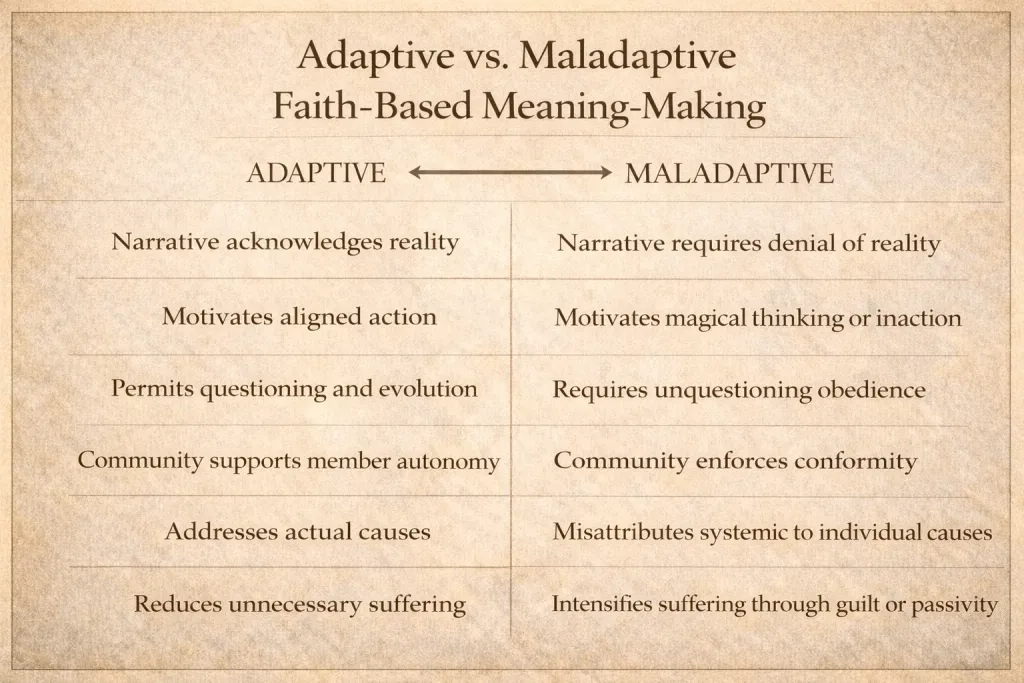
Adaptive vs. maladaptive meaning-making
Adaptive meaning-making has these characteristics:
It does not require denial of reality.
It motivates action aligned with actual circumstances.
It maintains capacity for future adjustment.
It does not suppress legitimate anger.
It connects individual experience to broader structural patterns rather than personalizing systemic failure.
Consider a cancer patient who develops the narrative “I will pursue aggressive treatment; I will build my life around recovery.” This is grounded in reality and motivates behavior aligned with survival.
Now consider someone in structural poverty told “God helps those who help themselves; your poverty reflects insufficient faith; if you pray and work hard, you will prosper.” This attributes systemic failure (inadequate wages, housing costs, discrimination) to individual spiritual deficiency. The person exhausts themselves through individual effort while the system generating poverty remains untouched. Their legitimate anger at injustice is reinterpreted as insufficient faith. They blame themselves for conditions they cannot individually change.
How religious narratives restructure traumatic experience
Religious traditions offer sophisticated frameworks for restructuring trauma. Theodicies (justifying divine goodness despite suffering) can reduce existential terror in the short term. But they often carry long-term costs. A parent losing a child told “God needed another angel” may find temporary solace. But the narrative suggests the death served a purpose. This can prevent genuine grief.
More problematically, theodicies enable abuse. A child in an abusive household told “Suffering brings you closer to Christ” has their fear reframed as spiritual opportunity. Resistance becomes sin.
When you lose your job through economic restructuring or discrimination, faith narratives reframe this as divine redirection. The neurological comfort is real. But it obscures the actual dynamics—economic forces or discrimination—and prevents recognition that you might need to document discrimination or join collective action.
Part II: The Hidden Costs of Faith-Based Resilience
The culpability trap
If suffering happens for a reason, the sufferer implicitly bears some responsibility. This operates through several mechanisms:
Retrospective guilt: A survivor of a car accident that kills another person faces an unbearable question: Why did God spare me? The meaning-making framework suggests they did something to merit survival the other person lacked. The survivor develops crushing guilt—not because they caused the accident, but because the framework suggests they did.
Insufficient faith diagnosis: A person with chronic illness is told by their faith community that faith heals. When medical treatment fails, the community suggests insufficient faith. The patient faces a double bind: their body is failing, and simultaneously, they are told their failure to heal reflects spiritual inadequacy.
Reinterpretation of legitimate anger: When someone faces injustice—discrimination, exploitation—they experience appropriate anger. This anger is information. It signals that a boundary has been crossed.
But many faith frameworks pathologize anger. You are told to “forgive,” to “let go of bitterness.” The anger is reframed as spiritual failure. A worker experiencing justified anger at unfair wages is told anger reflects lack of faith in God’s provision. The anger—which could motivate collective organizing—is redirected toward spiritual self-improvement.
Inaction and deferral
One serious cost is that faith-based meaning-making can prevent necessary material action.
A person experiencing homelessness is told to “have faith that God will provide.” Instead of accessing housing assistance, navigating social services, or joining advocacy, the person waits for divine intervention. The neurological benefit (reduced anxiety) is real. The material consequence—remaining homeless—is catastrophic.
A person in an abusive relationship is told to “trust God’s plan” and remain in marriage. Instead of accessing abuse shelters or consulting lawyers, the person prays. The neurological benefit may be real. The material consequence—continued exposure to violence—is grave.
The mechanism involves magical thinking: the assumption that internal states (beliefs, prayers, positive thoughts) can directly affect external circumstances without intervening action.
The exploitation vector
Faith-based meaning-making creates vulnerability to exploitation. Religious institutions positioning themselves as sole interpreters of meaning become gatekeepers of hope.
The prosperity gospel teaches that financial success reflects spiritual favor and donations to the church activate divine provision. A person in financial distress donates money they cannot afford to lose. The pastor becomes wealthier; the donor becomes poorer.
Or religious institutions teach that questioning the community’s teachings reflects insufficient faith, that leaving the community is spiritual death. The institution creates total ideological dependence.
In each case, faith functions as a tool extracting resources, obedience, or silence from vulnerable people.
Isolation and conformity
Faith communities can provide genuine support. But they can also enforce conformity that isolates vulnerable members.
LGBTQ+ individuals in conservative religious communities face a double bind. The community offers belonging, but only on condition of sexual or gender conformity. Coming out risks expulsion and isolation.
Women in patriarchal religious communities face similar dynamics. Women experiencing domestic violence are counseled to remain in marriage, to improve their submission. Those who leave risk ostracism.
Individuals experiencing crises of faith face communities structured to prevent apostasy. Doubt is treated as spiritual attack; questions as faithlessness. The person faces a choice: suppress intellectual and spiritual development, or lose their entire social support system.
Part III: The Genealogy of “Resilience”—Neoliberal Weaponization
From Engineering to Psychology
“Resilience” originated in materials science and engineering, referring to the capacity of a material to absorb energy and return to original state. In the 1970s-80s, developmental psychologists used it metaphorically to describe children who developed normally despite severe adversity.
But beginning in the 1990s, “resilience” shifted from description to prescription. Instead of asking “Why do some children develop well despite adversity?” (pointing toward structural factors: mentorship, economic stability, functional institutions), the question became “How can we teach resilience to all children?” (pointing toward individual psychology: mindset, emotional regulation, grit).
This shift reframed a phenomenon dependent on structural factors as a property of individuals. Resilience became something you could develop through correct thinking and emotional management.
How neoliberalism weaponized resilience?
Beginning in the 1980s, neoliberal ideology sought to reduce state provision of social services. Schools, healthcare, housing—these increasingly became framed as individual responsibilities. The state withdrew investment. Individuals were told to become “resilient.”
Every social failure could now be reframed as individual failure of resilience. You are unemployed? You lack resilience. You are sick and cannot afford treatment? You lack resilience. You are a student in an underfunded school struggling with trauma? You lack resilience.
The discourse of resilience allowed policy-makers to abandon structural responsibility while blaming individuals for suffering caused by structural abandonment. A teacher in a school with insufficient resources and oversized classes is told to develop resilience. The failure is attributed to the teacher’s individual psychology rather than to funding decisions.
A nurse working mandatory overtime in a hospital facing chronic staffing shortages experiences burnout. Rather than increasing staffing and reducing hours, the hospital offers “resilience training.” The message is clear: the problem is not the structure that produces burnout, but your failure to psychologically adapt to unbearable conditions.
The neurobiological reality that resilience discourse ignores
Neurobiological research reveals what resilience discourse obscures: the neurological capacity for resilience depends on conditions external to the individual’s mind.
When a person is chronically exposed to stress without adequate rest or resources, their nervous system becomes dysregulated. Repeated activation of threat-response systems produces pathological changes: reduced prefrontal cortex volume, reduced hippocampal volume, hyperactive amygdala. These are not failures of individual psychology. They are neurobiological consequences of chronic stress.
A person in chronic poverty experiences sustained stress. Their nervous system becomes dysregulated. They develop difficulty concentrating, sleep disturbances, impaired memory. This is not psychological failure. This is a rational neurobiological response to genuine ongoing threat. Telling them to develop “resilience” through mindfulness is neurobiologically incoherent.
Part IV: class, access, and distribution
Who can afford resilience?
The contemporary resilience industry has produced a vast market: meditation apps, yoga studios, wellness retreats, therapy, coaching, self-help books. Access is stratified by class.
A person with significant disposable income can afford a therapist ($100-200/session), meditation app ($100+/year), yoga membership ($100-200/month), wellness retreats ($2,000-10,000). Combined, this might cost $5,000-15,000 per year. For a wealthy person, this is marginal. For a person with median income, this is prohibitive.
A person in poverty cannot access these resources. They lack reliable internet, devices, or time. A person working multiple jobs has limited time for meditation. A person without stable housing cannot maintain a practice.
The populations most needing resilience resources (those facing chronic stress from poverty, discrimination, exploitation) have the least access. Resilience becomes a marker of class. A wealthy person practicing yoga is told they are developing superior psychology. A poor person, unable to access resources, is deemed to lack resilience.
But the neurobiological reality is different. The wealthy person’s nervous system has recovered because they have structural security. The poor person’s remains dysregulated because they face genuine ongoing threat. The difference is structure, not psychology.
Part V: comparative frameworks
Acceptance vs. resistance
Different religious traditions offer fundamentally different frameworks for understanding suffering.
Buddhist frameworks emphasize acceptance. Suffering (dukkha) is inherent to conditioned existence. The path involves releasing attachment to the demand that suffering be other than it is. This framework produces equanimity and capacity to endure adversity without being overwhelmed.
Abrahamic prophetic traditions emphasize resistance. God has revealed justice; the world falls short; the faithful are called to bring the world into alignment with divine justice. This framework produces mobilization for change.
These frameworks generate different responses to identical circumstances.
A person facing systematic discrimination could adopt a Buddhist framework: release attachment to the demand for recognition, focus on internal development. This produces psychological stability but may prevent change.
The same person could adopt a prophetic framework: refuse to accept discrimination as inevitable, work collectively to transform unjust systems. This may produce sustained psychological tension but mobilizes action that could change circumstances.
Neither framework is universally superior. The acceptance framework becomes problematic when applied to unjust conditions that could be changed. The resistance framework becomes problematic when applied to unchangeable circumstances.
Part VI: what actually helps during crisis
The problem: conflating neurological resilience with structural change
This is the deepest problem: contemporary discourse conflates the neurological capacity to endure adversity with the structural capacity to change it.
Resilience (the neurological capacity to function despite stress) is real and valuable. But these benefits do not address structural problems. A person can develop extraordinary neurological resilience and still remain trapped in structural poverty. A person can practice mindfulness while working in an exploitative job.
The danger is that emphasis on developing resilience obscures the need for structural change. It suggests that with sufficient psychological work, you can thrive in unbearable conditions. This is sometimes briefly possible. It is not sustainable or just.
What real support looks like?
Research on disaster response reveals: what determines whether people survive crisis is not individual psychology but collective organization and resource distribution.
During Hurricane Katrina, wealthier people evacuated safely. People without cars, money, or information remained and drowned. Their failure to survive was not a failure of resilience but a failure of institutions to distribute resources equitably.
What actually helps during crisis is:
Accurate information: Reliable data about what is happening and what options exist.
Material resources: Food, shelter, medical care, financial stability. No amount of psychological development substitutes for material provision.
Collective organization: Collective action can change circumstances in ways individual effort cannot.
Institutional accountability: Institutions that caused crisis need to be held accountable. Resilience discourse often prevents this by suggesting the problem is individual psychology rather than institutional failure.
Systemic change: Some crises result from systemic injustice. They require structural transformation, not individual resilience.
The burnout of care workers
Healthcare workers, teachers, social workers face a particular problem. They encounter human suffering constantly. They are told that developing resilience will prevent burnout.
A nurse works in a hospital with insufficient staffing, forcing mandatory overtime. She is told burnout reflects inadequate resilience. She practices yoga and meditates. The burnout continues because the problem is not her psychology. It is understaffing.
When these workers eventually leave their positions, they are blamed for lacking resilience. The institutional failure to provide adequate resources, support, and compensation is obscured. The worker’s departure is attributed to individual weakness.
Conclusion: integration, not abandonment
Faith can genuinely help during crisis. It can also genuinely harm. The difference is not about the quantity of faith but about the specific forms faith takes and the structural circumstances in which it operates.
What actually sustains people through crisis is not individual resilience developed in isolation, and not faith in abstraction, but participation in communities engaged in genuine collective struggle—communities that maintain both psychological hope and material realism, that develop psychological resources while also demanding structural change.
This cannot be reduced to individual practices or institutional belief. It requires constant navigation between psychological reality and structural reality, between hope and honesty, between acceptance of what cannot change and fierce resistance to what can. The deepest ethical requirement is not to have faith, but to develop capacity to diagnose which is which.