Published on January 22, 2026 at 3:43 PMUpdated on January 22, 2026 at 3:43 PM
The question seems simple until you ask it to a Thai monk, a secular mindfulness teacher in Brooklyn, and a Tibetan scholar all in the same afternoon. None of them will agree. And this disagreement isn’t a problem of language or mistranslation, it’s the living scar of 2,500 years of Buddhism trying to fit into categories it fundamentally refuses.
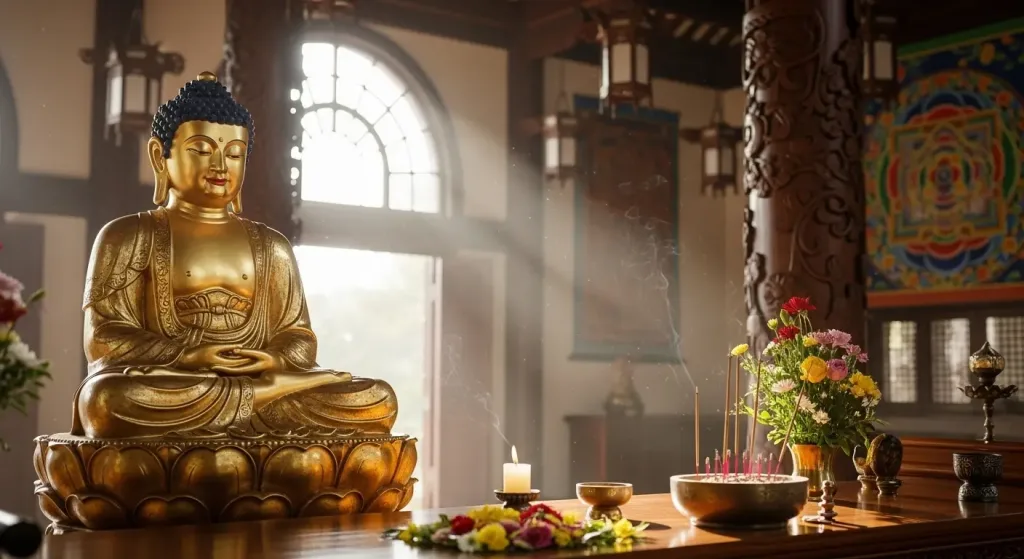
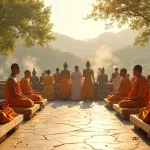
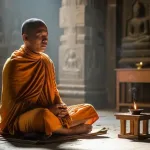
Buddhism religion or philosophy. (Image: ABPray)
This text will not answer “religion or philosophy?” with a clean resolution. Instead, it explores why this indefinition is the structural foundation of how Buddhism survived while monolithic traditions disappeared. More importantly, it reveals the practical, theological, and neuropsychological dilemmas that emerge when you try to live within this ambiguity.
The uncomfortable inheritance: how a tradition refuses its own category
First, a fact that introductory texts rarely touch: Buddhism was born as an explicit rejection of orthodox Hindu religion. Siddhartha Gautama (563–483 BCE, according to UNESCO records from Lumbini) did not introduce a new god. He did something more radically disturbing: he dismantled the very necessity of divinity as a condition for spiritual liberation.
Here lies the real discomfort: when Buddhism spread from India, through Emperor Ashoka’s missionary networks in the 3rd century BCE, to Southeast Asia, East Asia, and eventually Tibet, each region reconfigured it. Not through cultural incompetence. Through structural necessity. The pure philosophy that Siddhartha taught, that suffering emerges from attachment, and liberation is achievable through individual effort, had no answer for longings every human community possesses: How do you honor the dead? How do you mark life transitions? What is the cosmological significance of your existence?
Theravada (“Way of the Elders”), dominant in Sri Lanka and Southeast Asia, responded: “You don’t need cosmological answers. Practice meditation, follow ethical precepts, treat religious metaphors as tools, not truths.”
Mahayana (“Great Vehicle”), which flourished in China, Japan, and Korea, answered differently: “There are many Buddhas across time and space. Bodhisattvas (enlightened beings) can intercede for you. Ritual veneration carries transformative power.”
Vajrayana, centered in Tibet, went further: “The universe is energetic manifestation. Your tantric rituals aren’t metaphors, they’re precise operations on reality itself.”
Three answers. One source. None is “wrong.” This is what no introductory text adequately invites you to understand: Buddhism didn’t “diversify” into different schools because practitioners misunderstood the original message. It diversified because that message was too powerful to fit into a single cultural form.
The invisible tension in the field: when philosophy meets religious ritualism
Imagine you’re a Western student who discovered Buddhism through books about the Eightfold Path and impermanence. You start meditating. Six months later, you attend a Zen temple. On your first day, you see people bowing to a Buddha statue. Offering incense. Praying.
Your first instinct: “But Buddha taught against idolatry. He said he’s not a god, just a man who became enlightened.”
You’re right. And completely wrong.
The Buddha statue isn’t for Buddha. It’s for the potentiality within you that contemplating Buddha can awaken. The incense isn’t an offering to a deity that will consume it. It’s an act that aligns your body, mind, and intention in one direction. The bow isn’t submission. It’s remembrance: I too can awaken.
But, and here lies the nuance separating 3rd from 4th layer, this works only if you believe it works. And it doesn’t work if you intellectually understand it “shouldn’t.”
This creates one of three crises that contemporary Buddhism faces, rarely documented:
Crisis 1: the paradox of secularized ritual
When mindfulness jumped from Buddhist temples into clinical psychology offices, successive researchers discovered something counterintuitive. Mindfulness meditation practice works better when you don’t know it’s Buddhist. More precisely, when you believe it’s purely secular.
Why? Because the psychoneurological structure of meditation involves dissolution of ego-narrative. When you add a cultural or religious marker (“I’m a Buddhist practitioner”), you unconsciously reconstruct exactly what should dissolve: the notion of a consistent, identified “self.”
This isn’t failure. It’s feature. Traditional Theravada practitioners always knew this. That’s why they structure retreats so specifically: remove you from contexts that reaffirm identity and symbols. The Theravada monk and the secular psychologist are actually performing the same operation, one calls it “liberation from attachment,” the other “reduction of cognitive rumination.”
The research is stark. Studies on mindfulness-based stress reduction (MBSR) show measurable improvements in cortisol levels, heart rate variability, and emotional regulation, yet practitioners report these benefits despite not knowing they’re participating in Buddhist practice. The moment you introduce religious framing, something shifts. Not necessarily negatively, but differently. The neurobiological target changes. Instead of non-self dissolution, the brain begins reinforcing devotional neural pathways (increased activity in regions associated with meaning-making and social bonding).
Neither outcome is superior. But they’re fundamentally different operations wearing the same name.
Crisis 2: the clash between orthopedic cosmologies
Theravada Buddhism and Mahayana Buddhism literally disagree about how many Buddhas exist in the universe.
Mahayana: Infinite. Accessible now. You can invoke Amitabha Buddha and he hears you.
This isn’t difference in theological “emphasis.” It’s ontological difference. Reality functions differently in each cosmology.
When a Theravada practitioner and a Mahayana practitioner enter debate, common in academic circles and mixed Buddhist communities, they’re not disagreeing about interpretation of the same dogma. They’re operating in different realities.
The traditional Buddhist answer to this contradiction? “Both are true for those who practice them.”
This is philosophically intelligent (non-dualism, perspectival relativism). It’s religiously and pastorally complicated. It’s neurobiologically real, because your cosmology shapes the neural states you induce through meditation. If you visualize an infinite compassionate Buddha during meditation, you’re creating a specific neurobiological reality. If you visualize nothing and observe breath, you create a different one.
What Western practitioners rarely grasp is that this isn’t philosophical flexibility. It’s existential necessity. In traditional Buddhist societies, your cosmological context was inherited, you were born into Theravada or Mahayana, not choosing. The framework chose you. This inheritance allowed practitioners to operate within contradictions without constant cognitive dissonance. But a modern Westerner, choosing both frameworks sequentially, experiences genuine neurological conflict.
The historical convergence: how Ashoka created the pattern of contradiction that persists
There’s a specific moment when Buddhism crossed from “regional philosophical movement” to “global religious tradition capable of perpetual reinvention.”
Emperor Ashoka (304–232 BCE), who governed the Mauryan Empire at its zenith, did something extraordinary: he converted to Buddhism after a particularly violent military campaign (the conquest of Kalinga, killing an estimated 100,000 people). The conversion wasn’t intellectual. It was neuropsychological, remorse, trauma, redemption-seeking.
Ashoka then did what no religious leader had done before at scale: he sent missionaries to propagate Buddhism while simultaneously retaining secular and religious power in state hands.
Here, Buddhism encountered its first major structural contradiction: How do you promote a tradition based on non-violence (Ahimsa) through a state maintaining an army? How do you teach non-attachment through religious structures accumulating power and wealth?
Ashoka solved this, according to historical texts and his stone edicts, not through ideological coherence, but through multiple accommodation. He didn’t eliminate the army. He redefined it under Buddhist precepts. He didn’t remove religious power. He distributed it among different schools.
The result: Buddhism became “adaptable.” The quality enabling survival, the ability to function simultaneously as religion, philosophy, ethics, and mental technology, was born from a warrior-emperor’s pragmatic decision.
This adaptability explains why, 2,500 years later, Buddhism functions as secular meditation (mindfulness-based stress reduction in hospitals), complete religion with cosmology (Tibetan Vajrayana), ethical code (Buddhist-influenced activism), all simultaneously.
But, and here lies the nuance explaining why Buddhism often fails in modern contexts, this adaptability has a structural limit: it requires you not expect coherence.
The ritual-philosophy split: where diaspora Buddhism breaks
A phenomenon worth examining is what happens when Buddhism enters diaspora, communities geographically severed from traditional infrastructure.
In Japan, a Buddhist practitioner attends temple regularly. The rhythm is embedded in calendar, neighborhood, family expectation. When practicing Mahayana’s devotional elements, you’re surrounded by others doing the same. The shared reality-construction is constant.
In Western cities, a Buddhist practitioner sits alone in an apartment, using a meditation app, with zero inherited cultural context. When they encounter ritual practices, they’re often documented through academic texts or YouTube videos, mediated, decontextualized, intellectualized.
This isn’t marginal. This is the lived experience of 90% of Western Buddhists. And it creates a specific pathology: the simultaneous adoption of philosophical Buddhism (non-self, interdependence, emptiness) alongside religious practice (bowing, chanting, visualization) without the cultural syntax that traditionally held both together.
The result? Practitioners report cognitive dissonance. They meditate on non-self, then bow to a Bodhisattva they consciously don’t believe in. They intellectually reject cosmic realms, but visualize them in tantric practice. They preach compassion while competing with other practitioners for the “most authentic” interpretation.
This isn’t individual neurosis. It’s systemic to Buddhism without its original infrastructure.
Where this collapses: the urban Western scenario
Here’s where theory meets concrete reality:
A Theravada practitioner can maintain consistent practice because the structure is simple, meditation, ethical precepts, monastic community as reference. The aim is clear: personal enlightenment through individual effort.
A Mahayana practitioner can maintain practice because it offers multiple entry points, you can be devotional (focused on veneration) or philosophical (focused on intellectual understanding) or both.
A Vajrayana practitioner can maintain practice because it’s technically engaging enough to occupy the mind completely, you’re literally practicing sophisticated mental programming.
But what about the urban Westerner who discovered Buddhism through a book, practices mindfulness on a smartphone app, occasionally reads non-duality posts on Instagram, and once visited a temple?
He has fragments. No coherent structure. No community holding contradictions together. No cultural context making certain practices “natural” rather than “strange.”
This isn’t his failure. It’s structural collapse of importing Buddhism into contexts lacking the “infrastructure” enabling ambiguity tolerance.
The three schools: where the dilemma explodes
To truly understand “religion vs. philosophy?” you must differentiate not only between schools but how each manages this tension.
Theravada: The “Neither One Nor the Other” Approach
Theravada (literally “doctrine of the elders”) claims to be Buddhism’s purest form, closest to what Siddhartha actually taught. This claim is, empirically, defensible. Theravada texts comprise the Pali Canon, Buddhism’s oldest scriptural collection, first recorded on palm leaves in the 1st century BCE in Sri Lanka.
Structurally, Theravada does this: it eliminates all cosmology you cannot directly experience.
There are no infinite Buddhas you can’t see. There’s Siddhartha Gautama, who became enlightened. There’s possibility that you can too. Everything else, deities, cosmic realms, ritual power, is useful metaphor or mistaken explanation.
This approach is radically philosophical. Theravada ritual is functional: you bow to a Buddha statue to cultivate humility, not because the statue possesses power. You chant because sound structures the mind, not because invisible beings hear you.
Yet, here’s the complication, Theravada still involves faith. You must believe meditation works before practicing long enough for neurobiological change to become perceptible. You must trust the teacher. You must accept certain ethical precepts carry value without them carrying “proof.”
That’s non-religious faith. But still faith.
Mahayana: The “Yes, Both Things” Approach
Mahayana enters explicitly religious territory. Yes, there are Buddhas you can invoke. Yes, rituals carry direct power. Yes, celestial realms exist where you can be reborn. Yes, Bodhisattvas, enlightened beings who delayed their own Nirvana to help others, can intercede.
Unlike Western assumptions, this isn’t “corrupt deviation” from pure Buddhism. It’s philosophical re-articulation of propositions in the Theravada canon itself: If the universe is non-dual, there’s truly no separation between you and a Buddha. If you can affect reality through intention, invocation ritual has logical basis. If attachment to a “separate self” is illusion, so is illusion of “isolated self in an indifferent reality.”
Mahayana practically responds to “religion vs. philosophy?” with: “What difference does it make? If both practices yield the same result, liberation from suffering, the category becomes irrelevant.”
This is religious pragmatism. And philosophically defensible: philosophy is merely a useful map if it functions. If it functions as religion, utility becomes the criterion, not category.
Vajrayana: The Technical Approach
Vajrayana (the Tibetan and Mongolian branch) takes yet another position. Yes, reality is non-dual, as Theravada says. Yes, cosmic entities exist to work with, as Mahayana says. Beyond this: These beings and this void are operationalizable through precise practices.
There’s no debate about “believing in” Mahakala (a Tibetan protective deity). You work with Mahakala through visualization, mantra, and ritual movement. The question isn’t faith. It’s competence. Can you maintain a complex mental image for 20 minutes while reciting mantras in a dead language? Can you induce the specific neurobiological states the tradition mapped?
Vajrayana transforms “religion vs. philosophy?” into a question of mental engineering. It’s the most pragmatic approach, and most technically demanding.
The non-resolved recognition: how Buddhism really answers
Buddhism, as a tradition, doesn’t answer “religion or philosophy?” It responds: “What is the question you’re really asking?”
If the question is “How do I reduce suffering?” Buddhism offers practical tools, meditation, ethics, causal understanding.
If the question is “What is existence’s ultimate meaning?” Buddhism offers sophisticated cosmological speculation, non-dualism, rebirth, liberation.
If the question is “How do I connect with something larger than myself?” Buddhism offers religious ritual, veneration, invocation, prostration.
If the question is “How do I recognize my usual sense of ‘self’ is illusory?” Buddhism offers phenomenological investigation, investigative meditation, logical analysis, direct experience.
The “or” in “religion or philosophy?” is categorical error. It assumes these are mutually exclusive. Buddhism is neither one nor the other, it’s a structure containing both without collapse.
This answer frustrates because it refuses clarity. But it’s the honest one: The indefinition is the feature, not a bug.
The practical cost: what remains when you choose only one
What happens when contemporary Buddhists try to resolve the ambiguity by choosing only one pole, religion or philosophy?
Pure Philosophers (rejecting religious elements entirely) gain intellectual coherence but lose something critical: the embodied, community-based transformation that ritual provides. They meditate brilliantly but often remain isolated. They understand emptiness intellectually but rarely feel it in their bones. Their practice becomes hygiene, useful, but not liberating.
Pure Religionists (rejecting philosophical critique entirely) gain belonging and cosmic meaning but lose discernment. They’re vulnerable to charlatans, prone to fundamentalism, and often repeat patterns of institutional abuse. They avoid the destabilizing confrontation with their own assumptions.
The traditional answer, holding both simultaneously, requires something contemporary culture rarely trains: cognitive flexibility under ambiguity without collapsing into either/or thinking.
This is why Buddhism paradoxically becomes more difficult to practice as it becomes more accessible. Accessibility removes the infrastructure (monastic communities, geographic isolation, cultural inheritance) that historically held these contradictions in place.
Conclusion: the open space nobody wants to inhabit
If you’ve read this far expecting clear answers, I’ll disappoint you. The answer is this: indefinition is the defining characteristic.
Buddhism survived 2,500 years not because it achieved consistency across cultures. It survived because it achieved radical inconsistency while remaining functional. Cosmology changes. Rituals change. Even texts are interpreted differently. But the central structure, that suffering exists, has causes, can be transcended, that direct investigation of experience is the path, that remains.
Devoted religionists practice alongside secular investigators. Technical Vajrayana practitioners coexist with Theravada practitioners rejecting almost all religiosity. Modernists seeing Buddhism as self-help coexist with traditionalists seeing it as path to cosmic liberation.
None is completely wrong. None is completely right.
And that’s the answer: Buddhism is religion because it’s philosophy. It’s philosophy because it accepts faith. It’s practice because it theorizes. It lives in the space where categories dissolve. Which is precisely the space Buddhism invites you to inhabit.
If that sounds uncomfortable, you’re beginning to understand.
The question “Is Buddhism a religion or philosophy?” is ultimately not about Buddhism. It’s about you, about whether you can sit in a contradiction without rushing to resolve it, whether you can hold two incompatible truths simultaneously and let them teach you something neither could alone.
That capacity, uncomfortable as it is, might be the closest thing Buddhism offers to an actual answer.