Saint Patrick’s Day is often perceived as one of the most accessible cultural celebrations in the world. It appears lighthearted, colorful, and deliberately uncomplicated. Green clothing, parades, shamrocks, music, and alcohol dominate the imagery. Participation requires no explanation, no commitment, and no prior knowledge. For many, it is simply a festive day loosely associated with Ireland.
Saint Patrick’s Day beyond the green
Yet this apparent simplicity is deceptive.
Behind Saint Patrick’s Day lies a dense historical process in which Christian religion, national identity, colonial pressure, forced migration, and political symbolism gradually fused into a single global ritual. What looks like a harmless cultural festival is, in reality, the surface expression of centuries of religious transformation, ethnic survival, and strategic identity performance.
Saint Patrick’s Day did not become global because it was fun. It became global because it solved a problem: how a displaced people could remain visible, unified, and meaningful in foreign societies.
To understand Saint Patrick’s Day properly is not to ask how people celebrate it today, but why this specific religious feast survived, expanded, and transformed when countless others did not.
The historical Patrick bears little resemblance to the symbolic figure invoked today. He was not Irish by birth, nor did he set out to become a national icon. He was born in Roman Britain in the late fourth century, into a Christian family living at the edge of the collapsing Roman world.
As a teenager, Patrick was captured by Irish raiders and taken to Ireland as a slave. For years, he lived in isolation, working as a shepherd. His own writings describe this period not as heroic, but as spiritually formative. It was in captivity that his Christian faith intensified.
After escaping slavery and returning to Britain, Patrick made a decision that defines his historical significance: he chose to return to Ireland voluntarily as a missionary.
This choice matters because it reframes his role. Patrick was not a conqueror, nor an imperial agent. He was a religious actor driven by theological conviction. His mission was not cultural erasure but spiritual conversion, carried out through persuasion, adaptation, and long-term presence.
Historical evidence: Patrick’s primary sources and strategic integration patterns
What we know about Patrick comes from extraordinarily limited sources, and paradoxically, this is precisely what makes his history more credible. Unlike religious figures who accumulated elaborate hagiographies centuries after their deaths, Patrick left us two documents written in his own hand: a Letter to the Christian British and a Confessio (Confession).
These texts, preserved in manuscripts from the seventh century, offer crucial clues about patterns of Christian community establishment in Ireland. Patrick describes the conversion of “filliae et filii” (daughters and sons) of Irish leaders, suggesting a deliberately engineered strategy for penetrating existing power structures. This was not mass conversion; it was social surgery.
Historian Máirín Ní Dhonnchadha of University College Dublin (2000) demonstrated through onomastic analysis that the names of Patrick’s converts frequently correspond to aristocratic lineages documented in later Irish genealogical texts. This confirms that Christianization did not erase existing hierarchies—it integrated them. The evidence suggests that Patrick was simultaneously a religious missionary and a political negotiator, though he himself may not have fully grasped this duality.
This strategic integration explains a critical historical fact: Irish Christianity developed distinct characteristics not because it was imposed, but because it was negotiated. Patrick’s approach created conditions for adaptive synthesis rather than cultural replacement.
The Christianization of Ireland: a unique case in Europe
Ireland’s Christianization followed a path unlike most of Europe. The island had never been conquered by Rome, meaning Christianity arrived without imperial enforcement. There were no Roman legions, no state-mandated conversions, no centralized authority imposing belief.
Instead, Christianity spread through networks of monasteries, kinship structures, and local leaders.
Patrick and subsequent missionaries adapted Christian teaching to an oral, symbolic, and clan-based society. Rather than destroying Celtic culture, Christianity layered itself onto it. Local customs were reframed, not erased. Sacred spaces were reinterpreted. Storytelling traditions were preserved and repurposed.
This adaptive process explains why Irish Christianity developed a distinct character. Monasticism flourished. Literacy expanded. Ireland became a center of Christian learning at a time when much of Europe was fragmenting.
Over time, Christianity became inseparable from Irish cultural identity, not as an imposed system, but as a chosen framework of meaning.
Saint Patrick, in retrospect, came to symbolize this transformation.
When religion becomes indentity
For centuries, being Irish did not automatically mean being Catholic. However, that equation hardened dramatically after the English Reformation.
As England adopted Protestantism, Ireland remained overwhelmingly Catholic. Religion ceased to be merely theological; it became a marker of political loyalty, cultural resistance, and ethnic distinction.
Catholicism in Ireland was increasingly associated with dispossession, exclusion, and legal discrimination. Penal Laws restricted land ownership, education, and political participation for Catholics. Faith became intertwined with suffering.
In this context, Saint Patrick’s image changed. He was no longer just the missionary who brought Christianity; he became a symbol of pre-colonial Irish Christianity, implicitly opposed to English Protestant dominance.
Saint Patrick’s Day thus accumulated nationalist meaning long before modern nationalism existed.
Saint Patrick’s day as a religious feast
Originally, Saint Patrick’s Day was not festive in the modern sense. It was a liturgical feast day observed through church attendance, prayer, and restrained communal gatherings. In Ireland, it was a solemn occasion.
Until the twentieth century, pubs were often closed on Saint Patrick’s Day in Ireland.
This fact alone disrupts contemporary assumptions.
The idea of Saint Patrick’s Day as a public spectacle emerged outside Ireland, shaped not by theology, but by displacement.
The Irish diaspora and the reinvention
The mass Irish emigrations of the eighteenth and nineteenth centuries reshaped Saint Patrick’s Day more than any event within Ireland itself. Famine, land dispossession, and economic collapse forced millions to leave.
In places like the United States, Irish immigrants faced hostility, poverty, and exclusion. They were viewed as culturally inferior, religiously suspect, and politically dangerous.
Saint Patrick’s Day became a strategic response.
Public celebrations allowed Irish communities to assert visibility. Parades created collective presence. Catholic parishes organized social life. Symbols became tools of cohesion.
Importantly, these celebrations were not nostalgic recreations of Irish village life. They were new inventions, designed for urban, immigrant contexts.
Saint Patrick’s Day became a ritual of survival.
Why the parade matters more than the prayer?
The emergence of parades marks a turning point. Parades are not religious acts; they are political performances. They occupy public space. They demand recognition. They communicate strength through numbers.
For Irish immigrants, marching together on Saint Patrick’s Day served several functions simultaneously:
It reinforced internal solidarity. It signaled permanence to host societies. It reframed Irish identity as organized and respectable. It converted marginality into visibility.
Religion remained present, but it was no longer central. Catholic symbols coexisted with flags, music, and ethnic imagery.
Saint Patrick’s Day became a hybrid ritual, blending sacred origin with secular strategy.
The feedback loop: diaspora to homeland
Ironically, the global image of Saint Patrick’s Day was shaped abroad and later imported back into Ireland.
As Irish-American celebrations grew in scale and visibility, they began influencing how Ireland itself presented the holiday. Tourism, media, and eventually the Irish state adopted the diaspora version as a model.
This created a cultural feedback loop: Ireland exported people → diaspora reinvented tradition → Ireland reimported the spectacle.
Modern Saint Patrick’s Day in Dublin owes more to New York than to medieval Ireland.
Symbol compression: green, shamrocks, and simplification
As Saint Patrick’s Day globalized, its symbols became increasingly compressed.
Green shifted from political resistance to aesthetic branding. The shamrock moved from theological metaphor to decorative logo. Leprechauns, largely absent from religious tradition, entered mainstream imagery.
This compression made the holiday portable.
Symbols no longer required explanation. Meaning became optional. Participation became frictionless.
Yet something was lost in the process: historical depth.
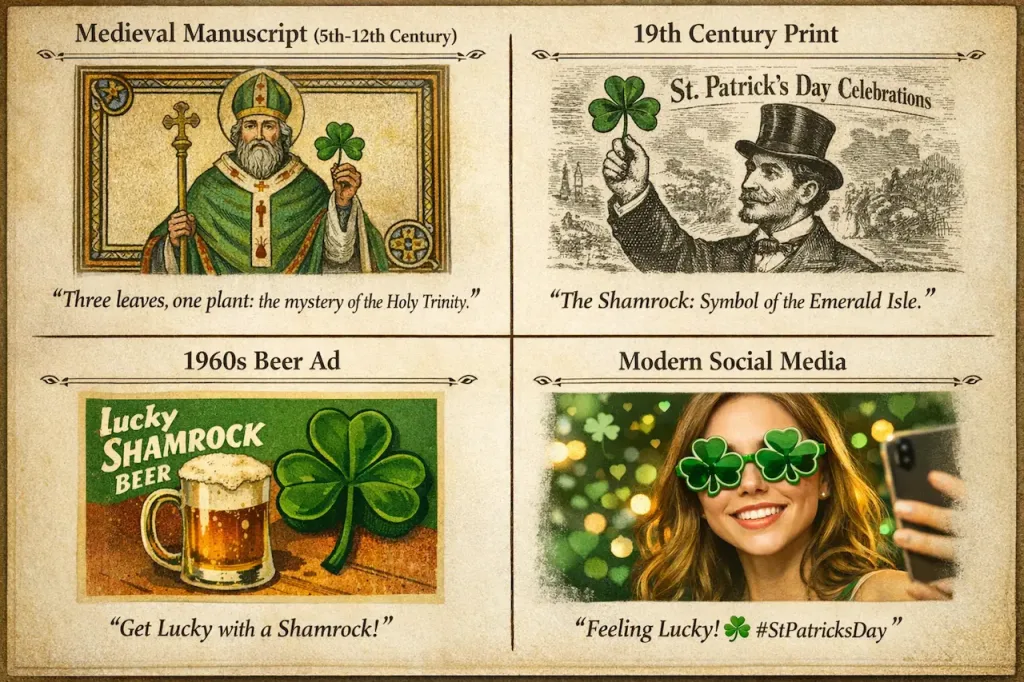
Visual analysis: the evolution of iconography across 1,500 years
The symbol simplification of Saint Patrick’s Day was not accidental; it was competent cultural engineering. Three primary icons reveal this deliberate transformation:
The shamrock: from theological metaphor to disposable logo
Phase 1 (5th-12th Century): Theological Symbol Patrick reportedly used the three-leafed clover (shamrock, from Irish “seamróg”) to explain the Trinity to pagan Irish. The plant embodied a concept: “three leaves, one plant.” The meaning was spiritual integrity through multiplicity—a direct theological apparatus.
Phase 2 (17th-18th Century): Symbol of Resistance During the Penal Laws, wearing shamrock in public was an act of political defiance. Children were taught to sew shamrocks into clothing under layers—the symbol carried risk, and therefore power. By the 18th century, shamrock had transformed into an underground marker of identity.
Phase 3 (19th-20th Century): Visual Branding Shamrock appeared on beer labels (Guinness, from 1862 onwards). It became decoration on diaspora postcards and greeting cards. The original theological meaning was effectively forgotten; the visual identity was memorized instead.
Phase 4 (21st Century): Empty Symbol Shamrock now appears in Instagram filters, divorced from any knowledge. It serves purely as a recognition icon—the visual pattern codes “Saint Patrick’s Day.” Function is purely aesthetic.
The transition from theology → politics → marketing → aesthetic void occurred in roughly 1,500 years. Each phase destroyed the previous meaning system.
Shamrock’s symbol evolution (image: Abpray)
The color green: from political claim to corporate brand
The history of green in Saint Patrick’s Day is even more revealing because it occurred in merely 100-150 years.
Until the 18th century, Saint Patrick was actually associated with blue in Irish tradition. The official coat of arms featured a light blue pattern (later called “Saint Patrick’s Blue”).
During the Penal Laws period (1600-1750), green became a color of resistance. Rebellions used green. The color acquired political meaning—not religious, but explicitly nationalist. It was a visual assertion of what the crown forbade: Irish identity.
In the diaspora era (1800-1900), Irish immigrants adopted green as a symbol of loyalty to their distant homeland. Parades wore green. Irish-American military uniforms used green.
In the branding era (1900-present), corporations discovered that green = Saint Patrick’s Day. Tech startups use green on March 17. Beer companies dye beer green. Entire cities illuminate buildings in green.
The crucial detail: green now means nothing. It is pure visual identifier. A corporation can use green on Saint Patrick’s Day with zero connection to Ireland, resistance, or religion.
This is extreme symbolic efficiency. It is also cultural evisceration.
Comparative analysis: why Saint Patrick’s day succeeds where other diasporic festivals fail?
To truly understand Saint Patrick’s Day’s resilience, we must compare it with other religious minority celebrations that did not globalize with equal success.
Consider three parallel cases:
Case 1: Festa de São João (portuguese diaspora)
São João is celebrated by Portuguese communities across five continents, with nearly identical structure to Saint Patrick’s Day (bonfires, music, symbolic elements). Yet it remains fundamentally localized within lusophone communities. The paradox: nearly identical format, vastly different outcomes.
Reason: Missing a meaning-conversion mechanism. São João remained “too Portuguese.” Saint Patrick’s Day became “universal enough.”
Case 2: Diwali (Indian diaspora)
Diwali experienced rapid global expansion in recent years (last 15 years), gaining presence in municipal chambers, shopping centers, and official calendars. Yet this expansion remains slower and still orbits Indian communities.
Reason: It requires prior knowledge. Entry barriers exist. The “low-friction entry point” does not exist. Diwali requires understanding of Ramayana narratives, ritual practices, and cosmological frameworks before participation feels authentic.
Case 3: Días de muertos (Mexican diaspora)
This is the closest parallel to Saint Patrick’s Day. Día de Muertos experienced accelerated internationalization following UNESCO recognition (2003) and especially after global media representation (Coco film, 2017). The similarities are notable: both combine religious elements, striking visuals, and narratives of memory and loss.
But critical differences emerge:
Aspect
Saint Patrick’s Day
Día de Muertos
Entry Barrier
None (wear green, celebrate)
Substantial (philosophical concept of death, specific rituals)
Symbol Appropriation Ease
Extreme (simplified symbols)
Moderate (requires cultural respect)
Globalization Timeline
~250 years (1760-2010)
~20 years (2003-2023)
Non-diaspora Community Presence
Ubiquitous
Growing but concentrated
Saint Patrick’s Day’s secret: Combine absolute absence of intellectual barriers with symbols of extreme malleability (green = anything) and you achieve viral diffusion. It did not succeed because it was better. It succeeded because it was easier to deculturalize.
Framework for global success: the structural analysis
Three key factors explain why Saint Patrick’s Day achieves what other diasporic celebrations cannot:
Paradox: Can be celebrated by atheists without contradiction
Día de Muertos:
Origin: Syncretism of Aztec worldview + Catholicism
Compatibility: Connected to specific beliefs about death and ancestrality
Paradox: Attempts at secularization face resistance from cultural guardians
Result: Saint Patrick’s Day can be “drained” into any context. Día de Muertos resists extraction.
Factor 3: geographic anchoring vs. symbolic mobility
Saint Patrick’s Day:
Place of origin: One specific island
Mobility: Extreme—functions anywhere (requires no climate, no specific landscape)
Plasticity: Green works in Mumbai or Melbourne without contradiction
Diwali:
Place of origin: Indian subcontinent (multiple religions, but specific context)
Mobility: Moderate—celebration “works” better in communities replicating environmental elements
Plasticity: Oil lamps make sense in interior climates; less so in tropical climates
Result: Saint Patrick’s Day is globally legible. Diwali remains geographically anchored.
Global participation data: quantifying dispersion
Moving from purely theoretical analysis to empirical foundation, consider these metrics:
U.S. Participation:
2023: 37% of American population celebrates Saint Patrick’s Day in some form (Ipsos polling)
From a country with ~10% Irish ancestry population, celebration extends to ~300% more participants than ethnic base would justify
Spending: $2.7 billion on alcoholic beverages on March 17, 2023 (Nielsen, 2024)
Global Penetration:
Saint Patrick’s Day is observed with public celebrations in 60+ countries
Green dominates urban environments in cities without significant Irish population presence (Tokyo, Dubai, São Paulo)
Social media: ~2 billion hashtags #StPatrickDay in 2023 (platform data analysis)
Comparative Dispersion:
Día de Muertos: ~15 countries with organized public celebrations (2023)
Diwali: ~20 countries with official municipal recognition (2023)
Saint Patrick’s Day: ~60 countries, with continuous expansion
This disparity reveals a critical point: Saint Patrick’s Day did not globalize through mass immigration (like Día de Muertos), nor through demographic growth (like Diwali). It globalized through voluntary cultural absorption—a unique mechanism.
Secularization without disappearance
Saint Patrick’s Day did not secularize by rejecting religion outright. It secularized by absorbing religious meaning into cultural form.
Saint Patrick remains a saint by name, but not by function. The day no longer requires belief. It requires recognition.
This makes Saint Patrick’s Day resilient in ways few celebrations achieve. It operates simultaneously as:
A religious feast (within churches) A national holiday (within Ireland) A cultural festival (globally) A political signal (in diaspora contexts)
Few celebrations maintain this flexibility.
Political utility outside Ireland
Outside Ireland, Saint Patrick’s Day functions as political currency.
Politicians attend parades to signal ethnic solidarity. Cities adopt green lighting to display multicultural alignment. Institutions use the holiday to perform inclusivity without addressing historical complexity.
In some contexts, Saint Patrick’s Day has even been appropriated into narratives unrelated to Irish history, serving broader ideological agendas.
This appropriation is possible precisely because the holiday’s origins have been systematically simplified.
Why so many cultures participate?
Saint Patrick’s Day succeeds globally because it offers low-risk identity participation.
One does not need to be Irish, Catholic, or knowledgeable. The holiday invites temporary belonging. It allows people to perform identity without obligation.
For societies shaped by migration, this is powerful.
Saint Patrick’s Day becomes less about Ireland and more about the universal experience of diaspora: memory, adaptation, and symbolic survival.
The core paradox
Here lies the central paradox:
Saint Patrick’s Day is deeply historical, yet widely celebrated without historical awareness.
It is religious, yet functions secularly. It is nationalist, yet globally inclusive. It emerged from suffering, yet presents itself as carefree joy.
This paradox is not accidental. It is the product of layered transformations across centuries.
Theoretical implications: what Saint Patrick’s day reveals about cultural survival in an era of global fluidity
Saint Patrick’s Day’s success is not historically coincidental. It is a case study of how minority cultures perpetuate themselves in threatening contexts.
The strategies are identifiable:
Radicial message simplification
Do not require people to understand Patrick. Require them to have fun. Immediate rewards exceed cultural education. This is not a criticism—it is a recognition of how human motivation actually functions. People adopt symbols through pleasure before adopting history through instruction.
Mobilization of existing infrastructure
Churches provided organizational centers (infrastructure already existed). Bars and breweries became celebration spaces (leveraged existing local economies). Parades copied already-accepted formats (protests, civic celebrations). Rather than building from zero, Saint Patrick’s Day repurposed existing social architectures.
Continuous vernacularization
Saint Patrick’s Day in Tokyo is not identical to Saint Patrick’s Day in Dublin. This is not failure—it is adaptability. Allowing local appropriation without contradicting “authenticity” means flexibility becomes strength rather than weakness.
Strategic deculturalization
Remove layers of context until the core is sufficiently empty for universal adoption. Green without history = adoptable by anyone. Shamrock without theological meaning = purely decorative. Leprechaun without folklore = generic symbol.
This framework is particularly relevant in 2024, when questions of “cultural appropriation,” “authenticity,” and “narrative rights” dominate discussions of global festivities.
Saint Patrick’s Day offers a non-obvious answer: minority cultures may gain global space precisely by abandoning their specificity. It is counterintuitive. It is also empirically true.
Final conclusion: what Saint Patrick’s day really teaches
Saint Patrick’s Day is not trivial. It is efficient.
It demonstrates how religion can become identity, how identity can survive displacement, and how symbols can be reengineered for global circulation.
The holiday’s endurance reveals a hard truth: cultures that survive are not those that remain pure, but those that adapt without disappearing.
Saint Patrick’s Day is not about wearing green.
It is about how a people carried faith, memory, and belonging across oceans—and learned to make themselves visible in the world without asking permission.