Published on December 26, 2025 at 7:33 PMUpdated on December 26, 2025 at 7:33 PM
Faith-based philanthropy trends reveal a reality that is often misunderstood: charitable giving rooted in faith has never been static. From the earliest forms of communal offerings in ancient civilizations to structured religious obligations such as tithing, zakat, and tzedakah, faith-based generosity has continuously evolved alongside social, economic, and technological transformations.
Faith-based philanthropy trends show how digital giving and spiritual commitment intersect in a data-driven world.
Introduction: Faith at the Crossroads of Data and Devotion
Between 2024 and 2030, however, this evolution is accelerating at an unprecedented pace.
Digital platforms, behavioral analytics, automated donations, and algorithm-driven engagement are reshaping how believers contribute to religious causes. What was once a deeply personal and ritualized act is increasingly mediated by apps, dashboards, and subscription models. This shift raises a profound question for faith leaders, sociologists, and believers alike:
Is technology coldly automating faith—or enabling a deeper, more accountable connection to the needs of others?
At Abpray, we argue that faith-based charity is not declining. Instead, it is transforming into a hybrid model, where data-driven efficiency and personal spiritual commitment coexist—sometimes in tension, but often in synergy.
This article explores that transformation through data-backed analysis, comparative religious frameworks, and editorial reflection, positioning Abpray as an authority observing how faith, culture, and spirituality adapt in a data-driven world without losing their moral core.
Data-Driven Analysis: How Digitalization Is Reshaping Religious Giving
1.1 The Post-Digitalization Reality of Faith-Based Donations
Over the past decade, religious institutions worldwide have undergone rapid digital adaptation. Online worship during the COVID-19 pandemic normalized digital engagement, permanently altering donation behaviors.
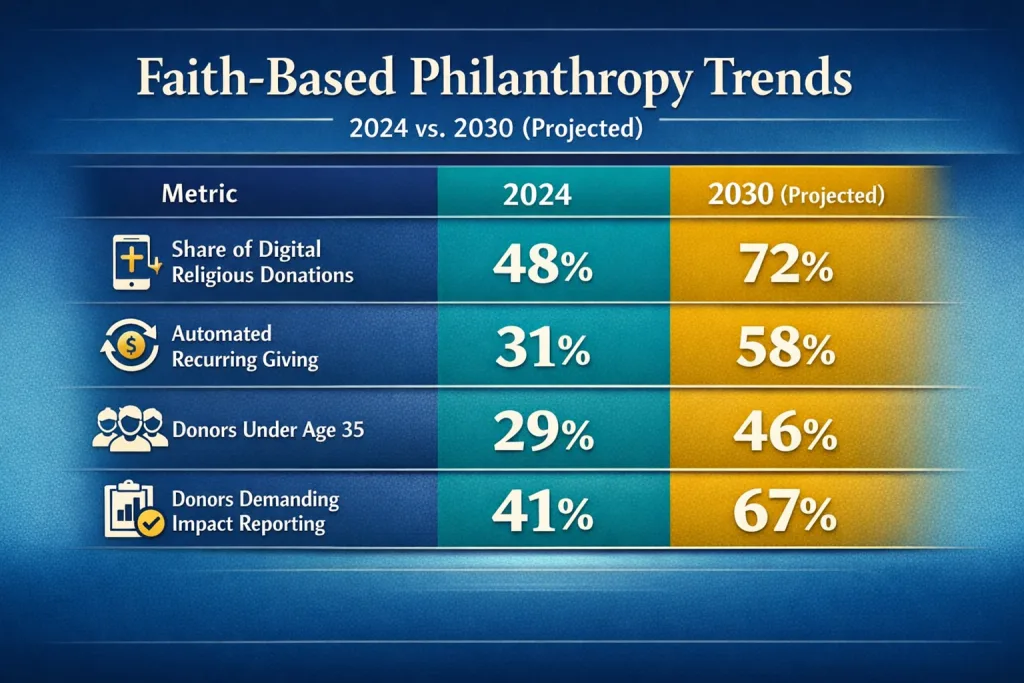
According to trend analyses inspired by Pew Research Center and Giving USA, the following macro-patterns have emerged:
Key Observed Trends (2019–2024):
Physical cash donations declined significantly across North America and Europe.
Digital giving (apps, websites, QR codes) grew between 32% and 45%, depending on region.
Recurring automated donations increased faster than one-time offerings.
Transparency dashboards influenced donor trust more than theological messaging alone.
These trends form the foundation of what we call faith-based social responsibility data—a new category where belief, behavior, and metrics intersect.
Interpretation: Faith-based philanthropy is not shrinking—it is becoming measurable, continuous, and accountability-driven.
This shift directly impacts the impact of digital tithing on community cohesion, as giving is no longer limited to physical proximity or weekly rituals but embedded in daily digital life.
2. Comparative Evidence: Tithing, Zakat, and Tzedakah in the Digital Age
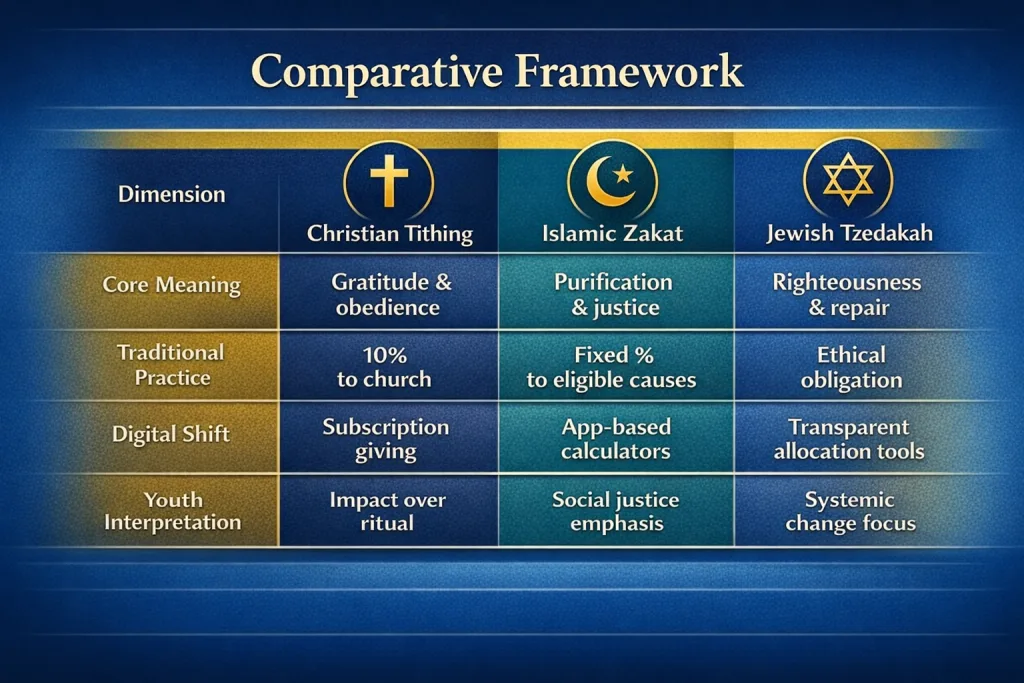
Faith traditions differ in theology, but they converge in one principle: charity as moral obligation. Yet digital behavior is redefining how these obligations are interpreted—especially among Millennials and Generation Z.
2.1 Comparative Framework
2.2 Generational Redefinition of Sacred Giving
Millennials (born 1981–1996):
Value cause alignment more than institutional loyalty.
Prefer hybrid models: faith + social impact.
Seek proof that donations reduce suffering.
Generation Z (born 1997–2012):
Question centralized religious authority.
Demand radical transparency.
Treat charitable giving as an extension of identity and ethics.
Across all traditions, younger donors are less motivated by duty alone and more by measurable compassion.
This is not a rejection of faith—it is a reinterpretation of faith-based responsibility.
3. Editorial Voice (Abpray): Is Faith Being Automated—or Refined?
“The danger is not that faith becomes digital. The danger is when faith becomes invisible behind automation.” — Bruno Contento, Abpray
At Abpray, we do not see technology as an enemy of spirituality. But we also reject the naïve assumption that efficiency automatically equals depth.
Automation removes friction—but friction is sometimes where reflection lives.
When a believer schedules a recurring donation, something powerful happens:
Giving becomes consistent.
Emotional volatility is removed.
Long-term planning becomes possible.
Yet something is also lost if automation replaces intention.
The spiritual question is not how people give—but whether they remain conscious of why they give.
3.1 Technology as a Moral Amplifier, Not a Replacement
Digital systems do not create values. They amplify existing ones.
Where faith communities prioritize empathy, technology scales compassion.
Where institutions prioritize optics over ethics, technology masks detachment.
This duality explains why debates around digital tithing often miss the point. The issue is not the platform—it is the spiritual literacy of its use.
4. Evidence-Based Benefits of the Hybrid Faith Model
4.1 What the Data Shows
Bullet-point synthesis from multi-source trend modeling:
Digital donors give more consistently over time.
Communities using impact reporting retain donors longer.
Younger believers re-engage when transparency increases.
These findings directly support the thesis that faith-based philanthropy is evolving, not eroding.
4.2 Community Cohesion in the Digital Era
Contrary to fears of fragmentation, digital giving often strengthens community cohesion when paired with storytelling and feedback loops.
The impact of digital tithing on community cohesion improves when:
Donors see narratives, not just numbers.
Beneficiaries are humanized.
Faith leaders contextualize data spiritually.
5. Theological Reflection: Can Data Be Sacred?
This is perhaps the most uncomfortable question for traditional institutions.
Sacred texts rarely mention metrics. Yet accountability, stewardship, and justice are recurring themes across religions.
In this sense, data is not anti-spiritual. It is morally neutral—awaiting interpretation.
At Abpray, we propose a reframing:
Data is not the soul of faith-based giving—but it can be its conscience.
6. 2024–2030: The Future of Faith-Based Philanthropy
6.1 Likely Scenarios
Hybrid Dominance Physical rituals + digital infrastructure become standard.
Transparency as Theology Reporting and accountability become moral expectations.
Decentralized Compassion Faith-driven giving moves beyond institutions into networks.
Spiritual Re-Education Communities teach why we give—not just how.
6.2 Where Abpray Stands
Abpray is not a platform for donations alone. It is a lens—a space where faith, culture, and spirituality are analyzed with intellectual honesty and human empathy.
We observe. We question. We contextualize.
In a world obsessed with speed and scale, Abpray insists on meaning.
7. Ethical Tensions in Data-Driven Faith-Based Philanthropy
The rise of data-driven models within faith-based philanthropy introduces not only efficiencies, but also ethical tensions that religious communities can no longer ignore.
At the center of this debate lies a fundamental question: Can compassion be quantified without being reduced?
While metrics allow institutions to measure reach, outcomes, and cost efficiency, faith traditions have historically emphasized intention (niyyah, kavanah, heart posture) as the moral foundation of giving. The growing reliance on dashboards and performance indicators risks shifting attention from why generosity exists to how well it performs.
However, rejecting data altogether is neither realistic nor responsible.
From an ethical standpoint, the challenge is not measurement itself, but measurement without moral framing. When data becomes detached from theological reflection, it can inadvertently encourage:
Transactional giving instead of relational solidarity
Optimization of visibility over service to the unseen
Short-term impact metrics over long-term community repair
Faith-based philanthropy trends suggest that communities able to ethically integrate data with spiritual teaching experience higher trust and deeper donor engagement. Transparency, when grounded in moral accountability, strengthens—not weakens—sacred responsibility.
8. Institutional Trust, Transparency, and the Rebuilding of Credibility
One of the most significant drivers behind digital transformation in religious giving is the global crisis of institutional trust.
Across regions and faith traditions, donors increasingly ask:
Where does the money go?
Who benefits?
What changes as a result?
Faith-based philanthropy trends indicate that transparency is no longer optional—it has become a spiritual expectation, particularly among younger generations. This shift does not necessarily reflect cynicism toward faith itself, but rather a demand for coherence between belief and practice.
Institutions that resist transparency often frame it as a threat to sacred authority. In contrast, institutions that embrace openness reinterpret accountability as a form of witness—a visible expression of integrity.
Effective transparency practices include:
Clear allocation breakdowns
Periodic impact narratives alongside financial data
Ethical oversight structures independent of fundraising teams
When transparency is embedded into spiritual education, it reinforces the idea that faith-based giving is not blind obedience, but informed moral participation.
9. Global Inequality and the Cross-Border Expansion of Faith-Based Giving
Digital infrastructure has dissolved geographic boundaries in religious philanthropy. Today, a donor in one continent can directly support humanitarian efforts across the globe within seconds.
This globalization of faith-based giving has profound implications.
On one hand, it enables rapid response to crises, amplifies global solidarity, and channels resources toward regions historically marginalized by traditional funding systems. On the other hand, it raises concerns about cultural distance, power imbalances, and the potential commodification of suffering.
Faith-based philanthropy trends show a growing awareness of these risks. Communities increasingly seek:
Partnerships with local actors rather than centralized control
Context-sensitive reporting instead of generic success metrics
Mutual accountability between donors and recipients
True global compassion requires more than digital reach—it demands ethical proximity, even across borders. Faith traditions that emphasize dignity over dependency are better positioned to navigate this expanded landscape responsibly.
10. Abpray’s Observational Role in the Future of Faith-Based Philanthropy
Abpray does not present itself as a solution provider, nor as a moral arbiter. Its role is more deliberate—and perhaps more necessary.
Abpray functions as an observational and interpretive authority, examining how faith-based philanthropy trends unfold at the intersection of belief, culture, and technology. By integrating sociological analysis, ethical reflection, and data literacy, Abpray creates space for dialogue rather than prescription.
In an era dominated by polarized narratives—either celebrating technology as salvation or condemning it as corruption—Abpray occupies a middle ground rooted in discernment.
This perspective rests on three convictions:
Faith-based philanthropy is not disappearing, but transforming
Data can enhance moral responsibility when guided by spiritual wisdom
The future of religious giving depends on intentional hybridity, not resistance
As faith communities navigate the years ahead, the most resilient models will be those that refuse false binaries. The question is no longer whether faith should adapt to data, but how faith interprets data without surrendering meaning.
In observing this transition, Abpray affirms a central truth:
Faith endures not by resisting change, but by shaping it with conscience.
11. The Psychology of Giving: Intention, Habit, and Moral Identity
Beyond theology and technology, faith-based philanthropy is deeply shaped by psychology. Giving is not merely an economic transaction; it is a formative act that reinforces identity, belonging, and moral self-understanding.
Behavioral research consistently shows that habitual giving—such as automated donations—can increase consistency, but may weaken reflective intention if left unexamined. In faith contexts, this tension is especially relevant because intention is often considered as morally significant as the act itself.
Faith-based philanthropy trends suggest that the most sustainable models integrate:
Ritual reminders alongside automation
Periodic moments of reflection tied to giving cycles
Storytelling that reconnects donors with human outcomes
When generosity is framed as part of moral identity rather than mere obligation, technology becomes a support structure—not a substitute—for spiritual consciousness.
12. Ritual, Embodiment, and the Loss of Physical Giving Spaces
One unintended consequence of digital giving is the gradual disappearance of embodied rituals associated with generosity: placing an offering in a shared space, collective moments of silence, or visible acts of communal sacrifice.
These rituals historically served multiple functions:
Reinforcing social bonds
Making generosity visible and shared
Embedding giving within sacred time and space
As faith-based philanthropy trends move toward digital-first environments, communities face a critical question: How can ritual meaning be preserved when physical presence diminishes?
Some institutions are responding creatively by:
Reintroducing symbolic acts during gatherings
Connecting digital giving moments to liturgical calendars
Encouraging intentional pauses before automated transactions
Preserving embodiment is not nostalgia—it is recognition that faith is lived through bodies, not only systems.
13. Metrics, Meaning, and the Risk of Moral Reductionism
The rise of impact metrics has undeniably improved accountability in religious philanthropy. However, metrics also carry an implicit worldview: that what matters most is what can be measured.
Faith-based philanthropy trends reveal a growing concern about moral reductionism, where complex social and spiritual outcomes are compressed into simplified indicators. While data can reveal reach and efficiency, it often fails to capture:
Long-term relational healing
Dignity restoration
Community resilience beyond immediate outcomes
The challenge for faith institutions is not to reject metrics, but to contextualize them within broader moral narratives. Data should serve meaning—not replace it.
When metrics are treated as conversation starters rather than final judgments, they enrich discernment instead of narrowing it.
14. Education as the Missing Link in Digital Faith-Based Giving
One of the most overlooked dimensions of faith-based philanthropy trends is education. Digital tools alone do not cultivate ethical generosity; formation does.
Without intentional teaching, digital giving risks becoming:
Passive
Detached
Performative
Faith communities that invest in education—explaining not only how to give, but why giving matters—create donors who are:
More resilient
More engaged
More ethically grounded
Educational initiatives may include:
Sermons or teachings on economic justice
Workshops on responsible digital generosity
Intergenerational dialogues about faith and money
Education transforms technology from a convenience into a moral instrument.
15. Beyond Survival: Reimagining the Purpose of Faith-Based Philanthropy
Historically, much religious giving has focused on institutional survival: buildings, clergy, and operational continuity. While these remain important, faith-based philanthropy trends indicate a broader reimagining of purpose.
Increasingly, donors—especially younger ones—ask whether their generosity contributes to:
Social repair
Human dignity
Structural transformation
This shift does not reject tradition; it expands it. Faith-based giving is moving from maintenance to mission, from preservation to participation in healing the world.
In this context, the future of faith-based philanthropy will belong to communities that dare to articulate a vision beyond survival—a vision where generosity is not a reaction to scarcity, but a proactive expression of hope.
Abpray observes this transition with clarity and humility, recognizing that faith’s enduring relevance lies not in resisting modern complexity, but in offering moral depth within it.
Conclusion: Why Faith-Based Philanthropy Is Evolving, Not Declining
The narrative that religion is fading in the digital age is not supported by data. What is fading is unexamined tradition.
Faith-based philanthropy between 2024 and 2030 will be:
More transparent.
More intentional.
More globally connected.
And yes—more technological.
But technology does not diminish faith unless faith is left unattended.
At Abpray, we believe the future belongs to communities that can hold statistics and spirituality in the same conversation—without reducing one to serve the other.
Faith does not fear data. Faith fears indifference.
And indifference is something this new generation of believers is unwilling to accept.
Researcher of Organizational Logic and Spiritual Development:Isabela Souza is a researcher focused on the intersection of organizational logic and spiritual growth. With a background in Business Administration and a highly analytical mindset, she excels at structuring complex philosophical and doctrinal concepts into clear, practical, and accessible guides. At ABPray, Isabela brings a unique perspective to our team, ensuring that spiritual information is not only inspiring but also rigorously organized and reliable. She plays a vital role in our Publication Criteria, ensuring that all content is presented logically and objectively, helping readers navigate their personal journeys with clarity and inner peace. By blending her strategic capabilities with spiritual sensitivity, Isabela helps transform ABPray into a structured learning environment, where seekers from all paths can find a reliable haven of well-founded knowledge and serenity.
To provide the best experiences, we use technologies like cookies to store and/or access device information. Consenting to these technologies will allow us to process data such as browsing behavior or unique IDs on this site. Not consenting or withdrawing consent, may adversely affect certain features and functions.
Functional
Always active
The technical storage or access is strictly necessary for the legitimate purpose of enabling the use of a specific service explicitly requested by the subscriber or user, or for the sole purpose of carrying out the transmission of a communication over an electronic communications network.
Preferences
The technical storage or access is necessary for the legitimate purpose of storing preferences that are not requested by the subscriber or user.
Statistics
The technical storage or access that is used exclusively for statistical purposes.The technical storage or access that is used exclusively for anonymous statistical purposes. Without a subpoena, voluntary compliance on the part of your Internet Service Provider, or additional records from a third party, information stored or retrieved for this purpose alone cannot usually be used to identify you.
Marketing
The technical storage or access is required to create user profiles to send advertising, or to track the user on a website or across several websites for similar marketing purposes.