Published on January 9, 2026 at 4:00 PMUpdated on January 9, 2026 at 4:00 PM
I walked into my first debate at a Tibetan monastery in Dharamshala expecting philosophy. What I found was theater, structured, rigorous theater with deeply real consequences for how these monks understood consciousness itself.
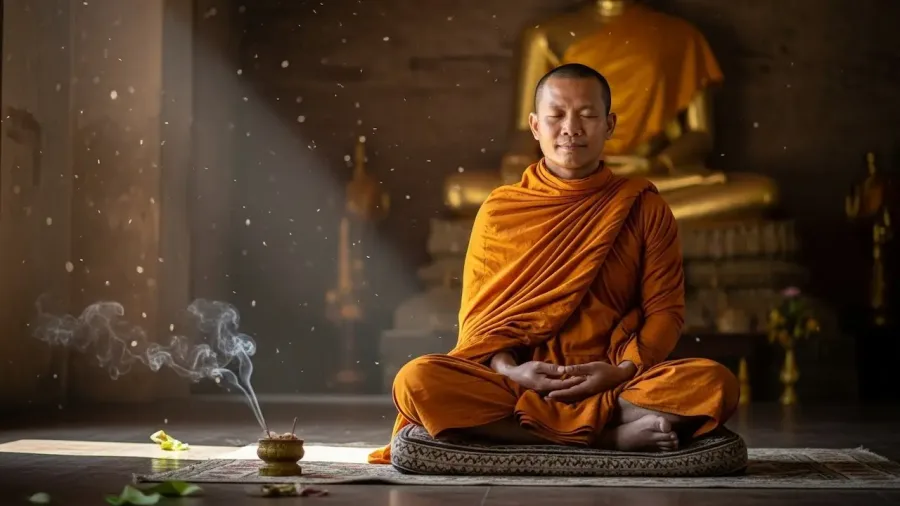
What really separates Theravada, Mahayana, and Vajrayana. (Image: ABPray)
Two monks stood facing each other in a courtyard, one passionately striking his palms together in sharp, staccato bursts. The other responded with counterargument, his hand gestures sharp enough to cut the thin Himalayan air. Around them, dozens of other monks watched, occasionally laughing at a particularly clever logical trap. An American tourist next to me whispered, “I thought Buddhism was about inner peace.”
It was then that I realized something fundamental: the three major branches of Buddhism, Theravada, Mahayana, and Vajrayana, aren’t simply different interpretations of the same teaching. They’re different epistemologies. They have different answers to the basic question of how you know something is true. And those differences run so deep that monks from each tradition don’t just disagree about doctrine. They disagree about what disagreement even means.
This is the conversation that doesn’t happen in most Buddhist scholarship, the real tensions, the practical contradictions, the places where the traditions don’t just differ theoretically but produce fundamentally incompatible ways of being.
The origin story we tell ourselves (and why it’s incomplete)
The standard narrative goes like this: the Buddha taught. After he died, his followers split into different schools based on geographical and cultural variations. Theravada preserved the “original teachings” in Southeast Asia. Mahayana adapted those teachings for different cultures across East Asia. Vajrayana, emerging later in Tibet, added esoteric tantric practices. Each represents a valid path, the story suggests. Different routes up the same mountain.
I believed this until I spent serious time in all three traditions.
Here’s what the narrative obscures: the traditions don’t see themselves as different routes up the same mountain. They see themselves as routes up different mountains. More radically, some traditions question whether there’s a mountain at all.
A Theravada abbot in Thailand told me directly: “Mahayana Buddhism contains useful psychology, but it departed from the Buddha’s actual teaching. It added concepts, Buddha-nature, bodhisattvas, other realms, that make enlightenment seem possible for everyone. The Buddha taught it requires extraordinary effort and is available to very few.”
A Mahayana teacher in Japan responded (when I brought this up) with patient disagreement: “The Theravada interpretation assumes the Buddha’s word is a fixed doctrine. But the Buddha taught differently to different people based on their capacity. What Theravada calls ‘departure,’ we call ‘fuller expression.'”
A Vajrayana scholar in Tibetan exile offered a third position entirely: “Both are incomplete. The Theravada focuses on individual liberation through gradual discipline. Mahayana adds compassion but lacks the precise methodology. Vajrayana provides the actual mechanisms, the tantric practices, that make rapid transformation possible. The previous approaches are preparatory.”
These aren’t academic disagreements. They’re radically incompatible claims about what the Buddha actually taught, what enlightenment actually means, and whether the person asking the question can even recognize truth. And yet, most Western Buddhism presents them as equivalent options, differences of cultural preference rather than fundamental philosophical disagreement.
Theravada: the archaeology of minimalism
My first extended encounter with Theravada came at a forest monastery in Thailand, Wat Pah Nanachat, one of the few English-language traditions for Westerners. The abbot, a British monk named Ajahn, embodied a philosophical position that took me weeks to understand. It wasn’t that he was rejecting something. He was practicing an almost forensic minimalism.
The Theravada approach, in its most rigorous form, treats the Buddhist canon, the Pali texts written down within a few centuries of the Buddha’s death, as a reliable record of what the Buddha actually taught. Everything else is addition, elaboration, or corruption. This isn’t presented as one interpretation among others. It’s presented as fidelity to source.
What this means in practice: enlightenment is presented as individually achievable but extraordinarily difficult. The texts describe specific stages, stream-entry, once-returner, non-returner, arhat, with precise psychological characteristics at each stage. You’re supposed to be able to know, with specificity, how far along you are. Progress isn’t vague or interior. It’s observable.
The path is austere: monastic ordination is presented as significantly more effective than lay practice. The rules are extensive and detailed. The psychology assumes that most human consciousness is clouded by craving and aversion, and that systematic reduction of both is the way out.
What I noticed on my second week: this creates a specific quality of relationship to practice. Theravada monks tend toward a kind of patient empiricism. They’re testing the teachings. Does reducing sensory input actually calm the mind? Does following the precepts produce different psychological states? They’re engaged in a long-term, personal experiment with a clear hypothesis.
But, this also creates a psychology of scarcity. If enlightenment is rare, if the path is narrow, if you’re in competition with your own mind to escape delusion, there’s an underlying assumption of insufficiency. You’re working against your nature. Your mind is the problem. Happiness requires overcoming the basic structure of human consciousness.
I watched a monk struggle with concentration during meditation. When he asked for guidance, the response was: “This is the nature of the untrained mind. Continue the practice. The resistance you feel is exactly what you’re supposed to be training through.” The underlying message was clear: your experience right now is the problem you’re solving. Don’t trust it. Transform it.
Mahayana: the radical reversal
The moment I encountered Mahayana Buddhism seriously was in a Zen temple in Kyoto. The difference wasn’t subtle.
A Zen teacher was leading a group through a koan practice, a kind of structured confusion designed to break logical thinking. The first koan was: “What is the sound of one hand clapping?” A young practitioner offered answer after answer. The teacher responded to each with a paradox or denial. Eventually, the practitioner just laughed, a genuine, full laugh.
The teacher nodded. “There. That. That’s it.”
Later, I asked what “it” was. The teacher explained: “In Zen, we don’t climb toward enlightenment. We suddenly recognize that the climbing is the blockage. Your Buddha-nature, your true nature, is already complete. Practice isn’t improving you. It’s removing obscuration.”
This is Mahayana philosophy, and it’s philosophically incompatible with Theravada at a fundamental level.
Where Theravada assumes your mind is clouded and needs discipline, Mahayana assumes your nature is Buddha-nature and needs recognition. Where Theravada posits enlightenment as rare, Mahayana asserts that Buddha-nature is universal, every being has it. Where Theravada emphasizes individual liberation, Mahayana introduces the bodhisattva ideal: enlightened beings who postpone their final liberation to help others awaken.
The practical implications are massive.
In a Theravada context, a senior monk is someone who has practiced longer and presumably understands the teachings more deeply. In a Zen context, a senior is often someone who has seen through the illusion of progress. These produce radically different teacher-student dynamics. A Theravada teacher is a guide pointing toward a distant destination. A Zen teacher is someone who points to what’s already here.
Mahayana also fundamentally reinterprets the Buddha. In Theravada, the Buddha was a human, extraordinarily accomplished, but human. He showed what’s possible through effort. In Mahayana, the Buddha becomes something else: a manifestation of ultimate reality. There are infinite Buddhas across infinite realms. The Buddha you’re praying to might be a celestial being, an archetypal force, or a principle of consciousness itself.
This shifts the entire structure of practice. In Theravada, you pray to the Buddha as inspiration, he did it, so you can too. In Mahayana, you might be calling on a Buddha for direct intervention or spiritual transmission. The Buddha becomes less distant ancestor and more accessible presence.
What I observed in Kyoto: this creates a fundamentally different quality of emotional access. Theravada practitioners work with a psychology of self-reliance tinged with melancholy, you’re alone with your mind, working through it yourself. Mahayana practitioners work with a psychology of connection, the Buddha-nature is already linking you to all beings, to all Buddhas, to reality itself. There’s a warmth, a sense of inherent okayness that precedes practice.
These aren’t just different approaches. They’re different answers to the question of whether reality fundamentally supports your awakening or requires you to overcome reality to find it. Theravada says: yes, you have Buddha-nature, but it’s buried under delusion. Keep digging. Mahayana says: Buddha-nature is your actual nature right now. Stop digging and recognize it.
These contradict each other. Not in a way that intellectual sophistication can resolve. They contradict each other at the level of basic metaphysics.
Vajrayana: the shortcut that isn’t
My encounter with Vajrayana Buddhism came through a Tibetan teacher in exile in Dharamshala. Unlike my previous Buddhist introductions, this one began with a warning.
“Vajrayana is not for everyone,” the teacher said. “Not because it’s better. Because it’s more dangerous. You’re working directly with the unconscious mind. You’re using practices designed to accelerate what would normally take many lifetimes.”
The practices he described were extraordinary: visualization of deities, transformation of the body into a mandala structure, the inversion of ordinary perception so that what appears as negative becomes recognized as fundamental wisdom. The texts mentioned these practices could produce enlightenment in a single lifetime. Or they could produce psychological dissolution if practiced without proper guidance.
Here’s where Vajrayana diverges so sharply from both Theravada and Mahayana that it’s almost a separate religion wearing Buddhist clothing.
Theravada and Mahayana, despite their differences, share an assumption: the path involves discipline. You follow precepts. You reduce harmful behavior. You cultivate virtue as a foundation. Vajrayana begins with a shocking inversion: the path sometimes requires breaking the precepts.
A tantric practice might involve consuming alcohol. Another might involve explicit sexual imagery. Another might involve acting with apparent anger or aggression. These aren’t accidental impurities in the practice. They’re deliberate reversals designed to demonstrate that enlightenment doesn’t depend on external behavior but on understanding the nature of mind itself.
This creates immediate practical tension. A Theravada monk maintaining 227 precepts would see this as spiritual degradation. A Mahayana teacher might see it as skillful means, teaching suited to a specific student’s capacity. A Vajrayana master would see it as the direct path through the illusion that purity and impurity are ultimately real.
I asked a Vajrayana teacher directly: “Isn’t this just permission to do whatever you want spiritually?”
“Yes,” he said. “If you’re enlightened. If you’re not, it’s permission to see that your attempt to be pure is itself the blockage. Most people, when they first encounter these practices, think they understand the freedom. They don’t. They just act out. That’s why guidance is essential. The practice isn’t the permission. The practice is learning to hold the paradox until it dissolves into clarity.”
What I observed in Tibetan monasteries: this creates a radically different relationship to the monastic environment. A Theravada monastery feels like a place of increasing refinement, you’re becoming gradually more subtle. A Zen monastery feels like a place of seeing through pretense, you’re recognizing what was always true. A Vajrayana monastery feels like a laboratory for consciousness manipulation, you’re actively rewiring your perception of reality.
The monks I met in Tibet were engaged in something more obviously psychological than their Theravada or Zen counterparts. They were intentionally destabilizing their ordinary perception. The deity visualizations weren’t prayer. They were neurocognitive exercises designed to demonstrate that what you perceive as external reality is actually a construction of mind.
The doctrine of “skillful means” (and its hidden agenda)
Mahayana Buddhism has a concept called “Upaya”, often translated as “skillful means.” It suggests that the Buddha taught different things to different people based on their capacity to understand. The same teaching can be expressed in multiple ways. Different paths are valid for different practitioners.
This sounds like radical acceptance. What it actually produces is something more complex.
I first encountered the tension with this concept in a conversation with a Zen teacher in Tokyo. I asked: “If all paths are valid, why teach Zen rather than Theravada or Vajrayana?”
He paused for a long time. “That’s the wrong question. I don’t teach Zen because all paths are valid. I teach Zen because I understand this path. The concept of skillful means isn’t permission to think all paths are equal. It’s an acknowledgment that the map isn’t the territory. Once you understand that, the path you’re walking is the right one, because it’s the one you’re actually walking.”
Later, a Vajrayana teacher said something similar: “Skillful means is often misunderstood as ‘anything goes.’ But it means the opposite: complete attentiveness to what this specific person needs to understand their own mind. That might require different teachings.”
What I realized: the doctrine of skillful means actually serves as a sophisticated intellectual apparatus that allows each tradition to simultaneously claim that all paths are valid and that their path is the most direct. Theravada can say, “Mahayana practices are useful for those people, but the Buddha’s actual teaching is preserved here.” Mahayana can say, “Theravada is a valid preparatory path; we offer the complete teaching.” Vajrayana can say, “Both previous approaches are valid but slower; we offer the rapid path.”
None of them are lying. But none of them are being fully honest either about the fact that they make incompatible claims about reality that can’t all be true simultaneously.
Practitioners within traditions often know this. A Theravada monk I met had studied Zen extensively. He acknowledged that Zen’s approach was coherent and legitimate. But he also acknowledged that it required a different metaphysical commitment than Theravada. The same with a Mahayana scholar I met who’d spent time in Vajrayana. They could appreciate each approach while recognizing that they couldn’t fully accept all of them simultaneously.
The doctrine of skillful means functions partly as intellectual honesty and partly as intellectual protection. It allows traditions to coexist without forcing resolution of their actual disagreements.
The hierarchy nobody admits
Here’s something I observed across all three traditions but never saw discussed explicitly: they rank each other.
In private conversations with serious practitioners:
Theravada teachers sometimes expressed doubt about whether Mahayana and Vajrayana had preserved the “authentic” teaching. This wasn’t presented as arrogance but as intellectual humility: “We try to stick closely to the earliest texts because we’re uncertain about later developments.”
Mahayana teachers sometimes expressed a kind of benevolent condescension toward Theravada: “Their path is valid but limited. They’re focused on individual liberation rather than universal Buddha-nature. That’s a narrower view.”
Vajrayana teachers sometimes presented both previous traditions as preparatory steps: “Theravada develops discipline. Mahayana develops compassion and understanding of emptiness. Vajrayana integrates both and adds the direct recognition of the nature of mind.”
These aren’t intellectual assessments. These are assessments of spiritual efficacy, and they’re made with full awareness that they contradict the other traditions’ self-assessments.
I asked a respected Western Buddhist scholar about this directly. His response was careful: “Each tradition genuinely sees its path as most aligned with what the Buddha taught. But they can’t all be right about that. Something has to give. Either the Buddha taught all three approaches, or at least one of them departed from his actual teaching. You can’t have it both ways, no matter how sophisticated your doctrine of skillful means becomes.”
The practical reality: many serious Western practitioners move between traditions precisely because they don’t resolve this hierarchy. A Zen practitioner will try Vajrayana and see methods of working with mind that Zen doesn’t have. A Theravada practitioner will encounter Mahayana devotional practice and recognize something emotionally meaningful that their tradition downplays. Rather than resolving the contradiction, they often integrate it.
But this integration isn’t actually permitted by the doctrines themselves. It’s a pragmatic workaround that the traditions tolerate but don’t officially sanction.
Where practice diverges from doctrine
Let me be precise about the most hyperespecific tension I encountered, the place where the actual lived practice revealed something that doctrine obscures.
A Theravada monk and a Zen monk I met had both practiced intensively for similar lengths of time. The Theravada monk had progressed through clearly identifiable stages of practice according to his tradition’s psychology. He could describe specific shifts: the dissolution of the sense of separate self, the arising of pīti (joy) in meditation, the increasing stability of attention. His progress was methodical and observable.
The Zen monk described his experience differently. He’d had sudden insights, periods of dissolution and reconstruction, moments of extreme clarity and periods of apparent groundlessness. His progress wasn’t linear. Some days advanced; others seemed like regression. The Zen framework expected this. In Zen, the “dark night of the soul” isn’t a problem, it’s often recognized as a sign of genuine deepening.
Here’s the tension: both men were genuinely practicing. Both were experiencing real transformation. But their frameworks predicted different things about what transformation should look like, and neither framework was “wrong” in its predictions, because each created the conditions for those specific predictions to manifest.
The Theravada framework, with its emphasis on gradual development through defined stages, created the psychological conditions for staged progress. The mind, in that framework, was being trained progressively toward increasingly subtle states. Progress was legible because the map said where you were.
The Zen framework, with its emphasis on sudden seeing-through, created conditions for discontinuous experiences. The map said that the mind was already enlightened; you were just removing layers of obscuration. So the map predicted sudden recognition rather than gradual improvement.
Both sets of predictions came true, within their respective frameworks. And this suggests something uncomfortable: the traditions might not be discovering universal truths about the nature of mind. They might be creating experiences consistent with their doctrines through the structure of their practices and their frameworks for interpreting experience.
A Theravada practitioner might experience something that a Zen framework would call “sudden insight,” but because the Theravada framework doesn’t expect that, it gets reinterpreted as a particularly vivid meditation state or a glimpse of a higher jhana (absorption level). A Zen practitioner might experience something that the Theravada framework would call “a distinct stage of practice,” but because the Zen framework doesn’t expect linear progression, it gets reinterpreted as a deepening of seeing.
Neither is lying. Both are interpreting genuine experience through their respective hermeneutical frameworks. And those frameworks are shaped, in part, by doctrine that isn’t universally binding but is treated as such within each tradition.
The question of authority: who decides?
This brought me to what might be the most unsettling insight of all: the traditions have radically different answers to the question of who holds interpretive authority.
In Theravada, authority rests with the texts, the Pali canon, and the consensus of established monastic communities. Innovation is treated with suspicion. Authority is distributed across senior monks and textual tradition.
In Mahayana, authority becomes more concentrated in the teacher. The teacher’s wisdom is recognized as more important than textual authority. Different teachers, different lineages, interpret the teachings differently. This produces more flexibility but also more potential for exploitation.
In Vajrayana, authority is explicitly concentrated in the guru. The entire system depends on a personal relationship with a teacher who has been properly trained in the transmission. The guru’s interpretation of your experience takes precedence over your own understanding. This is presented as necessary: without proper guidance, tantric practice is genuinely dangerous.
These systems can’t all be right about authority. Either interpretive authority should be distributed among texts and communities, concentrated in individual teachers, or concentrated in a guru-student relationship. You can respect all three approaches without pretending they’re equivalent.
What I observed: serious practitioners navigate this by essentially choosing which authority structure they’re willing to accept. Someone drawn to Theravada is drawn partly because they want authority located in established texts and communities. Someone drawn to Zen is often drawn because they want to relate directly to a teacher’s wisdom. Someone drawn to Vajrayana is often drawn because they want transformative transmission from a realized master.
The traditions aren’t just offering different paths. They’re offering different authority structures, different answers to the question of who gets to decide what’s true. And we rarely admit that openly.
Integration and the uncomfortable truth
By the end of my deep engagement with all three traditions, I’d spent time in Theravada monasteries in Thailand and Sri Lanka, Zen monasteries in Japan, and Vajrayana communities in Tibet, India, and the diaspora.
I experienced genuine transformation in each tradition. I also encountered genuine limitations in each. A Theravada practitioner could develop extraordinary mental clarity and equanimity but sometimes lacked the warmth, the sense of connection, that Mahayana and Vajrayana naturally cultivated. A Zen practitioner could experience startling insight into the nature of mind but sometimes worked with frameworks that were so anti-intellectual they missed important psychological complexity that Vajrayana explicitly addressed. A Vajrayana practitioner could engage with sophisticated psychological technologies but sometimes got lost in the complexity, needing the methodological clarity of Theravada or the simplicity of Zen to find ground again.
The uncomfortable truth: these traditions are incompletely specified. Each addresses some aspects of consciousness and practice brilliantly while leaving others out. And the gaps aren’t accidental. They emerge from the fundamental philosophical commitments that define each tradition.
A Theravada practitioner who becomes enlightened according to Theravada measures might not recognize the enlightenment of a Zen practitioner or a Vajrayana practitioner. Because enlightenment means something different in each context.
For Theravada, it means the cessation of craving and the arising of stable wisdom about the nature of emptiness, combined with psychological equanimity. The arhat is liberated.
For Zen, it means seeing through the illusion of separation, recognizing that the Buddha-nature you’ve always possessed is now obvious. There’s no longer any seeking, no “enlightened person” having an experience of enlightenment.
For Vajrayana, it means integrating the understanding of emptiness with the full activation of the mind’s luminous wisdom. You don’t abandon the world; you transform your relationship to it entirely through recognition that all phenomena are the display of the nature of mind.
These are describing different end-states. They’re not different paths up the same mountain. They’re different mountains.
What this means (and what it doesn’t)
After spending serious time in all three traditions, integrating teachings, practicing within each framework, and encountering the genuine limitations of each, I’ve come to something like a conclusion, though it’s an unsettled one.
The traditions aren’t equal. They’re not equally efficient. They’re not equally true in their metaphysical claims. But they’re not mutually exclusive in the way their doctrines suggest, either. The best Western practitioners I met had essentially done something the traditions don’t officially permit: they’d extracted the technologies from each tradition, the stability-training from Theravada, the insight-orientation from Zen, the deep psychological work from Vajrayana, and integrated them into a personal practice that the traditions themselves wouldn’t fully endorse.
This is possible precisely because the traditions do touch something genuine about consciousness, enough that their technologies produce real results. But it’s also possible to integrate them partly because the traditions are describing the same terrain from different entry points, using incompatible frameworks, without fully admitting how deeply they contradict each other.
What I hold now isn’t a settled understanding. It’s more like a lived question: if all three traditions produce genuine transformation, what does that tell us about the nature of consciousness? That it’s more flexible, more responsive to frameworks, more malleable than any single tradition admits? That human consciousness can actually become different things depending on the practices you apply to it and the frameworks you use to interpret the results?
That’s genuinely unsettling, because it suggests that enlightenment might not be the discovery of a universal truth so much as the construction of a particular form of consciousness according to the blueprint of your chosen tradition.
But the monks I met, genuinely transformed, genuinely wise, genuinely different in quality from ordinary consciousness, would probably say: “Maybe. And does the distinction matter?”
It’s the kind of question they’d sit with, rather than answer.