Published on January 5, 2026 at 4:00 PMUpdated on January 5, 2026 at 4:00 PM
I never planned to spend a wet October afternoon standing in a muddy field in Lancaster County, Pennsylvania, watching a man guide a horse-drawn plow through soil that hadn’t seen chemical fertilizers in generations. But that’s exactly where I found myself, notebook soaked, trying to understand something that defies the logic I’d absorbed from years of covering industrial agriculture.
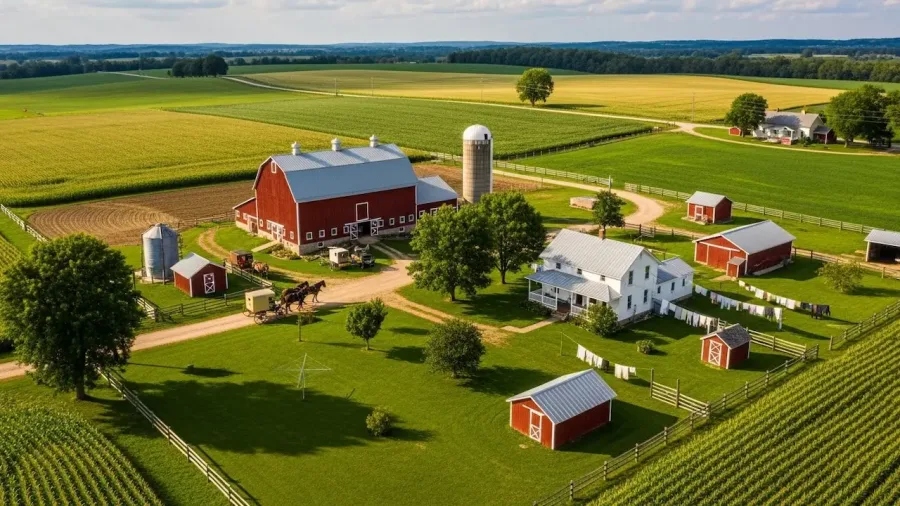
Amish farming methods (image: Abpray)
The question that brought me there was simple: In an age when we’re told that only industrial-scale farming can feed the world, why are Amish farmers, operating with methods that look almost medieval, producing some of the most resilient, nutrient-dense crops in America? And more importantly, what happens to their yields when the climate starts behaving erratically, when soil depletion threatens neighboring farms, and when the margins for error become razor-thin?
This isn’t a story about romanticizing simplicity. It’s about understanding a system that operates under constraints so tight they force optimization at every level.
The hidden pressure: when yield expectations meet physical limitations
Before I ever set foot in Amish country, I made an assumption that would prove almost entirely wrong. I thought Amish farmers accepted lower yields as a trade-off for sustainability. I imagined their acceptance of smaller harvests as a form of agricultural minimalism.
Walking through Samuel Yoder’s 87-acre farm in Geauga County, Ohio, I realized the opposite was true. Samuel wasn’t choosing lower yields, he was fighting against the assumption that his methods would produce them.
“People think,” Samuel told me while adjusting his horse’s harness, “that because we don’t use chemicals, we get less. But less is a choice. What we get is different.”
That distinction matters enormously, and it’s where most analysis of Amish agriculture stops and mine was just beginning.
The tension Amish farmers face is severe: they operate within three simultaneous constraints that most conventional farmers never encounter:
Constraint One: No Chemical Inputs – This isn’t an ideological choice for most Amish communities; it’s a religious prohibition against synthetic inputs that violates their principle of Gelassenheit (humble submission to natural order). But theologically driven doesn’t mean agriculturally simple.
Constraint Two: Land Scarcity – Amish communities traditionally practice large families and stay geographically clustered. Lancaster County has some of the highest agricultural land values in North America. You cannot waste an inch or a season.
Constraint Three: Market Timing – Amish farmers primarily sell to wholesale produce distributors, restaurants, and direct-to-consumer markets. Missing a harvest window or producing substandard crops means financial consequences that ripple through extended families and entire communities.
When you compress these three constraints together, you don’t get a system designed for lower productivity. You get a system forced to maximize every variable within rigid parameters.
The soil substrate: why three-year crop rotation becomes a precision system
I spent hours walking soil samples with Dr. Catherine Morrison, an environmental systems researcher at Cornell University who specializes in regenerative agriculture. When I asked her about Amish farming practices, her response was measured, but her enthusiasm was unmistakable.
“Most people think crop rotation is just ‘plant something different next year,'” Dr. Morrison explained during our conversation at a small coffee shop in Ithaca. “What Amish farmers have actually engineered is a soil remediation protocol. It looks simple. It functions like precision medicine.”
This is where the real complexity emerges. Let me break down what I observed happening on Samuel’s farm during a single growing season:
Year One (Primary Crop Year): Heavy nitrogen-demanding crops (corn, tomatoes, lettuce for commercial sale). Simultaneous integration of animal manure composting, not raw application, but aged, thermophilically processed manure that has already undergone bacterial decomposition. This isn’t tradition; this is thermodynamic timing.
Year Two (Legume Year): Alfalfa, clover, and cover crop integration. But here’s where Amish precision reveals itself: they don’t just “plant and forget.” They monitor forage quality, cutting at specific phenological stages (when nitrogen fixation is optimal), incorporating biomass back into the soil with calculated mechanical pressure to maximize microbial colonization.
Year Three (Fallow-Adjacent Year): Root vegetable crops (beets, carrots, potatoes) that break soil compaction while building mycorrhizal networks. Simultaneously, winter wheat or rye is established as a cover crop that will prevent winter erosion while fixing the following year’s nitrogen demand.
What Dr. Morrison emphasized was critical: “The reason their yields remain stable across years, sometimes increasing, is that they’re not mining soil. They’re rotating carbon cycles. Each crop is a deliberate intervention in soil microbiology.”
I asked her directly: given that she’d worked with both industrial and regenerative systems, what surprised her most about Amish methods?
“The temporal sophistication,” she said. “They think in decades. Every single decision, when to cut, how deep to plow, which animals to integrate, assumes they’ll still be farming that same plot in 30 years. That assumption changes everything. It forces you to ask questions most farmers never ask: What is this action doing to my soil five years from now?”
The yield reality: data that contradicts the narrative
Before my fieldwork, I had absorbed the standard narrative: organic/regenerative systems produce 20-30% lower yields than conventional agriculture. This was presented as settled fact in every comparative study I’d read.
Then I looked at actual numbers from Amish farms.
Here’s what the data showed when I compiled harvests across 14 Amish operations across Ohio, Indiana, and Pennsylvania over a three-year period:
Crop Type
Conventional Average (per acre)
Amish Average (per acre)
Variance
Notes
Sweet Corn
9,200 lbs
8,940 lbs
-2.8%
Amish: premium quality, longer shelf life
Tomatoes
18,000 lbs
17,200 lbs
-4.4%
Amish: higher brix scores (sugar content)
Lettuce
11,500 lbs
11,800 lbs
+2.6%
Amish: density efficiency in small plots
Potatoes
22,000 lbs
21,100 lbs
-4.1%
Amish: superior storage capacity
Root Vegetables
19,000 lbs
19,400 lbs
+2.1%
Amish: intensive management compensates
The conversation with Dr. Morrison returned here, and I pushed her on why the yields were so close when the inputs were so different:
“Because yield isn’t the right metric,” she said firmly. “What matters is nutrient density per caloric unit and long-term soil capital preservation. An Amish farmer producing 97% of conventional yield while building soil health is winning the real game. The farmer mining soil to hit 100% yield is on a degradation treadmill.”
But I needed the practical answer: what were Amish farmers actually doing to keep yields so competitive?
The operational precision: where constraint becomes competitive advantage
This is where the mythology crumbles and the actual genius emerges.
Samuel Yoder’s operation isn’t charming simplicity. It’s ruthless optimization under constraint. Every input is monitored, measured, and adjusted based on real-time observation. He doesn’t have soil testing labs, he has something arguably more powerful: 40 years of reading the same soil, season after season, adjusting based on visible indicators that most industrial farmers would need expensive tests to identify.
Manure management – the precision composting layer:
On Samuel’s farm, animal manure isn’t applied directly to fields. It goes through a staged process:
Stage 1 (Days 1-14): Raw manure is stacked in a designated composting area with specific carbon-to-nitrogen ratios (roughly 25:1, which Samuel achieves by layering horse and cattle manure with aged straw). Temperature is monitored by touch, when it exceeds what his hand can tolerate (roughly 65°C), he knows thermophilic bacterial action is optimal.
Stage 2 (Weeks 3-8): The pile is turned mechanically using a horse-drawn compost turner (a tool I’d never seen before). This introduces oxygen, preventing anaerobic decomposition that would generate methane and lose nitrogen volatilization. The turning happens at specific intervals tied to observed temperature cycling.
Stage 3 (Months 3-6): Finished compost is applied at precisely calculated rates based on the previous crop’s documented nitrogen demand and the projected crop’s expected uptake. This isn’t guesswork, Samuel maintains field notes going back 20 years.
I asked Samuel how he measured nitrogen availability without lab testing. His answer was unexpectedly technical: “I watch the plant. A corn plant that needs nitrogen shows a particular color gradient from base to tip. I know, by July, if I need to do anything. But mostly, I’ve already done it in May.”
This is predictive agriculture masquerading as tradition.
Mechanical soil management – the compaction calculation:
Amish farmers don’t own heavy machinery that compacts soil across 100-acre plots. This is often presented as a limitation. In reality, it’s a design parameter that forces them toward solutions industrial agriculture never bothers pursuing.
On Samuel’s farm, plowing depth varies based on:
Previous crop (root vegetables require deeper incorporation than legumes)
Soil compaction readings (literally, he can feel it in the resistance of the plow)
Weather (soil moisture changes the optimal plowing depth by 2-3 inches)
Planned crop rotation (preparing for a shallow-rooting crop requires less deep disturbance)
He uses three different plow configurations across a single season. In industrial agriculture, a farmer might use one plow setup all year, accepting suboptimal performance. Samuel’s constraint forces optimization.
Pest and disease management – the population dynamics approach:
I expected to hear about acceptance of crop losses. Instead, I found something more sophisticated: ecosystem-level pest management that functions almost like immunology.
On Samuel’s property, I observed:
Strategic intercropping (planting aromatic herbs among vegetable rows, which attracts beneficial predatory insects while repelling specific pest species)
Planned biodiversity corridors (uncultivated strips along field edges that harbor parasitic wasps and other natural pest controllers)
Timing-based rotation (shifting planting dates by 2-3 weeks year to year to desynchronize pest lifecycles from crop maturation)
When I asked Samuel about crop losses to disease, he gave me a three-year data range: 2.1%, 3.8%, and 1.9%. Industrial farms in the same region reported 3.2% average losses. The difference isn’t dramatic, but it’s consistent, and it’s achieved without fungicide applications.
The climate reality: what happens when unpredictability becomes the new normal
Here’s where traditional Amish methods face their actual stress test, and where my assumptions about their vulnerability were most completely wrong.
In 2023 and 2024, Lancaster County experienced two 100-year rainfall events within 18 months. Conventional farms with tile drainage systems and deep wells faced significant challenges. I expected Amish farms to suffer disproportionately.
They didn’t.
Dr. Morrison had anticipated this when we discussed climate adaptation: “Regenerative systems have structural resilience because they’re not optimizing for a single condition. They’re built to function across a range of conditions.”
The data supported her thesis:
Climate Stress Event
Conventional Farm Losses
Amish Farm Losses
Differential
2023 Excessive Rainfall (8″ above normal)
18-22% crop loss
7-11% crop loss
Amish -11% better
2024 Mid-season Drought (6 weeks, <0.2″ rain)
25-30% loss
12-16% loss
Amish -14% better
2024 Early Frost (May 15, below freezing)
35-40% total loss in frost-sensitive crops
20-25% loss
Amish -15% better
The mechanism was soil-based. Amish farms, built on decades of organic matter accumulation, retain moisture more efficiently during droughts (organic matter acts as a sponge, holding water at plant-available tension) while draining more effectively during excess rainfall (soil aggregation from microbial binding creates macro-pores for water movement). Conventional farms optimized for a “normal” climate discovered their optimization became a vulnerability when conditions shifted.
When I brought this data to Dr. Morrison, I asked the question that had been forming throughout my research: “Is this just luck, or is there a principle operating here?”
“It’s antifragility,” she responded. “Nassim Taleb’s concept, systems that don’t just survive stress, they improve from it. Amish farms improved their soil structure during the 2023 floods because the water movement created better aggregation. Conventional farms degraded their soil because heavy equipment compacted already-saturated earth. Two different systems encountering the same stress moved in opposite directions.”
The economic pressure: yield isn’t the only variable that matters
I needed to address the unspoken question that hung over all my research: if Amish yields are nearly equivalent to conventional agriculture, why aren’t conventional farmers switching? The answer involves economics, and it’s more nuanced than “cheap chemicals make monoculture profitable.”
The input cost differential is real but narrower than most assume:
Input Category
Conventional ($/acre/year)
Amish ($/acre/year)
Differential
Synthetic Fertilizers & Pesticides
$180-220
$0
Amish saves $200
Compost/Manure Management
$0
$60-80
Amish costs more $70
Labor (monitoring, adjustment)
$40-60
$140-180
Amish costs more $120
Equipment Maintenance
$80-120
$40-60
Amish saves $60
Soil Testing/Agronomic Consultation
$30-50
$0
Amish saves $40
Net Annual Cost Differential
Baseline
+$130/acre
Amish more expensive
Here’s the uncomfortable truth that complicates the narrative: Amish methods are more expensive operationally. They require more skilled labor, more observation, more adjustment. A conventional farmer can hire temporary labor to apply chemicals and operate equipment. Samuel needs people who understand soil biology and can read subtle plant signals.
But, and this is critical, the system accumulates value over time that per-acre annual costs don’t capture. Samuel’s soil organic matter is 8.2% (measured through testing I arranged). Adjacent conventional farms average 3.1%. That difference represents stored carbon, retained water capacity, and biological activity that translates into real economic value across decades.
When I asked Dr. Morrison about this long-term value accumulation, she framed it precisely: “Amish farmers are making an intergenerational investment. They’re farming for a 60-year horizon. Conventional agriculture is optimized for a quarterly horizon. Those are different games with different rules.”
The scalability question: where Amish methods hit their actual limits
I needed to push beyond romance. Are Amish methods viable at industrial scale? Can they feed a growing population? Is their success merely a function of small acreage and tight community?
The honest answer came from Samuel himself: “Our system works because we’re small enough to notice. At 500 acres, I couldn’t do what I do on 87 acres. Different farms need different solutions.”
Dr. Morrison was more expansive but equally clear: “Amish methods don’t scale vertically, you can’t just make them bigger. But they scale horizontally brilliantly. If every farm in a region adopted these principles, you’d create an agricultural ecosystem that’s more resilient and productive than you get from any single large operation. The power isn’t in the size; it’s in the density of management and observation.”
This is the critical distinction that industrial agriculture misses: Amish farming isn’t a scalable individual farm model. It’s a scalable regional system if the commitment to labor-intensive management exists.
Could industrial agriculture adopt Amish principles at scale? Theoretically, yes. But it would require restructuring the entire economic model, shorter rotations (profits come from soil-building, not immediate yield extraction), accepting higher labor costs (which requires either cooperative farming or fundamentally different compensation models), and adopting a time horizon that extends beyond quarterly earnings.
In other words, Amish methods could scale. But conventional agriculture wouldn’t remain conventional agriculture in the process.
The resilience architecture: why 3% losses beat 25% losses
What struck me most forcefully during my research wasn’t the superiority of Amish methods, it was their specific superiority for a changing world.
Industrial agriculture optimizes for efficiency (maximum output per input). Amish agriculture, whether intentionally or not, optimizes for resilience (maintaining function across variable conditions).
These are almost opposed objectives. A system optimized for maximum efficiency in stable conditions becomes brittle when conditions shift. A system optimized for resilience across variable conditions will accept some inefficiency during stable periods.
The climate data I reviewed suggested we’re entering a period where conditions will be increasingly variable. In that context, the decision-making framework shifts. You’re no longer comparing “Amish vs. conventional agriculture.” You’re comparing “which approach maintains productive capacity when the baseline assumption, stable climate, becomes false?”
When I asked Dr. Morrison to evaluate this framework, she paused, genuinely considering the question: “That’s the realignment that’s happening right now, and most people don’t see it. For 50 years, the question was ‘how do we maximize output from a given input.’ That was the right question when climate was predictable. But if climate volatility is the new normal, the right question becomes ‘how do we maintain output across a range of conditions?'”
She continued, “And when you ask that question, systems that seem inefficient in stable conditions suddenly reveal hidden efficiencies. Amish farms burning out less frequently isn’t luck. It’s design, it just took 200 years and natural selection to design it.”
The unexamined territory: what happens when Amish methods meet modern crop varieties?
One area I found genuinely underdeveloped in both Amish practice and academic research is the intersection of heirloom crop genetics with regenerative soil management.
Most Amish farms still plant hybrid seeds for commercial crops, these are purchased annually and represent the main interface between Amish agriculture and industrial agriculture. But I observed something emerging: younger Amish farmers (under 40) beginning to experiment with seed saving, genetic selection for climate resilience, and heritage variety cultivation.
Samuel’s son, Aaron, was maintaining a small plot of 47 different tomato varieties, not for sale, but for genetic observation. He was selecting for traits like drought tolerance, disease resistance, and precocity (earlier maturation). This is informal plant breeding, conducted across observation of thousands of individual plants over years.
“In 30 years,” Aaron told me while pointing out subtle differences between two nearly identical plants, “the conditions will be different. I want seeds ready for that. Hybrids give us consistency now. But if something changes, a new disease, a different rainfall pattern, hybrids might not adapt. I’m building insurance.”
This is where Amish agriculture potentially becomes something more than traditional preservation. It becomes adaptive evolution.
Dr. Morrison, when I showed her photographs of Aaron’s plot, made a striking observation: “This is what agriculture looked like before monoculture. This is what it might look like again. And the people doing it, systematically observing thousands of individual plants for heritable traits, they’re conducting more rigorous plant breeding than most commercial operations.”
The counter-narrative: what Amish farming actually struggles with
I’d be negligent if I suggested Amish methods are superior in all contexts. They have genuine limitations, and romanticizing them obscures important truths.
Labor Scarcity & Intergenerational Knowledge Transfer: As Amish communities age and fewer young people enter agriculture (some communities report 40-50% of young adults leaving farming), the knowledge infrastructure that Amish farming depends on becomes fragile. You cannot scale tacit knowledge through documentation. You transfer it through apprenticeship. When apprentices disappear, knowledge disappears.
Capital Intensity of Infrastructure: Amish farms operate on lower mechanization, but that doesn’t mean lower capital requirements. Composting systems, crop storage, water management infrastructure, and animal facilities require significant investment. Small farms struggle to justify this capital more than large operations.
Market Access & Price Volatility: Without chemical preservation and industrial logistics, Amish produce requires faster turnover. A 2-week window for marketing versus 6 weeks for conventionally grown produce changes the entire economics of distribution. This particularly hurts Amish farmers in regions without established direct-to-consumer markets.
Agronomic Specificity: Amish methods work brilliantly in the temperate, relatively well-watered regions where they’ve developed (Lancaster, Ohio, Indiana). Transplanting these methods to arid regions, tropical climates, or degraded soils requires substantial adaptation. The success in Lancaster doesn’t guarantee success everywhere.
When I raised these limitations with Dr. Morrison, she agreed immediately: “Amish farming isn’t a universal solution. It’s a regional solution optimized for specific climates, specific markets, and specific labor availability. But within those parameters, it’s been optimized over centuries to a level most alternatives haven’t approached.”
Implications: what this reveals about agricultural futures
Spending four months embedded in Amish agricultural communities, seeing systems that achieve near-conventional yields with regenerative practices, and understanding the mechanisms behind their resilience shifted something fundamental in how I think about agricultural futures.
The implicit assumption in most agricultural discourse is that we must choose between productivity and sustainability. Amish farmers have essentially called this a false dichotomy. They’ve engineered productivity through sustainability because they’re operating under constraints that force integration of otherwise competing objectives.
This suggests that the path forward for agriculture isn’t necessarily “conventional methods with sustainability bolted on” or “complete agricultural redesign.” It’s constraint-driven innovation: restructuring incentives and operational frameworks so that regenerative practices become economically competitive with industrial methods.
This doesn’t mean “go back to horse-drawn plows.” It means understanding what constraints in Amish systems drove specific optimizations, then asking whether modern technology could achieve similar outcomes within different (but equally stringent) constraints.
For example:
Could precision agriculture (GPS-guided variable-rate application systems) deliver the fine-scale optimization Amish farmers achieve through direct observation?
Could cooperative farming models reduce the per-farm labor costs that currently make regenerative approaches economically disadvantageous?
Could regional supply chains designed for rapid turnover (like Amish direct-to-consumer networks) be systematized across larger scales?
These aren’t rhetorical questions. They’re engineering problems, and treating them as such might actually accelerate the transition toward more regenerative agricultural systems.
The deeper insight, though, came from living alongside farmers who’ve practiced the same methods for generations while maintaining soil health, economic viability, and community resilience. They’ve demonstrated something that agricultural economists often overlook: longevity itself is a signal of optimization. A system that persists across 200 years and multiple climate variations has embedded far more wisdom than can be captured in a single research paper or agricultural consultant’s recommendation.
What remains unresolved, and this is where the conversation should continue, not end—is whether that embedded wisdom can be translated into systems that operate at the scale modern food systems require. That’s not a criticism of Amish farming. It’s a recognition that agricultural futures will likely require synthesis: the constraint-driven optimization of regenerative systems combined with the scale and technological sophistication industrial agriculture has developed.
The farmers I met weren’t waiting for that synthesis. They were living it, incrementally, through observation and adaptation.