Published on November 23, 2025 at 4:00 PMUpdated on November 23, 2025 at 4:00 PM
I was sitting in a Bible study in a conservative evangelical church when a young man with a sleeve tattoo, an elaborate design that looked like it had cost hundreds of dollars and taken dozens of hours to apply, raised his hand to ask a question. The question was direct: “Is it a sin for me to have gotten these tattoos?”
Can Christians get tattoos? (image: Abpray)
The pastor paused. He clearly wanted to say no. The young man was sincere, earnest, clearly devoted to his faith. But the pastor was also bound by what he understood to be biblical instruction.
“The Bible says in Leviticus 19:28 that we shouldn’t mark our bodies,” the pastor said. “So technically… yes. It would be sin.”
The young man looked devastated. “Even though I got them before I became a Christian?”
The pastor softened. “Okay, so you’re not responsible for what you did before you knew better. But going forward, you shouldn’t add more.”
Later, I asked that pastor directly: “Why is that your interpretation? Most evangelical Christians now have tattoos. Your church has members with tattoos. Why is this still the rule?”
He said: “Because the Bible clearly says not to mark your body. I don’t personally judge people who have tattoos, but I can’t pretend Scripture doesn’t say what it says.”
In that conversation, I encountered something fundamental about how Christian communities interpret Scripture: the tattoo question isn’t really about tattoos. It’s about how we distinguish between moral law, cultural custom, and identity formation. It’s about what we do when ancient biblical law seems to contradict modern Christian practice. And it reveals something profound about the fractures in Christian hermeneutics, the way different communities read the same text and arrive at radically different conclusions about what it means to follow Scripture faithfully.
Over the next two years, I investigated this question across dozens of Christian traditions and hundreds of conversations with theologians, pastors, practitioners, and people who’d experienced profound shame around their tattoos in Christian contexts. What emerged was far more complex than “the Bible says don’t get tattoos, but modern Christians ignore it.” It revealed how categories like “moral law,” “ceremonial law,” “cultural practice,” and “identity marker” structure our entire interpretation of Scripture, and how different traditions make dramatically different decisions about which biblical laws are eternally binding and which are culturally contingent.
The original text: what Leviticus 19:28 actually says
Let me start with what’s actually written in the biblical text.
Leviticus 19:28 in the King James Version reads: “Ye shall not make any cuttings in your flesh for the dead, nor print any marks upon you: I am the Lord.”
Most modern translations offer similar language. The ESV reads: “You shall not make any cuts on your body for the dead or tattoo yourselves: I am the Lord.” The NRSV reads: “You shall not make any gashes in your flesh for the dead, or tattoo any marks upon you: I am the Lord.”
Now, the first thing to notice is the context. The prohibition isn’t about marking your body in general. It’s about marking your body for the dead and in the context of funerary rites. The Greek translation (the Septuagint) makes this even clearer, the prohibition is specifically about markings made as part of mourning rituals.
In the ancient Near Eastern world, it was common practice for mourners to cut themselves or mark their bodies as expressions of grief and as ways of identifying with the deceased. The Book of Job describes this practice: “Job’s friends tore their robes and put dust on their heads” (Job 2:12). Jeremiah describes mourning practices: “they shall gash themselves” (Jeremiah 16:6). Isaiah condemns these practices: “Stop trusting in mere humans… Let them terrify you” (Isaiah 2:22, though this is about something different).
The context of Leviticus 19:28 is specifically mourning rituals and practices associated with pagan worship of the dead.
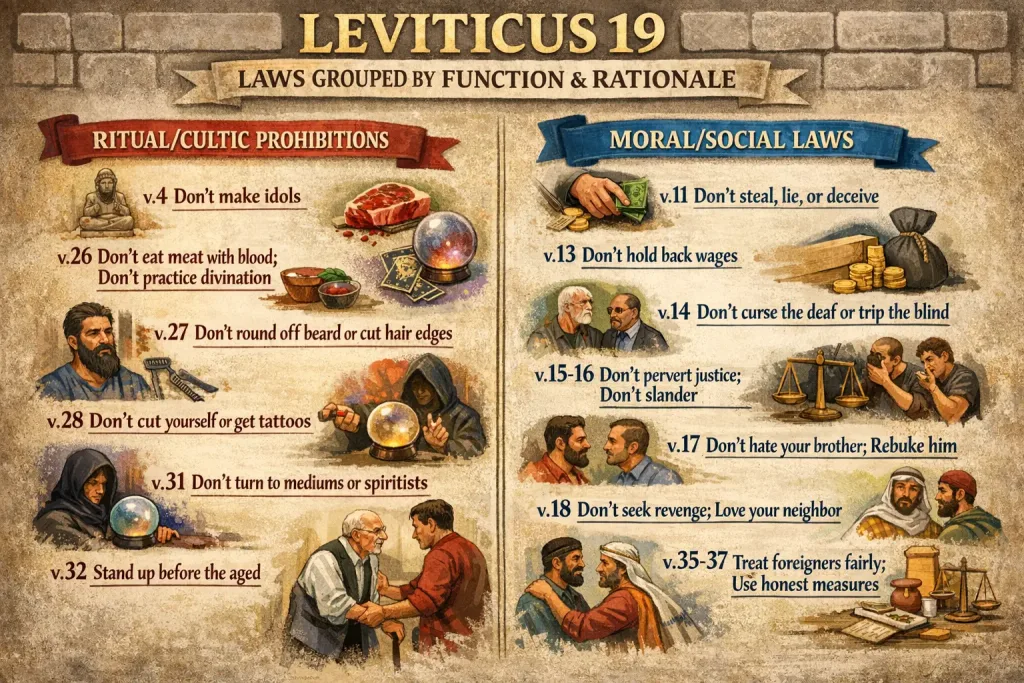
Let me place this in the broader context of Leviticus 19:
Leviticus 19: laws grouped by function and rationale. (Image: ABPray)
What’s immediately clear is that Leviticus 19 contains a mix of different kinds of laws. Some are explicitly about ritual purity (don’t eat meat with blood in it). Some are explicitly about mourning rituals (don’t mark yourself for the dead). Some are about moral conduct that seems timeless (don’t steal, don’t lie, love your neighbor).
The question becomes: Which of these laws are eternally binding on Christians, and which are culturally contingent, specific to ancient Israel, or applied only to the Old Testament period?
The history of Christian interpretation: how the tattoo rule emerged
If we trace the history of Christian interpretation, something fascinating emerges: the prohibition on tattoos is not ancient Christian doctrine. It’s modern doctrine, emerging in specific historical contexts.
The early church fathers, Augustine, Jerome, Chrysostom, don’t discuss tattoos. The medieval church doesn’t have developed doctrine on tattoos. The Reformation doesn’t emphasize tattoo prohibition. The early evangelical movement (18th and 19th century) doesn’t emphasize it.
The tattoo prohibition emerges prominently in late 19th and early 20th century Holiness and Pentecostal movements, particularly in America. These were movements that emphasized personal separation from worldly practices. They developed strict codes of personal conduct: no dancing, no card playing, no makeup, no jewelry, no cigarettes, no alcohol. Tattoos, in this context, were associated with sailors, circus performers, criminals, people outside respectable society. The prohibition on tattoos fit into a broader project of spiritual sanctification through personal separation from worldly practices.
A historian I spoke with explained it this way: “The tattoo prohibition isn’t about biblical interpretation. It’s about social class and respectability. In early 20th century America, tattoos were associated with working-class people, criminals, and military members. The evangelical churches that were becoming respectable and middle-class wanted to distance themselves from working-class cultural markers. The tattoo prohibition encoded that class distinction as biblical principle.”
This is crucial: the tattoo prohibition as Christian doctrine is not ancient. It’s a late development, rooted in specific historical circumstances, then retrofitted onto ancient biblical texts.
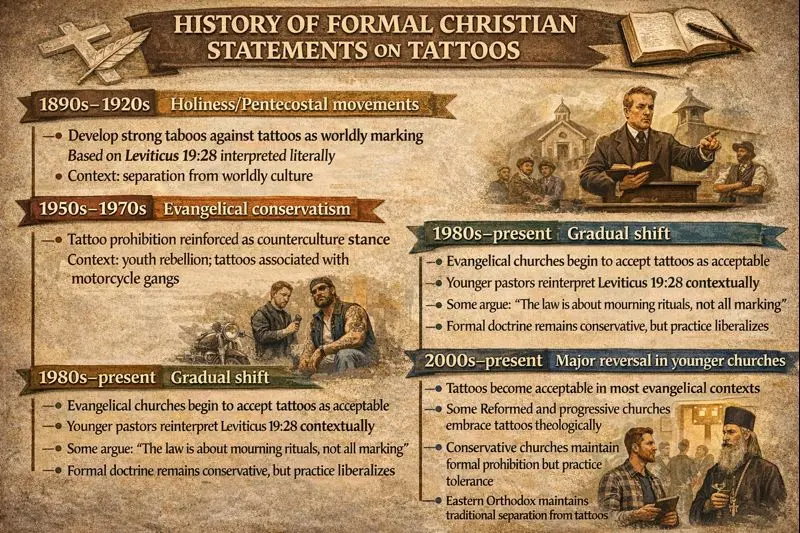
I examined when major Christian denominations addressed tattoos in their official positions:
History of formal Christian statements on tattoos. (Image: ABPray)
What’s striking is that the change in Christian practice on tattoos didn’t emerge from new scriptural insight or better biblical scholarship. It emerged from cultural change. As tattoos became mainstream in society, as doctors, lawyers, and professionals started getting them, Christian culture slowly followed. The biblical interpretation changed to match the change in social practice.
This reveals something about how Christian communities actually function: we interpret Scripture through the lens of our cultural moment, and when culture changes, our interpretation of Scripture changes to match.
Distinguishing categories: the hermeneutical problem
The core issue isn’t about tattoos. It’s about how we distinguish between different kinds of biblical law and instruction.
Christian theologians and pastors typically recognize three broad categories of Old Testament law:
Moral Law: Commands that reflect God’s eternal character and remain binding on Christians. Examples: don’t murder, don’t steal, honor parents, love your neighbor.
Ceremonial Law: Commands specific to the old covenant and the temple system, now fulfilled in Christ and no longer binding. Examples: animal sacrifice, temple offerings, dietary laws, purification rituals, Sabbath observance.
Civil Law: Commands specific to ancient Israel’s legal system, now binding only insofar as they reflect underlying moral principles. Examples: laws about punishment, laws about property, laws about slavery.
This threefold distinction was developed by medieval and Reformation theologians as a way to explain why Christians don’t follow all Old Testament laws. Christians don’t stone people for violating the Sabbath (civil law), don’t avoid shellfish (ceremonial law), but do prohibit murder (moral law).
The problem is that this categorization is not itself biblical. It’s a theological tool developed to make sense of how Christians relate to the Old Testament. And reasonable Christians disagree about which laws fall into which category.
Where should Leviticus 19:28 be placed?
If it’s ceremonial law: It’s specific to ancient Israel’s religious practices and not binding on Christians. The tattoo prohibition is obsolete.
If it’s moral law: It reflects something about God’s character and remains eternally binding. Christians should not get tattoos.
If it’s civil law: It’s binding insofar as it reflects an underlying moral principle. The question becomes: what is the underlying principle? Is it “don’t mark your body” (very broad) or “don’t participate in pagan mourning rituals” (more narrow)?
Different Christian traditions have made different calls:
Conservative evangelical and fundamentalist interpretation: Leviticus 19:28 is moral law. The prohibition on marking the body reflects God’s eternal will that human bodies remain unmarked. Tattoos violate this. The biblical principle is binding.
Moderate evangelical interpretation: Leviticus 19:28 is ceremonial law specific to ancient mourning rituals. The principle behind it, don’t participate in pagan religious practices, is still relevant, but getting a decorative tattoo is not participating in pagan mourning, so the law doesn’t apply.
Progressive/Reformed interpretation: Leviticus 19:28 is cultural law specific to ancient Israel’s context. It has no direct application to modern Christians. The question of tattoos should be decided based on other biblical principles (stewardship of the body, glorifying God) rather than on this specific prohibition.
Orthodox interpretation: The body is the temple of the Holy Spirit. Marking it permanently with a tattoo is disrespectful to the sacred nature of the body. Therefore, tattoos should be avoided, but this is based on the principle that the body is sacred, not specifically on Leviticus 19:28.
I sat with theologians from each of these traditions and asked them directly: “Why do you categorize Leviticus 19:28 the way you do?”
The fundamentalist pastor said: “It’s straightforward. The Bible says not to mark your body. I apply that literally. It’s God’s command.”
The moderate evangelical said: “The context is about mourning rituals and pagan worship. We’re not doing that, so the prohibition doesn’t apply to us. But we should still be respectful to our bodies.”
The progressive theologian said: “The law is a cultural artifact. It had meaning in ancient Israel. Now we interpret the principle, respect your body, in a contemporary context where a tattoo is a personal expression, not a religious practice.”
The Orthodox priest said: “The body is sacred. We teach this through many practices, fasting, avoiding intoxication. The prohibition on tattoos flows from this understanding, but it’s not the primary biblical teaching. The primary teaching is that your body is a temple.”
None of them are wrong, exactly. They’re simply making different judgments about how to apply ancient law in a contemporary context.
The crucial distinction: moral law, custom, and identity
Here’s where it gets deeper than just biblical categorization. The tattoo question reveals the difference between three things that are often conflated:
Moral law: Commands that reflect God’s character and are eternally binding. These commands reflect what’s actually right or wrong. Murdering is wrong not just because God commands against it, but because it’s wrong in itself, it violates the dignity and rights of another person. Stealing is wrong because it violates justice. These are binding eternally because they reflect eternal moral truth.
Custom: Practices that are appropriate within a specific culture or community but have no universal moral significance. What counts as respectful clothing varies by culture. What counts as appropriate personal presentation varies by culture. These are binding within a community but change across cultures and times.
Identity marker: Practices that signal belonging to a particular community or tradition. In some religious communities, distinctive dress marks membership. In some communities, specific tattoos mark group identity. These are socially significant but morally neutral.
The confusion around the tattoo prohibition comes from conflating these categories.
In conservative evangelical contexts, tattoo prohibition functioned as a custom and identity marker that became confused with moral law. For early 20th century Holiness churches, avoiding tattoos was a custom that marked separation from worldly culture. It became an identity marker, having no tattoos marked you as part of the holy, sanctified community. But over time, this custom and identity marker became presented as moral law, the claim that tattoos are actually wrong, reflecting God’s eternal character.
I interviewed a woman who’d grown up in a conservative evangelical church. She had a tattoo from before her conversion, and when she became Christian, she experienced profound shame about it. She said: “The church taught me that my tattoo was sin. That I had marked my body in disobedience. For years, I felt like I was carrying a mark of spiritual failure. I wore long sleeves to church. I was ashamed of my own body.”
Later, she moved to a different church that didn’t emphasize tattoo prohibition. She said: “The pastor there said, ‘Your body is sacred. Treating it with respect is important. But a tattoo isn’t disrespect, it’s a mark that means something to you.’ Suddenly the shame lifted. I could see the difference between a moral principle (honor your body) and a cultural rule (don’t get tattoos).”
This reveals the damage that occurs when customs are presented as moral laws. When a cultural practice becomes confused with God’s eternal will, people can experience deep shame for violating something that’s actually morally neutral.
The contextual history: what was actually happening in Leviticus 19:28
To understand what Leviticus 19:28 was actually addressing, I need to understand the context of ancient Near Eastern mourning practices and religious syncretism.
In the ancient world, cutting yourself or marking your body was a standard mourning practice. When someone died, family members would cut themselves as a physical expression of grief and as a way of identifying with the deceased. This is described in biblical texts as a normal practice.
But the practice had a deeper religious meaning. In Canaanite religion, marking oneself was also a way of showing devotion to particular deities. Baal worship involved ecstatic practices that included self-mutilation. The priests of Baal “cut themselves with swords and spears until the blood flowed” (1 Kings 18:28).
The prohibition in Leviticus 19:28 is addressing a specific problem: Israelites were adopting pagan mourning practices and pagan religious practices. They were marking their bodies both to mourn the dead and as a form of religious devotion to foreign gods.
The prohibition is not “don’t mark your body in general.” It’s “don’t mark your body for the dead” and implicitly, “don’t mark your body as a religious practice.” The underlying concern is spiritual: don’t participate in pagan religion. Don’t adopt the worship practices of surrounding nations. Maintain your distinctive identity as God’s people.
This context is crucial. The prohibition isn’t based on the idea that the human body is too sacred to mark. (That’s a different theology, developed later in Christian thought.) It’s based on the concern that marking your body was a pagan religious practice that Israelites should not adopt.
A scholar I spoke with put it this way: “Leviticus 19:28 is about cultural and religious identity. Israel was surrounded by pagan nations. The temptation was constant to adopt pagan practices, to worship pagan gods, to participate in pagan rituals. The prohibition on marking your body was one among many prohibitions designed to keep Israel distinct from pagan culture.”
The specific laws are designed to prevent syncretism, the blending of Israelite religion with pagan religion.
Now, the question for Christians becomes: Is this prohibition still binding, and if so, why?
If the concern is specifically about participating in pagan mourning rituals or pagan religious practices, then getting a decorative tattoo, which has no connection to pagan worship or mourning, would not violate the principle. The prohibition was context-specific.
If the concern is broadly about maintaining separation from worldly culture and distinctiveness as God’s people, then perhaps the principle is still binding, though it would apply differently in different cultural contexts.
The Christian transition: what changed between Old and New Testaments
The New Testament is largely silent on the topic of tattoos. There’s no explicit prohibition. There’s also no affirmation.
But the New Testament does address the broader question of how Christians relate to Old Testament law. This is the crucial transition.
In Acts 10, Peter has a vision where he sees animals that are ritually unclean and hears God say, “Get up, Peter. Kill and eat.” Peter refuses because the animals are unclean. God responds, “Do not call anything impure that God has made clean” (Acts 10:15). The vision was about food, but the principle was broader: the Old Testament dietary laws, which separated clean from unclean animals, were no longer binding.
Why? Because Christ had come. The old covenant had been fulfilled. The system of ritual purity that marked Israel as distinct from pagan nations was no longer necessary.
In Romans 14, Paul addresses debates about what foods are appropriate to eat and what days are appropriate to observe. He says: “Accept the one whose faith is weak, without quarreling over disputable matters… Each person should be fully convinced in their own mind… Some consider one day more sacred than others; each of them should be fully convinced in their own mind” (Romans 14:1-5). The point is that believers have freedom in these matters. They’re not issues of moral truth; they’re issues where different believers can reasonably disagree.
In Colossians 2:16-17, Paul writes: “Therefore do not let anyone judge you by what you eat or drink, or with regard to a religious festival, a New Moon celebration or a Sabbath day. These are a shadow of the things that were to come; the reality, however, is found in Christ.”
The pattern is clear: the Old Testament laws that were specifically about ritual purity and religious distinctiveness (dietary laws, Sabbath observance, festival observance) are no longer binding on Christians because they were specifically connected to the old covenant system. They were “shadows” that pointed to Christ.
The question becomes: Is the prohibition on tattoos a ritual law that falls into this category, or is it a moral law that remains binding?
If it’s a ritual law (a prohibition designed to maintain Israel’s distinctiveness through avoiding pagan practices), then it would fall away with the other ritual laws. Christians would not be bound by it.
If it’s a moral law (a prohibition reflecting God’s eternal character), then it would remain binding.
The problem is that Leviticus 19:28 appears in a chapter full of moral laws (love your neighbor, don’t steal, don’t lie) mixed with ritual laws (don’t eat meat with blood, don’t cut your hair). The chapter doesn’t make explicit which is which.
The real disagreement: what makes a law “moral”?
The fundamental disagreement among Christians isn’t really about tattoos. It’s about what makes a law “moral” versus “ceremonial.”
Fundamentalist/Conservative approach: A law is moral if it appears to apply to behavior that seems eternally wrong or right. Marking your body seems like something that could be eternally wrong (because bodies are sacred), so the law counts as moral. The conservative approach tends to apply a relatively high bar to counting something as ceremonial or culturally contingent. The default is to treat laws as binding unless there’s explicit indication they’re not.
Moderate/Evangelical approach: A law is moral if it reflects a principle that’s reaffirmed in the New Testament or if it addresses something that’s clearly wrong in itself. Since the New Testament doesn’t address tattoos specifically, and since getting a tattoo doesn’t seem inherently immoral (it’s not theft, murder, deception), the law is likely ceremonial or culturally contingent. The moderate approach applies a relatively high bar to treating something as eternally binding unless the principle is reaffirmed in the New Testament.
Progressive/Reformed approach: Laws should be evaluated based on the historical context and the underlying principle they address. Leviticus 19:28 addresses participation in pagan mourning rituals. That principle (don’t participate in pagan religious practices) is still relevant, but it applies differently in a Christian context than in ancient Israel. A decorative tattoo is not pagan religious practice, so the law doesn’t apply.
Orthodox approach: The body is sacred because it’s the temple of the Holy Spirit and will be resurrected. This underlying principle (reverence for the body) suggests that permanent marks or modifications should be approached carefully. But this isn’t specifically about Leviticus 19:28; it’s about a broader principle that Christian tradition has developed.
All of these approaches have some coherence. The disagreement isn’t that one interpretation is obviously right and the others obviously wrong. The disagreement is about what standard we use to evaluate biblical law.
The identity marker problem: how custom becomes law
One of the most interesting insights from my research came from recognizing how the tattoo prohibition functions as an identity marker in certain communities.
In conservative evangelical and fundamentalist churches, not having a tattoo historically marked you as part of the holy community. It was a visible sign of separation from worldly culture. The prohibition served a social function: it created a boundary. If you had a tattoo, you were marked as someone outside the holy community, someone whose body had been contaminated by worldly practice.
As a woman I interviewed explained: “In my church, not having tattoos was a sign that you were serious about your faith. If you had a tattoo, people assumed you were carnal, worldly, not truly committed to God. It was a status marker.”
This is a normal social function, communities develop practices that mark membership and signal commitment. The problem emerges when these identity markers become confused with moral law.
When the pastor told the young man with tattoos that it was “sin,” the pastor was conflating an identity practice (avoiding tattoos as a mark of separation from worldly culture) with moral law (the idea that getting a tattoo is actually wrong and violates God’s character).
The result is shame and spiritual damage. The young man internalized the message that his body was marked with sin. He carried that shame even though he got the tattoo before becoming Christian, even though, by his church’s own logic, he shouldn’t have been held responsible for it.
I interviewed a therapist who works with people leaving fundamentalist Christianity. She said: “One of the most common issues is shame about the body. Fundamentalist churches encode a lot of cultural preferences as spiritual law. Not having tattoos becomes about ‘purity.’ Not wearing certain clothes becomes about ‘modesty.’ Not dancing becomes about ‘worldliness.’ People internalize these as moral truths, as things that are actually wrong, when they’re really just cultural preferences that this particular community adopted.”
This reveals something crucial: the way we present moral law matters spiritually. If we present a custom as a custom, people can follow it or not based on their own judgment. If we present it as moral law, as something that’s actually wrong, people experience shame and guilt when they violate it.
What this reveals about Christian hermeneutics
The tattoo question, examined carefully, reveals something profound about how Christians actually interpret Scripture.
The process is not:
Read the text
Determine its meaning
Apply that meaning to modern life
The actual process is more like:
Hold current cultural practice
Read the text through the lens of that practice
Interpret the text to either affirm or challenge that practice
When culture changes, reinterpret the text
This isn’t cynical. It’s simply how human interpretation works. We’re always reading ancient texts through the lens of our contemporary moment. The question is whether we acknowledge that or pretend we’re engaging in “pure” biblical interpretation untainted by culture.
Conservative Christian hermeneutics often maintains the fiction that it’s doing pure textual interpretation, “the Bible clearly says…”, when in fact it’s making cultural judgments about what the text means and what obligations it places on modern readers.
Progressive Christian hermeneutics is more honest about this process. It acknowledges that interpretation is always culturally situated, that we’re always reading ancient texts in light of contemporary understanding, that we need to distinguish between the principle a law was addressing and how that principle applies in different contexts.
But honesty doesn’t resolve the hermeneutical problem. It just makes it visible. Even if we acknowledge that interpretation is culturally situated, we still have to make judgments about what Scripture means and how it applies.
The deeper question: moral law, obedience, and Christian Iidentity
Underneath all the debate about tattoos is a deeper theological question: What makes something binding on Christians?
For conservative Christianity, the answer tends to be: If the Bible says it, it’s binding. We need strong reasons to think a particular law doesn’t apply to us. The default is obedience to biblical commands unless we have explicit warrant to think they’re culturally contingent.
For progressive Christianity, the answer tends to be: We need to understand the historical context and underlying principle a law addresses, then ask whether and how that principle applies to us. The default is that ancient laws are culturally contingent unless we have good reasons to think they’re expressing eternal moral truth.
These are genuinely different hermeneutical approaches, and they produce different results.
I sat with a fundamentalist pastor and a progressive theologian and asked them: “If the Bible commanded something tomorrow that contradicted modern ethics, for example, if there were a clear biblical command to enslave certain people, what would you do?”
The fundamentalist said: “I’d have to follow Scripture. Even if it contradicted my understanding, the Bible is authoritative. But I don’t think Scripture would ever contradict genuine morality because Scripture is the foundation of morality.”
The progressive said: “I’d recognize that Scripture reflects the culture of its time. I’d look at the underlying principle and ask whether that principle is eternally true. In the case of slavery, I’d say the principle of human dignity and freedom has become clearer to us through history and reason. I’d affirm that principle while rejecting the ancient law.”
The fundamental difference is about the relationship between Scripture and morality. For the fundamentalist, Scripture is the foundation, morality is defined by Scripture. For the progressive, morality has some independent standing, we can evaluate Scripture through the lens of moral principles that we recognize through reason and experience.
This difference shows up in the tattoo debate. A fundamentalist will say, “The Bible says not to mark your body, so it’s wrong.” A progressive will say, “The Bible was addressing specific pagan practices. In our context, a tattoo is personal expression, not pagan worship, so it’s not wrong.”
Both approaches have coherence. The disagreement is fundamental.
What I’ve concluded
After two years of engagement with this question, studying the text, examining the history of interpretation, interviewing practitioners and theologians, observing how churches have actually changed their position, I’ve come to something like a conclusion, though it’s more of a set of recognitions than settled answers.
First: The biblical prohibition in Leviticus 19:28 is specifically about marking your body for the dead as part of mourning rituals or as part of pagan religious practice. It’s not a blanket prohibition on all body marking.
Second: This prohibition was part of a larger framework designed to maintain Israel’s distinctiveness from pagan culture. It had specific historical and religious context.
Third: Christian interpretation of this law has been filtered through cultural values that have more to do with specific historical movements (Holiness movement, fundamentalism, American evangelicalism) than with direct biblical reading. The tattoo prohibition became associated with spiritual separation and identity in ways that went beyond what the biblical text actually requires.
Fourth: The confusion between moral law, custom, and identity marker has caused real spiritual harm. People have experienced shame about their bodies because cultural preferences were presented as moral absolutes.
Fifth: Different Christian traditions have reasonably arrived at different conclusions. A conservative Christian who reads Leviticus 19:28 as a principle about respecting the body’s sacredness can coherently maintain that tattoos should be avoided. A progressive Christian who contextualizes the prohibition as addressing pagan religious practice can coherently maintain that tattoos are morally neutral. Both are making defensible hermeneutical choices.
What concerns me is not that Christians disagree on this issue. It’s that the disagreement is often presented as obvious, “the Bible clearly says…” or “anyone who really knows Scripture would understand…”, when in fact it’s based on hermeneutical choices that are debatable and historically contingent.
The young man with the tattoo didn’t sin. He made a personal aesthetic choice that has no moral significance. The shame he experienced was not biblically warranted. It emerged from a cultural taboo that had become confused with moral law.
The real wisdom, I think, is recognizing the difference between Scripture’s actual claims and the cultural values we’ve encoded in those claims. That recognition allows for both respect for Scripture and freedom from unnecessary shame.
José Lucas is a researcher driven by a lifelong fascination with the history of religions and how faith shapes the human experience. Specializing in the historical contexts of diverse traditions, José possesses a unique ability to translate ancient wisdom into practical, relevant insights for the modern seeker. At ABPray, his mission is to guide readers through the world’s vast spiritual heritage with both curiosity and reverence. He plays a crucial role in our Content Creation and Fact-Checking process, ensuring that all biblical, historical, and doctrinal references are grounded in legitimate sources and in-depth research. Through his articles and guides, José promotes understanding and compassion, connecting the facts of the past with the contemporary search for purpose. His work is essential in establishing ABPray as a global reference for interfaith content, nurturing the universal values that unite all of humanity.
To provide the best experiences, we use technologies like cookies to store and/or access device information. Consenting to these technologies will allow us to process data such as browsing behavior or unique IDs on this site. Not consenting or withdrawing consent, may adversely affect certain features and functions.
Functional
Always active
The technical storage or access is strictly necessary for the legitimate purpose of enabling the use of a specific service explicitly requested by the subscriber or user, or for the sole purpose of carrying out the transmission of a communication over an electronic communications network.
Preferences
The technical storage or access is necessary for the legitimate purpose of storing preferences that are not requested by the subscriber or user.
Statistics
The technical storage or access that is used exclusively for statistical purposes.The technical storage or access that is used exclusively for anonymous statistical purposes. Without a subpoena, voluntary compliance on the part of your Internet Service Provider, or additional records from a third party, information stored or retrieved for this purpose alone cannot usually be used to identify you.
Marketing
The technical storage or access is required to create user profiles to send advertising, or to track the user on a website or across several websites for similar marketing purposes.