Published on January 9, 2026 at 12:58 PMUpdated on January 9, 2026 at 12:58 PM
I made an error. It was the kind of error that looks reasonable until you’ve spent enough time inside a tradition to see how profoundly you’ve misunderstood it.
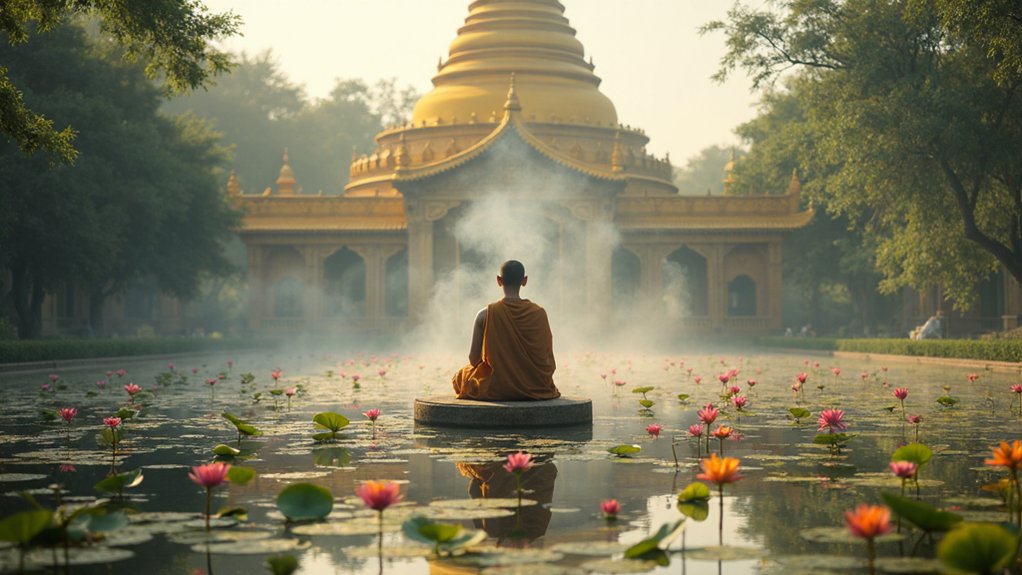
How to explain Buddhist non-theism is a lie (image: Abpray)
The error was this: I believed that Buddhism was “non-theistic,” and I understood what that meant.
I thought it meant Buddhism simply lacked God. No creator. No Supreme Being. No eternal judge. A religion, in other words, like secular humanism with meditation.
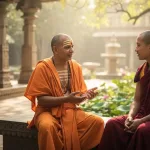
This belief survived until I sat with three practitioners from three different Buddhist traditions, a Theravada monk from Thailand, a Zen teacher from Japan, and a Tibetan Buddhist lama, and asked them each the same question: “Is there anything in Buddhism that functions like God?”
Their answers were so different that I realized my textbook understanding had been not just incomplete, but fundamentally wrong.
The Theravada monk said: “No. There is no God. The Buddha is not a God. Enlightenment is not union with God. There is only the Dharma, the law of how things work.”
The Zen teacher said: “Calling it non-theistic is misleading. Buddha-nature is not God, but it’s also not nothing. It’s the nature of mind itself. When we point to it, we’re pointing to something that pervades everything.”
The Tibetan lama said: “We have hundreds of deities. They are not Gods, they are enlightened beings. But they respond to prayer, they grant blessings, they protect practitioners. If you call that ‘not theistic,’ you’re using words in a way that avoids rather than clarifies.”
I realized, sitting with these three men, that “Buddhism is non-theistic” is a statement so compressed and reductive that it erases everything important about what actually happens inside Buddhist practice.
Buddhism doesn’t lack God. Buddhism has reorganized what “God” means, and in doing so, has created something that looks remarkably similar to theistic religion while claiming to be fundamentally different.
This is not a criticism. It’s an observation. And understanding it requires abandoning the textbook definition and sitting inside the actual structure of what Buddhist practitioners do, believe, and experience.
The apophatic mirror: why negative theology looks like Buddhism
When I told a Christian mystic scholar about the Tibetan lama’s claim that Buddhas “respond to prayer,” she laughed.
“That’s just apophatic theology,” she said. “It’s Pseudo-Dionysius dressed up in Sanskrit.”
Apophatic theology is the tradition within Christianity (and within Judaism, Islam, and Sufism) that says: God cannot be known through concepts. All our statements about God are false. The only honest approach to God is negative theology, saying what God is not, rather than what God is.
When a Christian mystic says “God is beyond all names and forms,” and a Buddhist says “Buddha-nature is empty of all conceptual elaboration,” they are making structurally identical claims.
Both are saying: the ultimate reality transcends language, form, and conceptual understanding. Both are saying: attempts to define it are failures. Both are saying: you can only approach it through negation.
In fact, when I read the apophatic theology of Meister Eckhart, the medieval Christian mystic, I found passages that are almost indistinguishable from Buddhist philosophy:
Eckhart: “God is not being and not goodness. Goodness does not touch God. God is beyond goodness.”
A Buddhist would say: “Ultimate reality is empty of being and non-being. No conceptual elaboration can capture it.”
Eckhart: “The soul becomes so intimate with God that all distinction falls away. It is not that the soul becomes God, but that it becomes One with God in such a way that ‘soul’ and ‘God’ are no longer separate concepts.”
A Buddhist would say: “Through meditation, the illusion of separation between subject and object dissolves. There is not ‘you’ meditating on ’emptiness,’ but the direct realization of emptiness itself.”
The Christian scholar I spoke with, Dr. Kate Smith, a specialist in apophatic theology, told me something that reframed my entire understanding:
“The reason Buddhism and apophatic Christianity sound so similar is that they’re pointing to a real ontological problem. When you try to speak about ultimate reality, whether you call it God or Sunyata, you run into the same wall: language fails. Concepts fail. All you can do is point. Both traditions discovered this independently and developed sophisticated methods for living inside that failure. But what they do with that failure is different.”
“How?” I asked.
“Christianity says: even though we cannot speak of God, God speaks to us. God reveals himself. The failure of our language does not mean God is not real or relational. Buddhism says: even though we cannot speak of ultimate reality, we can investigate the mechanism of how language and concept create illusion. The failure of language shows us something about the nature of mind itself.”
So both are non-theistic in one sense, both reject the idea that you can capture ultimate reality in concepts or form. But they diverge sharply in whether the ultimate reality is relational (reaches toward you in revelation) or non-relational (reveals itself as the nature of mind/emptiness).
This distinction matters. Because it’s the hinge on which everything else turns.
Where the similarity becomes disguised: Buddha-nature as soul
Here’s where the textbook understanding of Buddhism collapses completely.
In Mahayana Buddhism, the form practiced in East Asia, Tibet, and increasingly in the West, there is a concept called Buddha-nature. It is taught that:
All sentient beings possess Buddha-nature
Buddha-nature is inherent, not acquired
Buddha-nature is eternal (it exists across all lives and all time)
Buddha-nature is immaculate (not defiled by karma, greed, or confusion)
The goal of practice is the “actualization” or “manifestation” of Buddha-nature
Now read this description of the Christian soul:
All persons possess a soul
The soul is created by God (given, inherent)
The soul is eternal (survives the body, goes to heaven or hell)
The soul is made in the image of God (carries divine essence, not defiled by nature)
The goal of Christian life is the “manifestation” of the soul’s divine nature
The structural parallels are uncanny.
I asked a Zen teacher, Sensei David, about this, and his response was surprising:
“You’re noticing something real. Buddha-nature is not exactly a soul, but it functions very similarly in practice. When a practitioner in our tradition hears ‘all beings have Buddha-nature,’ it lands in the mind the same way ‘all beings have a soul made in God’s image’ lands in a Christian mind. Both of them are saying: you have something essential, eternal, and sacred within you.”
“So Buddhism is theistic after all?” I asked.
“Not theistic,” he said carefully. “But it has created something that serves the same existential function as the soul in theistic religion. It’s a way of saying: you are not just a temporary arrangement of matter and energy. There is something about you that is real, permanent, and not reducible to your circumstances.”
This is the moment I realized: the question ‘Is Buddhism theistic?’ is poorly framed, because it assumes that the presence or absence of God is the defining feature of a worldview.
What actually matters is whether the tradition posits an eternal, irreducible, sacred essence. And on that criterion, Mahayana Buddhism does posit such an essence, it just calls it Buddha-nature instead of soul, and it tries to claim that this essence is “empty,” which is a form of conceptual maneuvering I’ll address in a moment.
The immortal vow: how Bodhisattva promises become eternal souls
In Mahayana Buddhism, practitioners take what’s called the Bodhisattva Vow. It sounds like this:
“However innumerable sentient beings are, I vow to save them. However inexhaustible the defilements are, I vow to extinguish them. However immeasurable the dharmas are, I vow to master them. However incomparable enlightenment is, I vow to attain it.”
This vow is taught as binding across all lives and all time. A practitioner who takes this vow is understood to be committing not for this lifetime, but forever, until all sentient beings are liberated.
In Tibetan Buddhism, this vow is deepened through guru devotion. You commit yourself to a teacher for lifetimes, following their guidance through infinite rebirths, trusting that the relationship will lead you toward enlightenment.
Now, let me point out what’s happening here: a Buddhist practitioner is making a promise that transcends death, rebirth, and ordinary time. They are binding their eternal continuity to a vow and a relationship.
This is not what a non-theistic, non-essentialist, emptiness-based system is supposed to look like.
In pure Theravada Buddhism, the form in Thailand, Sri Lanka, Burma, there is no Bodhisattva Vow. Each practitioner is responsible for their own enlightenment in their own lifetime. There is no eternal commitment, no carrying of vows across lives, no devotion to gurus across eternity.
But in Mahayana, which represents the majority of Buddhists globally, you have practitioners making eternal vows, cultivating eternal relationships with enlightened beings (Buddhas, Bodhisattvas), and carrying their spiritual commitments across lifetimes.
How is this different from a monotheistic believer’s eternal covenant with God?
I asked Sensei David: “When you take the Bodhisattva Vow, are you not essentially creating an eternal self, the self that made the vow, that continues to carry the vow, that will fulfill the vow across lifetimes?”
He paused for a long time. “Yes. That’s exactly what happens. And it contradicts the doctrine that there is no self. The bodhisattva path is shot through with this contradiction. We posit no-self as ultimate truth, but we practice as if there is a continuity of self that persists and can commit itself eternally.”
“How do you live with that contradiction?” I asked.
“Carefully,” he said. “And with a tolerance for paradox that most Western practitioners don’t have when they come to Buddhism.”
Vajrayana’s secret: how Buddhism rebuilt the pantheon
This is where the disguise becomes complete.
Vajrayana Buddhism, the form practiced in Tibet, Bhutan, and Mongolia, explicitly teaches that there are countless enlightened beings: Buddhas, Bodhisattvas, dakinis, protectors. These beings are understood to:
Have attained enlightenment and exist in pure realms
Possess powers beyond ordinary human comprehension
Respond to prayer and ritual
Grant blessings and protection to practitioners
Have specific iconographies, narratives, and mythologies
In Vajrayana practice, you do not meditate on emptiness directly. You visualize yourself as a deity, as an enlightened being with all its powers and forms. You make offerings to Buddhas. You ask for blessings. You build relationships with enlightened beings across multiple lifetimes.
When I asked a Tibetan lama about this, he said: “The deities are not Gods. They are enlightened beings who have manifest in form to help practitioners.”
“But,” I said, “they have all the properties of Gods: they’re eternal, they respond to worship, they grant blessings, they have specific cosmologies and narratives. What’s the substantive difference?”
He smiled. “The difference is that they were not always enlightened. They achieved enlightenment through practice, just as you can. This makes them models rather than creators. But experientially, functionally, yes, the worship looks very similar to theistic worship.”
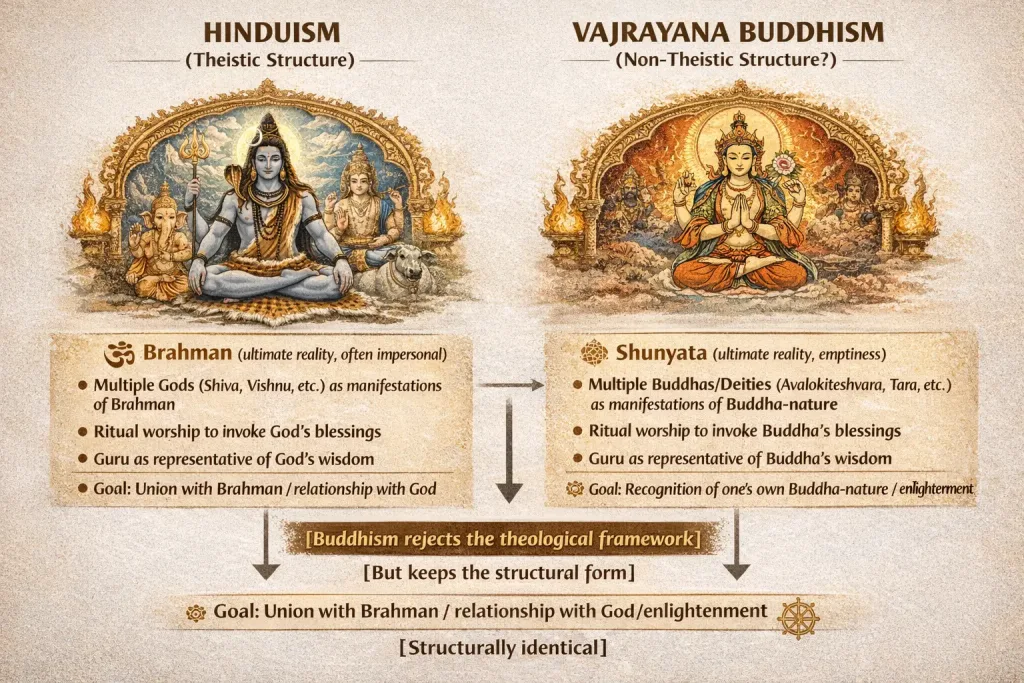
This is the critical move: Vajrayana Buddhism has recreated the entire pantheon and ritual structure of Hindu theism, but framed it as the manifestation of enlightened beings rather than Gods.
Here’s a diagram of what happened:
Diagram: Hinduism and Vajrayana Buddhism. (Image: ABPray)
What Vajrayana did was take the form of theistic religion and replace the theological content while keeping the functional structure. It’s as if you took a church, removed God, replaced him with enlightened beings, and said: “Now it’s non-theistic.”
But for the practitioner on their knees making offerings, the difference is subtle at best.
The Christian mystic’s recognition
I brought these five definitions to Dr. Kate Smith, the Christian apophatic theologian, and asked: “Do these even qualify as non-theistic?”
She said: “No. Most of these are just reorganized theism. The Mahayana claim that Buddha-nature is not God but functions like a soul, serves the same existential role as God. The Vajrayana structure of Buddhas and deities is functionally theistic religion with different names. Even the apophatic claim, that ultimate reality transcends all concepts, is something Christianity already has.”
“So Buddhism isn’t actually non-theistic?” I asked.
“I’d say it’s a-theistic,” she said. “Meaning: it sidesteps the question of whether God exists. Instead of saying ‘God doesn’t exist,’ it says ‘the question of God is not relevant to liberation.’ And then it goes about creating theological structures anyway.”
“Why would it do that?” I asked.
“Because humans need theology. We need metaphysical frameworks. We need to know where we stand in relation to the transcendent. Buddhism tried to build a system without theology, discovered it couldn’t maintain that, and gradually reintroduced theology while claiming it wasn’t theology.”
This is the insight that crystallized everything for me: Buddhism didn’t succeed in being non-theistic. It succeeded in creating a non-theistic-sounding language for fundamentally theistic (or at least religio-metaphysical) structures.
The practice-belief divide: what buddhists actually do vs. what they claim
There’s a profound gap between what Buddhist doctrine says and what Buddhist practitioners do.
Doctrine says: There is no God. There is no eternal self. All concepts are provisional.
But practitioners:
Make eternal vows that bind them across lifetimes (positing eternal self)
Worship Buddhas and ask for blessings (functionally theistic)
Develop profound relationships with gurus that they believe will continue forever (positing relationship continuity)
Visualize themselves as enlightened beings (positing identity transformation)
Make merit and dedicate it to others (positing causal efficacy of devotion)
The Zen teacher, Sensei David, acknowledged this: “What we teach in the meditation hall is not the same as what we teach in the ritual chamber. In the meditation hall, we’re deconstructing the self. In the ritual chamber, we’re affirming it. Most practitioners navigate between these two spaces without fully reconciling them.”
“Is that intellectually honest?” I asked.
“No,” he said. “But it might be psychologically necessary. The deconstructed self is very difficult to live from. Most people need some structure, some continuity. So the tradition provides both, the radical deconstruction and the gradual path of commitment.”
This is where I realized: Buddhism is not actually non-theistic. It’s bi-theistic, it holds two contradictory views of the self and ultimate reality simultaneously, and practitioners are expected to navigate between them.
The question that breaks open the entire framework
Near the end of my conversations, I asked each practitioner the same question: “If I practice Theravada Buddhism and achieve enlightenment, what happens to me?”
Theravada monk: “You cease. The illusion of a separate self dissolves. There is no longer anyone there.”
Then I asked: “If I practice Mahayana Buddhism and achieve Buddhahood, what happens to me?”
Zen teacher: “You recognize that you were never separate to begin with. But that recognition is not a cessation, it’s an awakening. You continue, but you understand yourself completely differently.”
Tibetan lama: “You manifest as an enlightened being across multiple dimensions. You continue to work for the liberation of all beings. Your mind becomes inseparable from the minds of all Buddhas.”
“These are incompatible,” I said. “In the first, you cease. In the second, you awaken to continuity. In the third, you become eternal across many realms.”
All three men nodded.
“So which is Buddhism?” I asked.
“All of them,” the Tibetan lama said. “Depending on what you mean by ‘Buddhism.'”
The historical knot: why this happened
The reason Buddhism evolved these contradictory systems is historical and practical.
When Buddhism spread from India to China, Tibet, and Japan, it encountered cultures with deep theistic and cosmological traditions. Practitioners brought their assumptions with them. Over centuries, Buddhism adapted, incorporating local deities (reinterpreted as Buddhas), creating ritual structures (reinterpreted as wisdom practices), and positing eternal beings (reinterpreted as manifestations of emptiness).
But it never explicitly reconciled these additions with the original teaching of the Buddha, which was genuinely non-theistic and focused on the ending of self.
The result is that modern Buddhism contains:
A Theravada strand that retained something closer to the original non-theistic vision
A Mahayana strand that reintroduced Buddha-nature (eerily similar to soul) and eternal commitment
A Vajrayana strand that fully reconstructed theistic religion while denying it
All three claim continuity with the Buddha. All three claim to be non-theistic. None of these claims are entirely true.
The lived paradox: what this means for practitioners
Here’s what I understood by the end: a Buddhist practitioner is not simply practicing a single coherent system. They are navigating multiple, contradictory systems, sometimes within a single tradition.
A Zen practitioner sits in meditation and deconstructs the self, experiencing emptiness. Then they bow to the Buddha and make a vow to liberate all beings, implicitly affirming both the reality of the self that makes the vow and the reality of the beings it will save.
A Tibetan practitioner visualizes themselves as an enlightened deity (positing essential nature, eternal form) while simultaneously being taught that this visualized form is empty of inherent existence (denying essential nature).
A Theravada practitioner follows a path of individual effort to end the self, while also relying on the teachings of the Buddha as an external authority that guides their practice.
These are not minor inconsistencies. These are fundamental contradictions about what reality is and what you are.
But here’s what I noticed: the practitioners I spoke with were not troubled by this. They moved between these systems with grace and intelligence, holding them simultaneously without trying to reconcile them.
The Zen teacher said: “We call this ‘the gateless gate.’ You pass through it by not trying to make it coherent.”
The Tibetan lama said: “The contradiction is the teaching. When you stop trying to resolve it, you’ve begun to understand.”
The final question: which Buddhism are you actually practicing?
I want to leave you with this:
When someone tells you that “Buddhism is non-theistic,” they are not describing Buddhism. They are describing one interpretation of one strand of one school of Buddhism, and even that interpretation is contested.
Buddhism is far more complex, far more self-contradictory, and far more theistic-in-function than the textbook understanding admits.
You might be practicing:
Theravada Buddhism: genuinely non-theistic, focused on individual effort and the cessation of self. This is closest to Buddhism without God.
Zen Buddhism: apophatic non-theism, where ultimate reality transcends concepts but direct realization is available now. Functionally very close to Christian mysticism.
Pure Land Buddhism: explicitly theistic, focusing on devotion to Amitabha Buddha, who grants blessings and guides practitioners to his Pure Land. This is functionally identical to Christian salvation religion.
Tibetan Buddhism: hierarchical non-theism, where you relate to Buddhas and gurus with the devotion and trust you might give to God, believing that relationship will guide you to enlightenment. Functionally theistic.
Secular Buddhism: pragmatic non-theism, stripping Buddhism of metaphysics and treating it as psychology and technique. This avoids the question entirely.
All of these claim to be Buddhism. All of them contradict each other on fundamental questions: Does the self exist? Is enlightenment cessation or awakening? Do enlightened beings respond to devotion? Is ultimate reality one or many?
The honest answer is: Buddhism is not a single worldview. It’s a family of related but contradictory worldviews that happen to share a name and a founder.
So the question for you is not: “Is Buddhism theistic or non-theistic?”
The question is: Which Buddhism are you actually practicing? And do you understand what metaphysical commitments you’re making with each practice you engage in?
Because if you’re doing Tibetan deity yoga and also professing non-theism, you’re not being intellectually rigorous. You’re navigating a contradiction the way the tradition teaches you to navigate it, by not asking what it means.
José Lucas is a researcher driven by a lifelong fascination with the history of religions and how faith shapes the human experience. Specializing in the historical contexts of diverse traditions, José possesses a unique ability to translate ancient wisdom into practical, relevant insights for the modern seeker. At ABPray, his mission is to guide readers through the world’s vast spiritual heritage with both curiosity and reverence. He plays a crucial role in our Content Creation and Fact-Checking process, ensuring that all biblical, historical, and doctrinal references are grounded in legitimate sources and in-depth research. Through his articles and guides, José promotes understanding and compassion, connecting the facts of the past with the contemporary search for purpose. His work is essential in establishing ABPray as a global reference for interfaith content, nurturing the universal values that unite all of humanity.
To provide the best experiences, we use technologies like cookies to store and/or access device information. Consenting to these technologies will allow us to process data such as browsing behavior or unique IDs on this site. Not consenting or withdrawing consent, may adversely affect certain features and functions.
Functional
Always active
The technical storage or access is strictly necessary for the legitimate purpose of enabling the use of a specific service explicitly requested by the subscriber or user, or for the sole purpose of carrying out the transmission of a communication over an electronic communications network.
Preferences
The technical storage or access is necessary for the legitimate purpose of storing preferences that are not requested by the subscriber or user.
Statistics
The technical storage or access that is used exclusively for statistical purposes.The technical storage or access that is used exclusively for anonymous statistical purposes. Without a subpoena, voluntary compliance on the part of your Internet Service Provider, or additional records from a third party, information stored or retrieved for this purpose alone cannot usually be used to identify you.
Marketing
The technical storage or access is required to create user profiles to send advertising, or to track the user on a website or across several websites for similar marketing purposes.