Published on October 19, 2025 at 4:03 PMUpdated on October 19, 2025 at 4:03 PM
If you’re curious about how Buddhism began in ancient India, you’re about to explore one of the most influential spiritual stories in world history. The beginnings of Buddhism are closely tied to the life of Siddhartha Gautama, a prince whose personal journey, from privilege to profound enlightenment, sparked a movement that forever transformed Asia and later the entire world. When you learn how Buddhism began in ancient India, you also uncover the early teachings that shaped this tradition, most notably the Four Noble Truths, which explain the nature of suffering and offer a path to liberation.
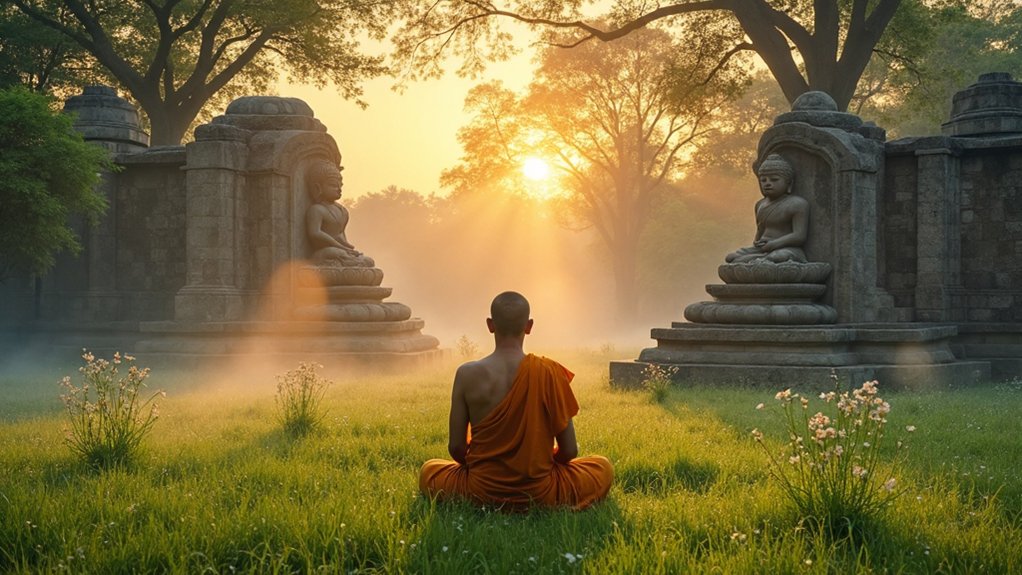
How Buddhism began in ancient India (image: Abpray)
Understanding how Buddhism began in ancient India also helps you appreciate how its teachings spread far beyond its birthplace, inspiring countless cultures with messages of compassion, mindfulness, and inner wisdom. This long, transformative journey, from a single seeker to a global spiritual tradition, makes the story of Buddhism’s beginnings truly extraordinary.
The Life of Siddhartha Gautama: The Path to Enlightenment
At the heart of understanding how Buddhism began in ancient India is the life of Siddhartha Gautama, the historical figure who would become known as the Buddha, or “the Enlightened One.” Born in the 5th century BCE in the foothills of the Himalayas, Siddhartha belonged to a royal family that provided him with every comfort imaginable. According to traditional accounts, his father shielded him from the hardships of the world, hoping Siddhartha would grow into a powerful ruler rather than a spiritual seeker.
However, the story of how Buddhism began in ancient India truly begins when Siddhartha left the palace and encountered what are known as the Four Sights: an old man, a sick man, a corpse, and a spiritual ascetic. These encounters revealed to him a universal truth, no amount of wealth or comfort can protect anyone from aging, illness, or death. This realization deeply unsettled Siddhartha and ignited a powerful desire to understand the nature of suffering.
Determined to find answers, Siddhartha renounced his luxurious life and embarked on a spiritual quest. He spent years practicing extreme self-discipline, meditation, and austerity. Yet he soon realized that neither indulgence nor extreme deprivation led to true understanding. This insight led him to the Middle Way, a balanced path between excess and hardship.
Siddhartha’s transformation into the Buddha occurred beneath the Bodhi tree in Bodh Gaya, where he meditated until he attained profound enlightenment. This awakening revealed the true causes of suffering and the path to freedom from it. From that moment, the Buddha dedicated his life to teaching others how to overcome suffering and achieve inner peace.
The powerful story of Siddhartha Gautama remains central to understanding how Buddhism began in ancient India. His journey continues to inspire millions who seek a more mindful, compassionate way of life.
The Four Noble Truths: The Foundation of Buddhist Teaching
To understand how Buddhism began in ancient India, you must explore the core teachings that the Buddha shared after his enlightenment. At the heart of his message are the Four Noble Truths, which serve as the foundational structure of Buddhist philosophy.
1. The Truth of Suffering (Dukkha)
The Buddha taught that suffering is a natural part of life. Whether it takes the form of physical pain, emotional distress, or dissatisfaction, suffering affects everyone.
2. The Truth of the Cause of Suffering (Samudaya)
According to the Buddha, the root cause of suffering is desire, or attachment. Our cravings, for pleasure, power, status, or permanence, create cycles of disappointment.
3. The Truth of the End of Suffering (Nirodha)
The Buddha taught that it is possible to end suffering by letting go of attachment. This state of liberation is known as nirvana.
4. The Truth of the Path to the End of Suffering (Magga)
The Buddha outlined the Eightfold Path, a guide to ethical conduct, mindful living, and mental discipline.
These Four Noble Truths provide a clear and practical way to understand the human condition, making them essential for anyone who wants to know how Buddhism began in ancient India. By learning and applying these teachings, individuals can cultivate peace, resilience, and inner clarity.
How Buddhism Began in Ancient India and Spread Beyond Its Borders
While Buddhism began in ancient India as a regional movement, it quickly grew into a global spiritual tradition. Understanding how Buddhism began in ancient India also means recognizing the cultural, political, and spiritual forces that helped it flourish beyond its birthplace.
After the Buddha’s death, his disciples organized teachings into oral traditions known as the Tripitaka. These teachings preserved his message and were later written down, helping Buddhism spread more widely.
Missionaries and Early Expansion
One of the most influential supporters of Buddhism was Emperor Ashoka, who ruled India in the 3rd century BCE. After converting to Buddhism, Ashoka sent missionaries throughout Asia, including Sri Lanka, Nepal, and Central Asia. His support played a crucial role in broadening Buddhist influence and establishing monasteries across the region.
Cultural Adaptation and Diversity
As Buddhism spread, it adapted to local beliefs and cultural practices. This led to the development of different branches of Buddhism, such as:
Theravada Buddhism, prominent in Sri Lanka and Southeast Asia
Mahayana Buddhism, influential in China, Korea, and Japan
Vajrayana Buddhism, centered in Tibet and Mongolia
Each tradition maintained the Buddha’s essential teachings while expressing them through unique cultural lenses.
Global Legacy
The spread of Buddhism beyond India shaped art, literature, architecture, and philosophy in countless cultures. Its teachings on compassion, nonviolence, and mindfulness influenced everything from daily meditation practices to modern psychology.
Understanding how Buddhism began in ancient India and expanded globally reveals the profound adaptability of its teachings and the universal relevance of its message.
Conclusion: Why Understanding the Beginnings of Buddhism Matters
Learning how Buddhism began in ancient India offers valuable insight into one of the world’s most enduring and influential spiritual traditions. Buddhism originated with Siddhartha Gautama, who questioned the nature of suffering and ultimately achieved enlightenment. His teachings, such as the Four Noble Truths, became the foundation of a philosophy that continues to help people navigate life’s challenges with mindfulness and compassion.
As Buddhism began in ancient India and spread across Asia, it evolved into a diverse global tradition that touches millions of lives. By exploring how Buddhism began in ancient India, you gain a deeper understanding of its universal teachings and its ability to inspire personal transformation.
Whether you’re studying history, spirituality, or simply looking for wisdom to apply in daily life, the story of how Buddhism began in ancient India offers timeless guidance and insight.
José Lucas is a researcher driven by a lifelong fascination with the history of religions and how faith shapes the human experience. Specializing in the historical contexts of diverse traditions, José possesses a unique ability to translate ancient wisdom into practical, relevant insights for the modern seeker. At ABPray, his mission is to guide readers through the world’s vast spiritual heritage with both curiosity and reverence. He plays a crucial role in our Content Creation and Fact-Checking process, ensuring that all biblical, historical, and doctrinal references are grounded in legitimate sources and in-depth research. Through his articles and guides, José promotes understanding and compassion, connecting the facts of the past with the contemporary search for purpose. His work is essential in establishing ABPray as a global reference for interfaith content, nurturing the universal values that unite all of humanity.
To provide the best experiences, we use technologies like cookies to store and/or access device information. Consenting to these technologies will allow us to process data such as browsing behavior or unique IDs on this site. Not consenting or withdrawing consent, may adversely affect certain features and functions.
Functional
Always active
The technical storage or access is strictly necessary for the legitimate purpose of enabling the use of a specific service explicitly requested by the subscriber or user, or for the sole purpose of carrying out the transmission of a communication over an electronic communications network.
Preferences
The technical storage or access is necessary for the legitimate purpose of storing preferences that are not requested by the subscriber or user.
Statistics
The technical storage or access that is used exclusively for statistical purposes.The technical storage or access that is used exclusively for anonymous statistical purposes. Without a subpoena, voluntary compliance on the part of your Internet Service Provider, or additional records from a third party, information stored or retrieved for this purpose alone cannot usually be used to identify you.
Marketing
The technical storage or access is required to create user profiles to send advertising, or to track the user on a website or across several websites for similar marketing purposes.