I sat with a Hindu Priest and a Buddhist Monk for six hours. Here’s what they revealed about why their traditions can’t agree on anything, including reality Itself
Published on January 8, 2026 at 4:00 PMUpdated on January 8, 2026 at 4:00 PM
The conversation began with a disagreement about whether a conversation was even possible.
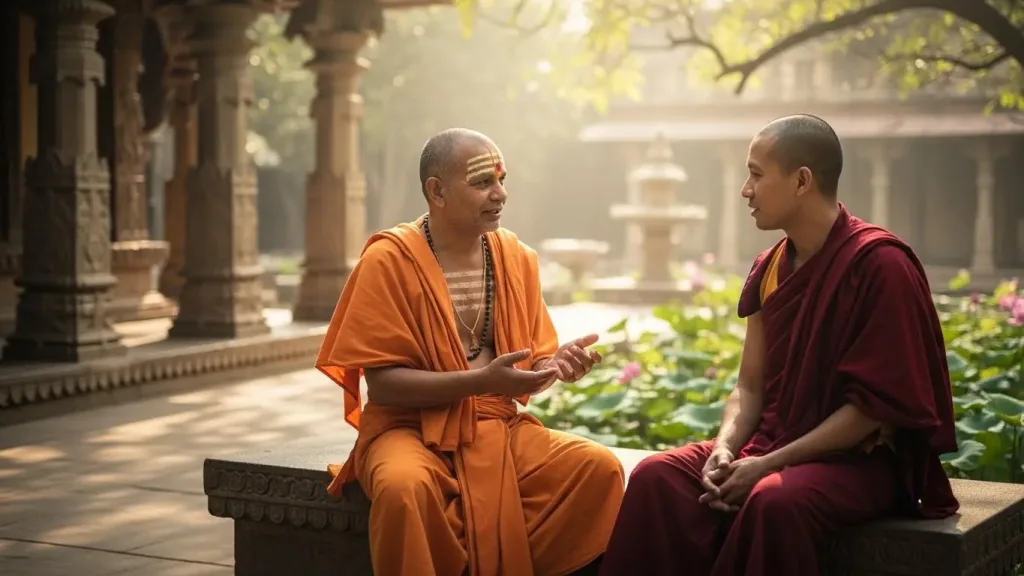
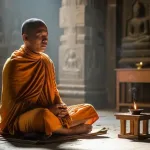
Hindu Priest and a Buddhist Monk (Image: ABPray)
Swami Ananda, a Hindu priest trained in Advaita Vedanta and serving a temple in Queens, New York, opened our first session by saying: “The problem is that Buddhism denies the Self. We affirm it. Everything else follows from that.”
Venerable Tenzin, a Tibetan Buddhist monk trained in the Gelug tradition and teaching at a center in Vermont, smiled and said: “But the Swami is also affirming a Self. That is precisely where we diverge. There is no Self to affirm. There is only the appearance of one.”
It was 9 AM on a Saturday morning in a rented conference room in Boston, and within ninety seconds, these two practitioners had outlined a chasm so fundamental that I realized this conversation would not be about finding common ground. It would be about understanding why common ground is impossible, and more importantly, why each tradition contains internal contradictions so severe that they can barely agree with themselves.
I had come to answer a simple question: “Why is Hinduism different from Buddhism?”
What I discovered was that the question itself was naive. It assumed that “Hinduism” was one thing, and “Buddhism” was one thing, and they diverged. The reality is stranger: Hinduism contains five entirely different ontological systems, and Buddhism contains three to four mutually contradictory cosmologies. The traditions don’t just differ from each other. They differ from themselves.
The moment the traditions parted ways: a historical rupture
Before I can explain the internal contradictions, I need to show you where and why Buddhism emerged from Hinduism and then rejected it so completely that the split has never healed.
Around 500 BCE, in what is now northern India, a man named Siddhartha Gautama (later called the Buddha) sat under a tree and had an insight. He had been trained in the Vedic traditions, the religious frameworks that would eventually become Hinduism. He understood the cosmology: there is a cosmic Self called Brahman, eternal and unchanging. Each individual self (atman) is actually a fragment or expression of that Brahman. The goal of spiritual life is to realize that atman is Brahman, that you are, at the deepest level, identical with the absolute reality.
And then the Buddha rejected all of it. Not gradually. Not diplomatically. Completely.
He said: There is no Brahman. There is no eternal Self. There is no unchanging essence at the core of consciousness. What you call the “self” is a constantly changing process, a flow of sensations, perceptions, mental formations, consciousness. It has no essence. It is empty (shunyata).
This was not a minor theological disagreement. This was a repudiation of the foundational claim of Vedic religion. It was as if someone had said: “Everything you’ve built your life on is based on a fundamental misunderstanding of what exists.”
Swami Ananda, when I asked him about this, said quietly: “This is why we say Buddhism is not a development of Hinduism. It is a rejection. The Buddha took the methods we had developed, meditation, ethical discipline, philosophy, and pointed them toward a false conclusion. He said the Self doesn’t exist. We say: the Self is all that exists.”
Venerable Tenzin responded: “But the Swami is affirming something that is not there. We didn’t reject the Self. We investigated it carefully and discovered that what is called ‘self’ has no intrinsic, unchanging essence. This is not a belief. This is an observation.”
“But it contradicts your own tradition,” I said to Venerable Tenzin. “Because Tibetan Buddhism teaches that buddhas exist eternally, that Avalokiteshvara is compassion itself, that there is a Buddha-nature in all beings. These sound like selves.”
He nodded. “This is the paradox we carry. We say there is no self, but we also speak of Buddha-nature, of bodhisattva vows that persist, of lineages that transmit realization. These seem to contradict. And they do contradict, at a certain level of analysis. But the contradiction itself is part of the teaching.”
Swami Ananda interjected: “This is exactly the difference. In our traditions, contradiction is a problem to be solved. In Buddhism, it is a feature of enlightenment. We do not accept contradiction at the ultimate level. We say that at the highest level of reality, there is perfect unity. Paradox is just ignorance not yet dispelled.”
This was the first moment I understood that the conversation would not resolve into harmony. These two people were not just disagreeing about details. They were disagreeing about what disagreement even means.
The hidden plurality: five Hindu schools hidden inside “Hinduism”
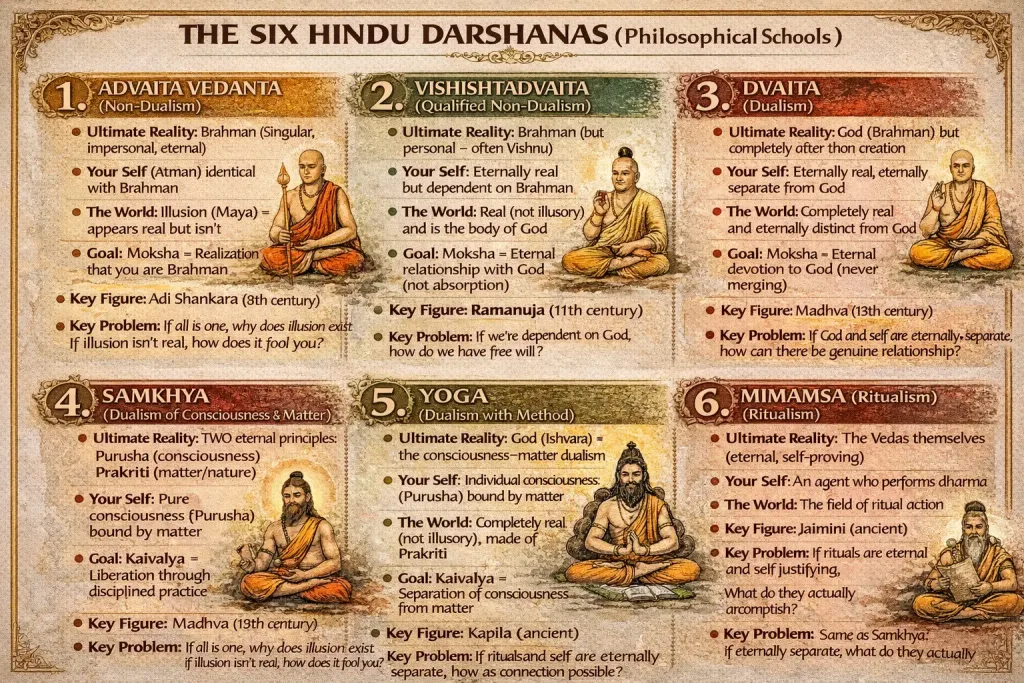
Here is what most people don’t realize: when someone says “Hinduism,” they are not describing a unified system. They are naming a family of six major philosophical schools (darshanas) that share some texts and some practices but have fundamentally incompatible metaphysics.
Swami Ananda spent two hours walking me through these, and by the end, I understood that calling them “different schools of Hinduism” is actually misleading. It’s like calling Christianity, Judaism, and Islam “schools of monotheism.” They share an ancestor and some vocabulary, but they have different Gods, different histories, and different ultimate goals.
Here’s what the Swami showed me:
The six Hindu Darshanas. (Image: ABPray)
When I pointed out that these six schools contain completely contradictory metaphysics, some say the world is illusory, some say it’s completely real; some say God is personal, some say impersonal; some say you remain eternally separate from God, some say you merge with God, Swami Ananda didn’t deny it.
“Yes,” he said. “This is the strength of our tradition. We allow multiple valid paths. Advaita is the highest, in my view, because it points to the ultimate truth. But Dvaita is valid for those who need a personal God. Samkhya is valid for those who need a dualistic metaphysics. All of these are ways of understanding the same fundamental reality.”
“But they can’t all be true,” I said. “If Advaita is right, and the world is illusion, then Samkhya is wrong, the world isn’t real, it’s a cosmic illusion. If Samkhya is right, then Advaita is wrong.”
Swami Ananda smiled. “At the relative level, you are correct. But at the ultimate level, these distinctions fall away. The Advaita teacher would say that Samkhya practitioners are still operating within Maya. They will eventually realize that the distinction between consciousness and matter is also part of the illusion.”
“So Advaita subsumes all the others,” I said. “Yes, if you follow that path. But if you follow Dvaita, you would say that it is the highest, and Advaita is incomplete because it cannot account for the reality of relationship with God.”
I turned to Venerable Tenzin. “Does Buddhism have this same internal flexibility?” He laughed. “No. Buddhism is much more problematic.”
The Buddhist Catastrophe: three to four incompatible cosmologies
Venerable Tenzin spent the next hour showing me something I had not fully grasped: that Buddhism, which emerged as a rejection of Hindu pluralism, had fractured into multiple schools that contradict each other far more severely than the Hindu schools do.
“The problem,” he said, “is that the Buddha’s original insight, there is no self, enlightenment is the cessation of craving, you can achieve it through your own effort, was so radical that within five hundred years, it had fragmented into completely different religions.”
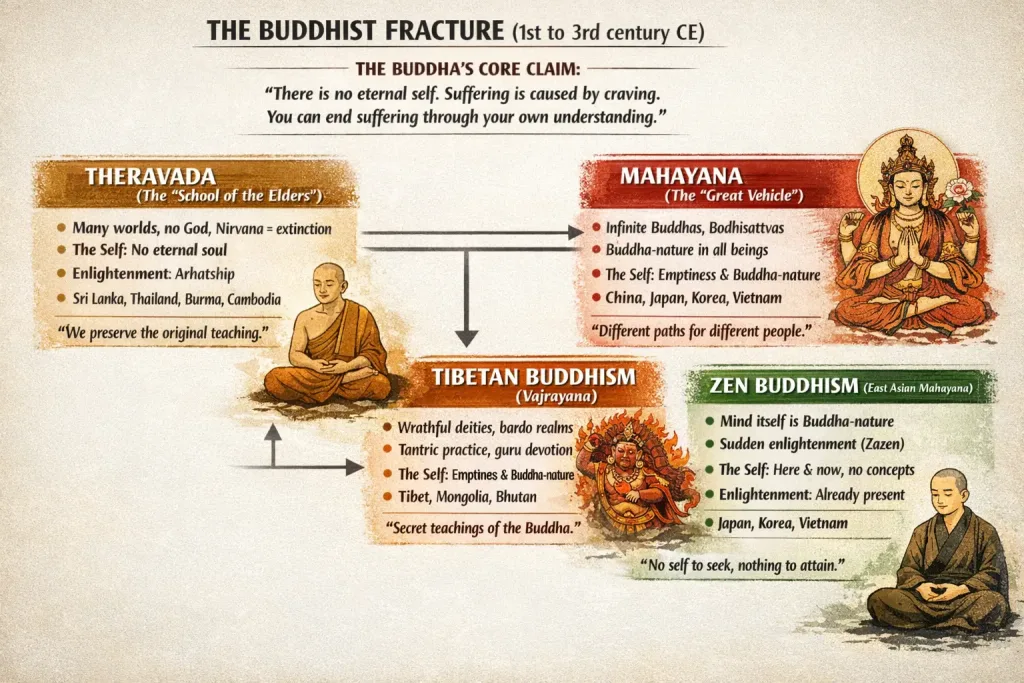
He showed me this map:
The Buddhist fracture. (Image: ABPray)
I stared at this map for a long time. “So Theravada says: ‘There is no self, and at enlightenment, you cease to exist.’ Mahayana says: ‘There is no separate self, but you have Buddha-nature that awakens.’ And Zen says: ‘You’re already enlightened; you just don’t know it.’ These are not the same religion.”
“No,” Venerable Tenzin said. “They are profoundly different. And the tragic thing is that when I studied Theravada in Thailand, the monks told me that Mahayana had corrupted the Buddha’s teaching by reintroducing gods and eternal principles. When I studied Zen in Japan, the teachers implied that Tibetan Buddhism was too conceptual, too focused on doctrine. And when I came to my own Tibetan lineage, I was taught that both Theravada and Zen had missed the deepest teachings.”
“But you’re the same religion,” I said. “We share a name and a founder. We do not share a metaphysics. We do not share an understanding of what enlightenment is. We do not share a cosmology. In some ways, we are closer to being different religions than different schools.”
I turned to Swami Ananda. “Can Hinduism claim to handle this kind of diversity?”
He thought for a moment. “Yes and no. The Hindu schools contradict each other, but they have a framework for holding contradiction. They say: the ultimate reality is beyond all concepts, so all concepts can be valid at some level. This allows contradiction to be meaningful rather than destructive.”
“But Buddhism claims not to be conceptual,” I said. “It claims to point directly to reality.”
“Exactly,” Swami Ananda said. “This is the Buddhist problem. You reject concepts and metaphysics, but then your different schools have developed the most elaborate metaphysics in human history. Theravada has one metaphysics. Mahayana has another. Tibetan Buddhism has a third. They contradict each other. And you cannot use the Hindu move of saying ‘these are all valid at their level,’ because Buddhism claims to be pointing to how things actually are, not to different perspectives on ultimate reality.”
Venerable Tenzin nodded. “This is fair. We have created a problem we cannot solve with our own tools.”
Why the divergence happened: the historical knot
I asked both of them: “Why did Buddhism reject the Hindu framework so completely? And why did Buddhism then fragment so severely?”
Swami Ananda answered first: “The Buddha was reacting to the Vedic priesthood. The priests controlled access to enlightenment. They said: you must perform rituals, you must be born into a caste, you must trust the Brahmins. The Buddha said: no. You yourself can investigate reality. You don’t need priests or rituals or caste. This was revolutionary. But to make this claim, he had to reject the Vedic cosmology, he had to say that there is no eternal Self, no Brahman, no cosmic order. He had to make reality accessible to anyone.”
“But in doing that,” I said, “he created a tradition that couldn’t maintain internal coherence.”
“Yes,” Venerable Tenzin said. “Because the Buddha’s original teaching was anti-metaphysical. He said: don’t speculate about whether God exists, whether the soul is eternal, whether the world had a beginning. These questions distract from the path. Practice, and you will see the truth directly.”
“But communities need metaphysics,” I said. “They need a shared picture of reality.”
“Correct,” Venerable Tenzin said. “So within a few hundred years, different Buddhist communities developed different metaphysics. Theravada developed one. Mahayana developed another. And these metaphysics were so different that the communities essentially became separate religions.”
Here’s what I realized: Hinduism fragmented into multiple coherent philosophical systems, each complete in itself, and then created a meta-framework (the idea that multiple truths can coexist at different levels) to hold them together.
Buddhism fragmented into multiple systems that claim to be anti-systematic, leading to a situation where the schools contradict each other while both claiming to transcend conceptual thought.
The irony is devastating: Buddhism emerged to escape the complexity and hierarchy of Vedic religion, but created something more fragmented and contradictory.
The real divide: Atman vs. Anatta (and why this one thing matters more than everything else)
After six hours of conversation, I asked them to distill it to the absolute core difference. What, if you removed everything else, is the one thing that separates Hinduism from Buddhism?
Both answered at the same time: “The Self.”
Swami Ananda: “We say the Self is real. Your deepest nature is Atman, which is eternal, unchanging, and identical with Brahman. This is not a belief. It is the discovery you make when you meditate deeply enough. You are not your mind, not your body, not your experiences. You are the witness of all of these. And you are, ultimately, the Brahman, the reality behind all existence.”
Venerable Tenzin: “We say there is no such self. What you call the Self is a construction, a useful fiction that the mind creates to organize experience. When you meditate deeply, you don’t discover an eternal Self. You discover that the self you thought existed has no intrinsic reality. There is an awareness process happening, but no entity having the experience. This is terrifying and liberating at the same time.”
I asked: “Can both be true?”
“No,” they said in unison.
“So one of you is simply wrong,” I said.
“From our perspective, yes,” Swami Ananda said. “The Buddhist is suffering under the illusion of emptiness. They have not yet realized the eternal Self within them.”
“From my perspective,” Venerable Tenzin said, “the Swami is clinging to the illusion of a permanent self. They have not yet seen through the construct.”
“And there’s no way to resolve this?” I asked.
“Not through argument,” Swami Ananda said. “Only through direct experience. If you meditate in our tradition, you will encounter the Self. If you meditate in theirs, you will encounter emptiness.”
“But both are using meditation as the method,” I said.
“Yes,” Venerable Tenzin said. “The method is the same. The interpretation of what you find is completely different. And I believe, not as an article of faith, but from my own practice, that what you find depends partly on what you’re looking for.”
This struck me hard. They were both admitting that the ultimate claim of their traditions, “this is how reality actually is”, might be partly constructed by the framework they brought to the investigation.
The internal collapse: why hinduism and buddhism can’t even agree with themselves
By hour five, I was seeing a pattern that neither Swami Ananda nor Venerable Tenzin had explicitly named.
Both traditions contain internal contradictions that are not minor:
In Hinduism:
Advaita says the world is illusion. Samkhya says it’s completely real. Both claim to be interpreting the same Vedas.
Advaita says Brahman is impersonal and beyond qualities. Vishishtadvaita says Brahman is Vishnu, the personal God. Both claim to point to the ultimate reality.
Samkhya and Yoga say consciousness and matter are eternally separate. Advaita says they’re both illusion. These cannot both be true.
In Buddhism:
Theravada says enlightenment means the complete cessation of the self. Mahayana says enlightenment awakens the Buddha-nature within you. These contradict.
Theravada says enlightenment requires discipline and effort. Zen says you’re already enlightened; effort is the problem. These contradict.
Theravada says Nirvana is the absence of all conditioned phenomena. Tibetan Buddhism says enlightenment involves the manifestation of infinite Buddhas and realms. These contradict.
And I realized: both traditions tried to solve the same problem, how to speak about ultimate reality, and both created internal contradictions they cannot resolve because they rejected the framework that could contain them.
Hinduism rejected the idea of a single, authoritative text that would enforce doctrinal unity. It said: “All paths are valid.” This created philosophical coherence but organizational fragmentation.
Buddhism rejected the idea of an eternal Self that could anchor reality. It said: “There is no unchanging principle.” This created metaphysical fragmentation that no amount of “skillful means” language can truly resolve.
“So which is more honest?” I asked them. “To have multiple contradictory systems under one umbrella? Or to fragment into multiple religions?”
Swami Ananda said: “We are more honest because we acknowledge the contradiction. We say these are different valid paths. The Buddhist claims that their schools all point to the same realization, but they don’t. They point to different realizations.”
Venerable Tenzin said: “We are more honest because we acknowledge that all concepts are provisional. The Hindu claims that contradictory systems can all be valid, but they can’t be, one is true and the others are false. We say all systems are false. None of them capture reality. We just use them as fingers pointing at the moon.”
“But that’s not actually true either,” I said. “Because Zen Buddhists are quite attached to their view that Zen is superior. And Tibetan Buddhists claim that tantric Buddhism has access to truths the others don’t.”
“Yes,” Venerable Tenzin said quietly. “This is the shame of Buddhism. We created the most elaborate metaphysics and then claimed not to have metaphysics. We created the most rigid hierarchies of truth and then claimed that all is emptiness. We are contradicting ourselves constantly.”
“And we Hindus,” Swami Ananda said, “we created a framework that allows contradiction, but that framework itself might be an illusion. We say ‘all truths are valid at their level,’ but what level? What validates the levels? We have not answered that question.”
The map of why they cannot converge
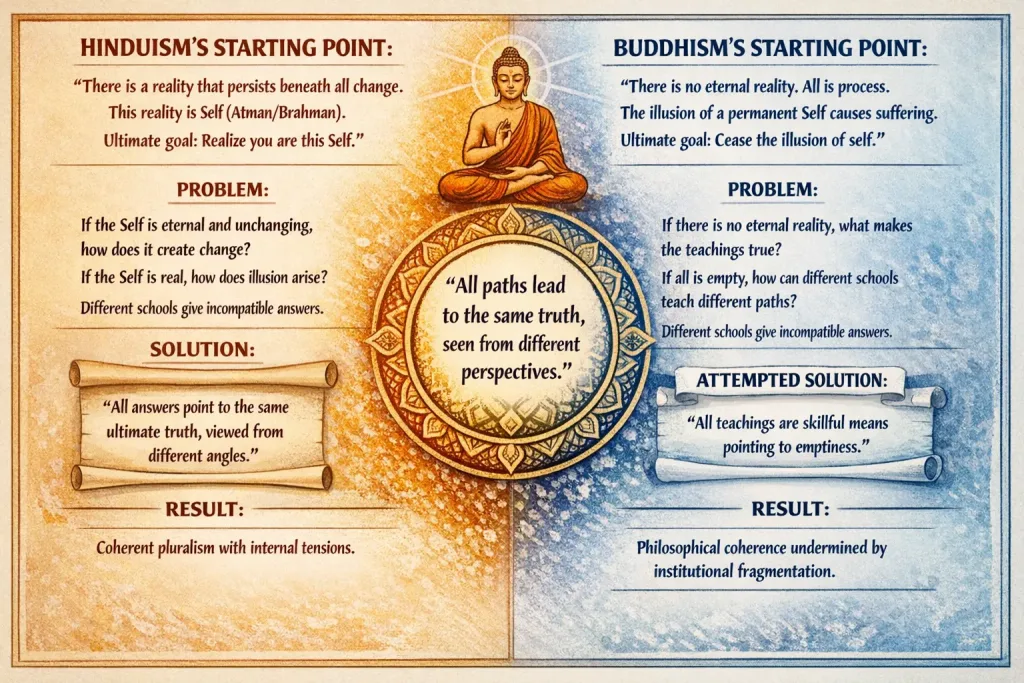
I asked them to show me, one more time, what the fundamental divergence actually is. Not the metaphysics, but the starting point.
Hinduism and Buddhism’s staring point. (Image: ABPray)
“The Hindu solution works better,” I observed.
“Strategically, yes,” Venerable Tenzin said. “But metaphysically, no. Because the Hindu framework assumes that there is a higher truth that can hold the contradictions. If there is no such truth, if all really is empty and processual, then the Hindu framework is an illusion. And if the Hindu framework is valid, then Buddhism is incomplete.”
“These cannot both be true,” Swami Ananda said. “No,” Venerable Tenzin agreed. “They cannot.”
And there it was. The moment the conversation became honest: both traditions make claims about ultimate reality that are logically incompatible. And both contain internal contradictions they cannot fully resolve.
Why this matters: the practitioner’s dilemma
Before we ended, I asked both of them: “What would you tell someone who is drawn to both traditions?”
Swami Ananda said: “Choose one. Commit deeply. If you practice Advaita Vedanta fully, you will come to know the eternal Self. If you practice Buddhism fully, you will come to know emptiness. But you cannot do both. They are not compatible frameworks.”
Venerable Tenzin said: “I agree and disagree. I agree that you cannot fully practice both. But I also say that the contradictions themselves are part of the teaching. If you hold both the Hindu insight, that reality might have an eternal ground, and the Buddhist insight, that this ground might be fundamentally empty, you might transcend both. But this requires tolerance for paradox that neither tradition officially teaches.”
“So your answer is that both traditions are incomplete,” I said.
“Yes,” they said together.
“And that the complete picture requires holding positions that contradict each other,” I said. “Yes,” they said again.
“That seems unstable,” I said.
“It is,” Venerable Tenzin said. “But so is human consciousness. So is existence. Stability might be the illusion.”
The invitation: to sit in the genuine paradox
Here is what I want you to understand about this conversation, and about Hinduism and Buddhism, that the comparative religion textbooks do not adequately convey:
These are not two different paths up the same mountain.
They are two fundamentally different cartographies of what the mountain is, where the mountain is, and whether the person climbing is actually a person.
Hinduism says: There is a Self that persists. Reality is structured. Different truths can coexist at different levels of understanding. You are seeking to awaken to who you already are.
Buddhism says: There is no persisting Self. Reality is not structured; it is process. Different teachings are provisional crutches, not truths. You are seeking to release the illusion of who you think you are.
And within each tradition, there are schools that contradict these central claims. Hindu Samkhya accepts dualism rather than the unity of Advaita. Buddhist Zen claims enlightenment is immediate rather than requiring the gradual path of other schools.
The reason this matters, the real reason, not the academic reason, is this: if you commit to either tradition, you are not simply choosing a path. You are choosing a fundamental answer to “what is real” and “what am I.” And that answer will shape how you live, what you see as possible, what you do with your suffering, and what you believe happens when you die.
You cannot choose Buddhism and Hinduism simultaneously because they make contradictory claims about what is real. But you also cannot fully resolve the contradictions within either tradition without adopting meta-frameworks (like Hinduism’s “multiple valid truths” or Buddhism’s “all teaching is provisional”) that are themselves controversial.
The honest answer is: we do not know which is true. Both traditions have produced genuine practitioners and genuine insight. Both have produced communities and individuals that bear witness to something real. And both contain internal logical contradictions that they cannot fully resolve.
This is not a comfortable place to sit. Comfort comes from choosing a tradition and committing fully to its worldview. I respect that choice.
But there is also a value in sitting with the paradox itself, in holding the Hindu insight about the reality of Self alongside the Buddhist insight about the emptiness of Self, and letting them both crack you open.
This is not what either tradition officially teaches. But it might be closer to the truth than either tradition alone.
José Lucas is a researcher driven by a lifelong fascination with the history of religions and how faith shapes the human experience. Specializing in the historical contexts of diverse traditions, José possesses a unique ability to translate ancient wisdom into practical, relevant insights for the modern seeker. At ABPray, his mission is to guide readers through the world’s vast spiritual heritage with both curiosity and reverence. He plays a crucial role in our Content Creation and Fact-Checking process, ensuring that all biblical, historical, and doctrinal references are grounded in legitimate sources and in-depth research. Through his articles and guides, José promotes understanding and compassion, connecting the facts of the past with the contemporary search for purpose. His work is essential in establishing ABPray as a global reference for interfaith content, nurturing the universal values that unite all of humanity.
To provide the best experiences, we use technologies like cookies to store and/or access device information. Consenting to these technologies will allow us to process data such as browsing behavior or unique IDs on this site. Not consenting or withdrawing consent, may adversely affect certain features and functions.
Functional
Always active
The technical storage or access is strictly necessary for the legitimate purpose of enabling the use of a specific service explicitly requested by the subscriber or user, or for the sole purpose of carrying out the transmission of a communication over an electronic communications network.
Preferences
The technical storage or access is necessary for the legitimate purpose of storing preferences that are not requested by the subscriber or user.
Statistics
The technical storage or access that is used exclusively for statistical purposes.The technical storage or access that is used exclusively for anonymous statistical purposes. Without a subpoena, voluntary compliance on the part of your Internet Service Provider, or additional records from a third party, information stored or retrieved for this purpose alone cannot usually be used to identify you.
Marketing
The technical storage or access is required to create user profiles to send advertising, or to track the user on a website or across several websites for similar marketing purposes.