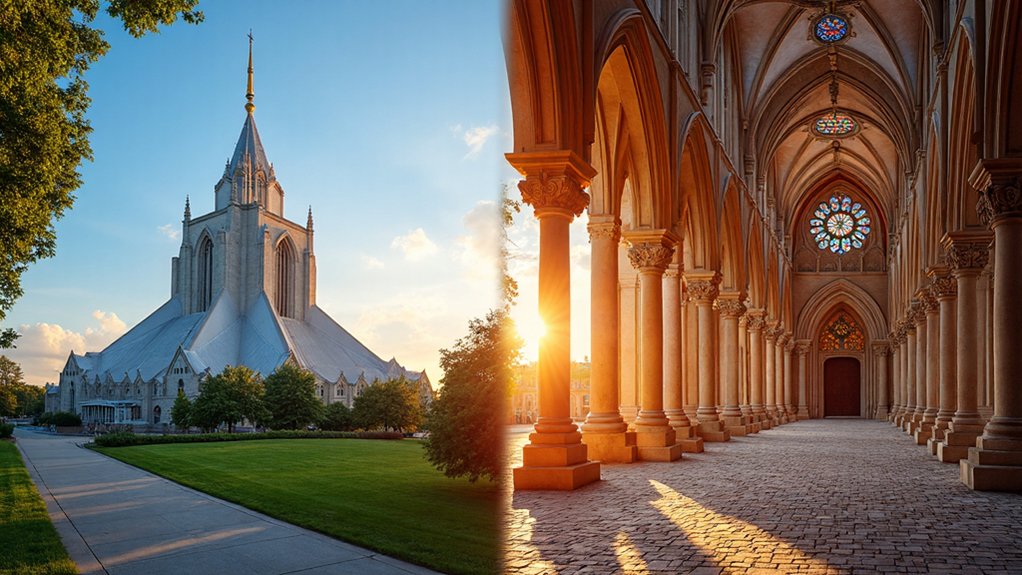
I was standing in the Visitor Center of the Salt Lake Temple when a young Mormon missionary, her name badge read “Sister Jensen”, asked me a question that seemed innocent but contained a philosophical depth that neither of us fully grasped in the moment: “Do you believe God has a body?”
Differences between Mormonism and Catholicism (Image Abpray)
I said no, I assumed God was spirit.
She smiled with the confidence of someone who’d had this conversation dozens of times. “That’s what most Christians believe. But the Prophet Joseph Smith revealed that God does have a body. Not just spiritually, but physically. God is a perfected, glorified man with a body of flesh and bones.”
I asked her: “Then how is God infinite? How is God omnipresent?”
She paused. “Those are good questions. But they assume something’s wrong with having a body. In our doctrine, God’s body is the foundation of everything else. It’s not a limitation. It’s what makes God real.”
In that moment, I encountered something that theological scholarship often misses: Mormonism and Catholicism don’t disagree about doctrine in the way that, say, Catholicism and Protestantism disagree. They disagree about what kind of thing God is. They disagree about the nature of reality itself. And those disagreements are so fundamental that no amount of theological negotiation or hermeneutical sophistication can bridge them.
Over the next eighteen months, I spent time in both traditions, not as a neutral observer but as someone trying to understand the actual metaphysical commitments underneath the surface doctrines. I attended Catholic Mass and Mormon sacrament meetings. I read the Book of Mormon and the Catechism. I interviewed theologians, missionaries, and ordinary practitioners in both traditions. And what emerged was something far stranger and more interesting than “Mormonism is just Christianity with extra stuff.”
The truth is: Mormonism and Catholicism are building different universes. They have different ontologies, different answers to what actually exists. They have different epistemologies, different answers to how we know what’s real. They have different conceptions of authority, different answers to who gets to speak truth. And these differences don’t sit alongside each other like different flavors of the same basic Christian faith. They contradict each other at the foundation.
The fundamental incompatibility: theism versus divine embodiment
Let me begin with the most basic incompatibility, because it’s where everything else hangs.
Catholic theology begins with a specific metaphysical commitment: God is pure spirit, non-corporeal being, utterly transcendent and immaterial. This isn’t a doctrine that emerged from later philosophical reflection. It’s baked into the structure of Catholic theology from Augustine forward. God is ipsum esse subsistens, subsistent being itself. God doesn’t have being; God is being. God is absolutely simple, without composition, without parts, without extension in space.
From this foundation flows everything else: God’s omnipresence (because God is not limited by space), God’s omniscience (because God is not temporal), God’s immutability (because God is not subject to change), God’s impassibility (because God is not subject to suffering or emotional disruption).
This is classically expressed in what theologians call “divine simplicity”, the doctrine that God is absolutely one, without internal differentiation, without composition. The three persons of the Trinity are real distinctions, but they don’t divide God into parts. God’s essence and existence are identical. God’s knowledge and God’s being are identical. God’s justice and God’s mercy are identical. There are no separations, no potentiality, no unrealized aspects to God’s nature.
This theology is deeply counterintuitive, it produces paradoxes and difficulties that theologians have been wrestling with for 1,700 years. But it’s the foundation of Catholic metaphysics.
Now, Mormon theology, particularly as articulated by Joseph Smith and developed through Brigham Young and subsequent Mormon prophets, makes a radically different metaphysical commitment.
God, in Mormon theology, has a body. Not metaphorically, not mysteriously. Literally. God is a man, a perfected, glorified man, but a man nonetheless. God has flesh and bones. God is spatially localized. God is temporal in the sense of experiencing succession. God is subject to growth, development, and increase.
This is expressed most famously in the Mormon maxim: “As man now is, God once was. As God now is, man may become.” The doctrine of exaltation teaches that humans can progress to divine status through faithfulness and obedience. But this is only possible if divinity is itself a state of advanced human existence, not a fundamentally different category of being.
Here’s what’s crucial: these aren’t compatible metaphysics. They can’t both be true. Either God is pure spirit, absolutely simple, non-corporeal, and transcendent, or God is an embodied being with a glorified body, spatially localized, subject to temporal succession. Either God is a fundamentally different kind of being than humans, or God is an advanced stage of human development.
I sat with a Mormon theologian at Brigham Young University who explained it this way: “The Catholic understanding makes God abstract and distant. It’s based on Platonic and Aristotelian philosophy, not on Scripture. When the Bible says God walks in the garden, or God’s face shines, or God’s hand moves, Catholicism has to spiritualize all of that. We take it literally. God has a face. God has hands. God is real in that sense.”
I then spoke with a Catholic theologian at Notre Dame who responded: “If God is corporeal, then God is limited by that body. God would be localized in space. God couldn’t be omnipresent. You’d have the problem of explaining how God can be here and there simultaneously. Mormon theology solves this by abandoning omnipresence, but that abandons a core attribute of God that both Catholic and Protestant theology, going back to Augustine and Aquinas, understood as essential.”
What neither of them could do was pretend that both positions were true simultaneously. The Catholic theologian could acknowledge that the Mormon position was internally consistent given its starting assumptions. But she couldn’t say it was consistent with Catholic theology. The Mormon theologian could acknowledge that Catholic theology was sophisticated and that it had a philosophical heritage. But he couldn’t say it aligned with the Mormon understanding of God’s nature.
The metaphysical incompatibility is complete.
The doctrine of God: where everything else falls into place
Once you’ve committed to God having a body, everything else in the theological system shifts.
In Catholic theology, the Trinity is a mystery, three distinct persons in one undivided substance. The mystery consists in how three can be one without dividing the divine unity. Centuries of theological reflection have produced formulations that make this comprehensible (though not fully rational). The key is that the Trinity doesn’t divide God. God remains absolutely one.
In Mormon theology, the Godhead is three distinct beings, God the Father, Jesus Christ the Son, and the Holy Ghost. They are one in purpose, but they are three separate persons. They are not one substance. They are not absolutely unified in the way Catholic theology demands.
This creates immediate implications. In Catholic theology, Jesus’s incarnation is God becoming human, the Word (God) taking on human nature while remaining God. Jesus is fully divine and fully human, but the unity of the incarnation preserves divine transcendence. God doesn’t change by becoming incarnate; God merely assumes human nature.
In Mormon theology, Jesus is literally the son of God the Father, the offspring of God and a heavenly mother. Jesus is divine because he inherited divinity from his divine parents, not because he is God. The incarnation, for Mormons, is not God becoming human but a divine being becoming human.
The Father, in Mormon theology, is also subject to growth and development, though at a level infinitely beyond human development. The Father advanced to divine status through his own exaltation. The Father continues to create worlds and populate them with spirit children. The Father is engaged in work, in activity, in temporal succession.
None of this is remotely compatible with the Catholic understanding of God as immutable, non-temporal, engaged in a single eternal act of creation, existing outside of time and space.
I watched a Mormon missionary try to explain exaltation to a Catholic nun. The missionary said: “If you’re faithful, you can become like God. You can have your own kingdom. You can populate worlds with spirit children.”
The nun asked: “You mean we would become divine?”
The missionary: “Yes. We would be exalted to godhood.”
The nun paused, then said: “But you understand that in Catholic theology, God is infinite. You can’t have multiple infinities. You can’t have God, and also have you as a god. It’s a logical contradiction.”
The missionary: “I understand. But we read Scripture differently. We see humans as children of God, not metaphorically, but actually. God is our Father. And children grow up to be like their parents.”
The nun: “But that’s not what infinity means. If God is infinite, nothing else can be infinite. And if you’re not infinite, you’re not truly God. You’d just be a glorified being.”
The missionary: “Maybe that’s what Mormon theology teaches, that we become glorified beings, not divine in the Catholic sense. I’d accept that.”
And in that exchange, you see the incompatibility clearly. The nun is operating from a metaphysics where God is absolutely unique, infinite, immutable, transcendent, utterly different in kind from creation. Any attempt to make humans divine contradicts this. The missionary is operating from a metaphysics where godhood is an advanced state of being that can be extended to other beings, where divinity is a condition of exaltation rather than an absolute uniqueness.
These can’t both be true. One of them has to be mistaken about the basic nature of God.
Revelation and authority: the fracture of how we know
The next layer of incompatibility concerns how we know religious truth, what epistemology each tradition operates within.
Catholic epistemology is built on two sources: Scripture and Sacred Tradition, understood together through the lens of the Magisterium (the teaching authority of the Church). Scripture is authoritative, but it’s not self-interpreting. It requires the living tradition of the Church and the guidance of the Pope and bishops as successors to the apostles. Revelation is essentially closed, Jesus Christ is the fullness of revelation, and the apostolic tradition continues to unfold what’s already contained in that revelation, but no fundamentally new revelation is expected.
This creates a specific relationship to authority: the Pope and the bishops are the interpreters of Scripture and tradition. They possess the authority to settle disputes about doctrine. Vatican II formally articulated this: the Pope is protected from error in matters of faith and morals (the doctrine of infallibility). The bishops, in union with the Pope, teach authoritatively. The deposit of faith is complete. What remains is the development of doctrine, unpacking what’s already implicitly contained in Scripture and apostolic tradition.
Mormon epistemology is radically different. In Mormon theology, revelation is not closed. Revelation is ongoing. The church has a living prophet, the President of the Church, who receives new revelation directly from God. The Book of Mormon, Doctrine and Covenants, and Pearl of Great Price are considered Scripture equal to the Bible. The prophet’s words are considered the word of God.
I attended a Sunday service at the Salt Lake Temple where a stake president (a regional church leader) said: “We believe in all that God has revealed, and we believe He will yet reveal many important things pertaining to the kingdom of God.”
This is not incidental. It’s foundational. Mormonism explicitly teaches that revelation continues. The prophet can and does speak new doctrine that becomes binding on the church. When Brigham Young declared that God and the universe were eternal (rejecting the creation ex nihilo of Christian theology), he was not reinterpreting existing revelation. He was announcing new revelation. When the church reversed its stance on Black church members receiving the priesthood in 1978, it wasn’t discovering something that was always true. It was announcing a new revelation from God.
The practical implication: in Catholicism, if you disagree with papal teaching, you’re disagreeing with the interpreter of an already-closed revelation. You can propose alternative interpretations, but there’s a single deposit of faith that’s complete and binding. In Mormonism, if the prophet says something new, that becomes revelation. It becomes the word of God. Disagreement with the prophet is disagreement with God’s current word.
I spoke with a Mormon woman who’d left the church. She said: “The hardest part was realizing that every generation, the prophet changes doctrine, and we’re told it’s because of new revelation. But if it was revelation from God, why would it change? Why would God contradict himself?”
A Mormon theologian I met acknowledged this difficulty: “The prophetic office is a gift to the church. The prophet can receive new revelation as the church develops. But yes, this creates challenges. There are doctrines that were taught as eternal truth that later prophets abandoned. This requires faith; faith that the Spirit is guiding the church even as doctrine evolves.”
But here’s the problem: faith in the prophet’s continued revelation is incompatible with the Catholic epistemology of a closed revelation. In Catholicism, if someone claims new revelation that contradicts Scripture or apostolic tradition, that’s by definition not from God. In Mormonism, the prophet can announce new revelation that contradicts previous doctrine, and that’s considered the ongoing guidance of the Spirit.
These are not compatible epistemologies. They represent fundamentally different answers to how we know religious truth. And there’s no neutral ground from which to adjudicate between them. Each tradition’s epistemology is self-validating, it contains within itself the criteria for what counts as truth.
The ontology of salvation: what are we actually being saved for?
Perhaps the deepest incompatibility concerns what salvation actually means and what the human being is fundamentally.
In Catholic theology, salvation consists in union with God through sanctifying grace. Humans are created in the image of God, that image is God’s rationality and free will, not God’s body or physical form. Humans are damaged by sin, which separates them from God. Salvation is the healing of that separation through the sacraments (particularly the Eucharist and Penance) and through grace. The goal of salvation is theosis, becoming like God, but not becoming God. There is an infinite chasm between Creator and creature that grace bridges but does not eliminate.
This theology understands humans as fundamentally derivative, we exist by God’s gift. Our existence is contingent. We do not have being in ourselves; we have being as creatures, received from God. Salvation is the perfection of that creaturely existence.
Mormon theology offers a radically different ontology. Humans are, in Mormon doctrine, literally the offspring of God. Before mortal existence, humans existed as spirit children of Heavenly Father. Humans are fundamentally divine in origin, not because God gives us grace, but because we are God’s children. We inherit divinity from our divine parents.
The purpose of mortal life is progression toward exaltation, becoming like God. The term “exaltation” in Mormonism has specific technical meaning: it means eternal life in the presence of God, progressing toward godhood, potentially creating and populating worlds of one’s own. It’s not metaphorical. It’s a literal progression from spirit child to mortal being to exalted god.
The Book of Mormon teaches: “God became as man, that man might become as God.” This is not poetic. This is describing the actual metaphysical trajectory of existence. Humans are meant to become divine. Not to participate in God’s life, but to achieve divinity themselves.
I spoke with a Mormon woman who described her understanding of exaltation: “We’re not just saved from sin and going to heaven. We’re meant to become like God, to create worlds, to be eternally creative and generative. That’s what exaltation means. It’s not that we lose ourselves in God’s presence. It’s that we become ourselves fully, as divine beings.”
A Catholic priest I spoke with was troubled by this: “This makes humans and God essentially the same kind of being. It erases the fundamental distinction between Creator and creature. In Catholic theology, the joy of heaven is precisely that we remain creatures, eternally dependent on God, but united with God in love. There’s a beauty in that, in the ecstatic joy of being held in God’s love, not in becoming God ourselves.”
The Mormon woman said: “But doesn’t that make it sound like humans are never really fulfilled? Like we’re always secondary, always less?”
The priest: “No. Because fulfillment in Catholic theology isn’t about being equal to God. It’s about being perfectly loved by God and returning that love. That’s sufficient. More than sufficient. It’s the fullness of human meaning.”
What’s clear: these represent radically different understandings of what humans are and what we’re for. In Catholic theology, the human fulfillment is creaturely fulfillment, being perfectly dependent on God while returning love. In Mormon theology, human fulfillment is divine progression, becoming increasingly like God, eventually achieving godhood.
These are not compatible visions of human destiny. And they emerge from incompatible ontologies. For Catholic theology, humans are contingent beings, created by God, fundamentally derivative. For Mormon theology, humans are spirit children of God, fundamentally of the same kind of being as God, destined for exaltation.
The nature of time, eternity, and causality: incompatible metaphysics
Let me push deeper into the metaphysical structure beneath both theologies, because there’s something even more fundamental being contested.
Catholic theology, building on Augustine and Aquinas, understands God’s relationship to time differently than creatures. God is eternal, not in the sense of infinite duration through time, but in the sense of standing outside time entirely. God experiences all moments simultaneously. God’s knowledge is not temporal succession of knowing one thing, then another. God knows all things in a single eternal act.
This creates a specific metaphysical picture: God creates the universe in a timeless eternal act. Causality flows from God to creation, but God is not temporally conditioned by that causality. God does not change. God does not become different. Time is a feature of creation, not of God.
This theology produces a specific conception of free will and divine knowledge that creates notorious philosophical puzzles: How can God know the future and humans still be free? How can God be immutable and create a changing world? Centuries of theological reflection have produced various solutions (Molinism, Thomism, etc.), but the basic metaphysical framework remains: God is outside time, absolutely immutable, and the source of all causality.
Mormon theology operates with a fundamentally different metaphysical picture. God is temporal. God experiences succession. God progresses, grows, and develops. Brigham Young taught that matter and intelligence are eternal, they exist independently of God. God does not create the universe from nothing; God organizes pre-existent matter according to intelligence that also exists eternally.
This creates a universe where God is not the sole ultimate reality. Matter exists eternally. Intelligence (the essence of consciousness) exists eternally. God did not create these; God organized them. There is thus something independent of God, something God did not create but works with.
The implications are staggering. It means God is not omnipotent in the classical sense. God cannot create the uncreatable, matter and intelligence already exist. God can only organize them. It means the universe is not contingent on God in the way classical theology teaches. Matter and intelligence would exist even if God did not.
I asked a Mormon theologian about this: “So God is not actually all-powerful in Mormonism?”
He paused. “God is all-powerful in the sense that God can do anything that’s logically possible. But God cannot do things that are logically impossible. Creating something from nothing would be logically impossible in this framework because you’d be creating being from non-being, which is a contradiction.”
I pressed: “But in Catholic theology, God does exactly that. Creation ex nihilo means creating from nothing. That’s precisely God’s unique divine power.”
He said: “In our understanding, that’s impossible. You can’t create being from non-being. The universe is eternal. What God does is organize it.”
This is a fundamental metaphysical disagreement about what’s logically possible. For Catholic theology, creation from nothing is logically possible and is what God actually does. For Mormon theology, creation from nothing is logically impossible, and God instead organizes eternal matter.
These views cannot both be true. They represent incompatible metaphysical frameworks.
Similarly, Mormon theology offers a different conception of the relationship between God and time. God experiences time, though God’s experience of time may be vastly longer and deeper than ours. God develops, progresses, and increases. God is not absolutely immutable in the way Catholic theology requires.
I sat in a class at Brigham Young University where a professor explained it: “Joseph Smith taught that God is not abstract and distant. God is engaged in work, continually creating worlds, continually giving commands to his children, continually developing in knowledge and glory. Time is real for God in a way that traditional Christianity denies.”
This metaphysical picture, where time is real for God, where matter is eternal, where God organizes rather than creates, produces a completely different theology. It’s not simply that Mormonism has different doctrines while accepting the same metaphysical framework. The metaphysical framework itself is different.
The incompatibility in practice: authority structures that can’t coexist
These metaphysical differences produce radically different authority structures.
In Catholicism, authority flows from a metaphysical commitment to a closed revelation. The Pope speaks with authority because revelation is closed and the Pope is the living interpreter of that closed revelation. The source of authority is a specific metaphysical claim: that God has revealed Himself fully in Christ and the apostolic tradition, and this revelation is complete and binding.
In Mormonism, authority flows from a commitment to ongoing revelation. The prophet speaks with authority because God continues to reveal new truths through the prophetic office. The source of authority is a specific metaphysical claim: that revelation is not closed but continues as the church develops and as new circumstances arise.
These authority structures are incompatible. They would have to make contradictory claims in any given situation where new information emerged about doctrine or practice.
For instance, consider the change in Mormon teaching about race and the priesthood.
Brigham Young taught that Black people should not receive the priesthood. This was taught as doctrine for over a century. In 1978, the church announced a new revelation overturning this. The current president of the church, Spencer W. Kimball, announced that God had revealed that Black people should indeed receive the priesthood.
From a Catholic perspective, this is deeply problematic. It suggests that the earlier teaching was false, that Brigham Young, who was considered a prophet receiving God’s word, was actually teaching something contrary to God’s will for over a century. If God was not actually guiding that teaching, then what assurance is there that the new revelation is genuine?
From a Mormon perspective, this is explained as progressive revelation. God revealed what was appropriate for that time, and now God has revealed something different for this time. Circumstances change. The church develops. God’s revelation adapts.
But these are incompatible epistemologies. If earlier prophetic teaching was false, that undermines the prophetic authority structure. If it was not false but merely appropriate for the time, then it was not actually God’s will, it was a culturally situated teaching that happened to align with God’s guidance.
There’s no coherent way to maintain both the Mormon authority structure (the prophet speaks God’s current word) and acknowledge that earlier prophetic teaching on race was wrong.
A Mormon scholar I spoke with acknowledged this tension: “There’s a real problem here. We claim the prophet cannot lead the church astray. But we’ve clearly led the church astray on the question of race. How do we hold both claims?”
The answer, in Mormon theology, is faith. You have to trust that despite the confusion and the moral failure on race, the Spirit is nonetheless guiding the church. You have to believe that God permits prophetic error when God chooses to, but God ultimately corrects it.
But this means the prophet’s authority is not actually unconditional. It’s conditional on faith that God is ultimately working things out, despite the errors along the way.
From a Catholic perspective, this is actually worse than Protestantism, which at least acknowledges that the church is always semper reformanda (always reforming). Catholicism claims the Pope is protected from error on faith and morals. Mormonism claims the prophet speaks God’s word, but then has to acknowledge that the prophet taught things contrary to God’s will. That’s a more profound epistemological fracture.
The problem of different ontologies in the same language
What makes all of this so difficult to articulate is that Mormonism and Catholicism use the same English words, God, revelation, salvation, exaltation, grace, but mean radically different things by them.
When a Mormon says “God,” she means a perfected human being with a glorified body, who grew up to godhood, who has limits and boundaries.
When a Catholic says “God,” she means pure spirit, absolutely simple, infinite, immutable, outside time and space, utterly transcendent.
These are not the same word. They’re homonyms, same sound, different meaning.
I encountered this explicitly when a Mormon missionary and a Catholic nun were discussing the Incarnation.
The missionary: “Jesus is God’s son. He came to earth as a baby and lived among us.”
The nun: “Yes, Jesus is God the Son. But the Son is God, not a creature who happens to be divine, but God Himself.”
The missionary: “So Jesus is God?”
The nun: “Yes. Jesus is the second person of the Trinity. Jesus is fully God.”
The missionary: “But Jesus is the son of God. How can he be God?”
The nun: “Because the Son is identical to God. God’s nature is Trinitarian. The Father is God. The Son is God. The Spirit is God. But there is only one God.”
The missionary: “I don’t understand how that makes sense. If the Son is the son of someone, then the Son is not that someone.”
The nun: “The Trinity is a mystery that transcends our human logic. The three persons are real distinctions, but the one God is an absolute unity. You can’t apply human categories of father-and-son to God because God is not human in that way.”
And there it is. The entire conversation is a failure of communication, not because either party is stupid, but because they mean fundamentally different things by the words they’re using.
For the missionary, “God” means a being with a body, with gender, who has offspring. For the nun, “God” means something that transcends all such categories. They’re not disagreeing about doctrine. They’re not even disagreeing about which texts should be authoritative. They’re using words in ways that are literally incommensurable.
This is what it means to have different ontologies. You don’t just disagree about claims. You disagree about what the terms of the claims even mean.
Where this breaks down: the impossibility of integration
I spent considerable time trying to see if there was any way to integrate these perspectives, to find a way that both could be true simultaneously.
I examined whether Mormon theology could be understood as teaching something compatible with Catholic theology. Could exaltation be understood as participation in God rather than becoming divine? Could embodied God be understood as a metaphor?
No. The Mormon sources are clear and explicit. God has a body of flesh and bones. Humans can become exalted to godhood. Revelation is ongoing. These are not metaphors or poetic language. They’re metaphysical claims about the nature of reality.
I examined whether Catholic theology could accommodate some Mormon insights. Could God’s embodiment be understood as real without being limiting? Could God’s temporality be accommodated?
No. Catholic theology explicitly rejects embodied God as incompatible with divine omnipresence, omniscience, and immutability. The doctrine of divine simplicity, that God is absolutely without composition, is non-negotiable in Catholic theology. God cannot be temporal without being subject to change, and God cannot be subject to change without violating the doctrine of immutability.
There is no way to hold both metaphysical frameworks. One or the other has to be mistaken about the basic nature of reality.
The Real Disagreement Beneath the Surface
What I learned through this engagement is that the disagreement between Mormonism and Catholicism is not really about whether certain doctrines are biblical. It’s about what kind of universe we’re living in.
Both traditions claim to be Christian. Both claim to follow Christ. But they’re following Christ into fundamentally different metaphysical pictures of reality.
For Catholicism, Christ is God made human, the infinite becoming finite, the transcendent entering time, but remaining radically transcendent. Salvation is participation in God’s life while remaining eternally creature to Creator. The trajectory is upward: from sin toward union with God, but always as creature approaching Creator.
For Mormonism, Christ is the Son of God, a divine being born into mortality, demonstrating the path of exaltation that all can follow. Salvation is progression toward godhood, toward becoming like God and eventually becoming God. The trajectory is from pre-mortal spirit child toward exalted divine being, a progression through stages of development.
These are not variants of the same thing. They’re different narratives about what reality is and what we’re becoming.
What I hold now
After months of engagement with both traditions, studying the theology, attending worship, speaking with practitioners and theologians, I’ve concluded that Mormonism and Catholicism represent genuinely irreconcilable worldviews.
The Mormon position is internally coherent. The Mormon reading of Scripture is defensible. The Mormon theological project is sophisticated. But it’s built on metaphysical commitments that directly contradict Catholic metaphysics.
It’s also not to say that one is obviously true and the other false. Both traditions can construct reasonable arguments for their positions. Both traditions can point to scriptural support. Both traditions have produced people of genuine spiritual depth and moral seriousness.
But they cannot both be right. Either God is the pure spirit of Catholic theology or God is the embodied being of Mormon theology. Either revelation is closed or it is ongoing. Either humans are creatures fundamentally dependent on God or humans are divine beings progressing toward exaltation. Either creation involves bringing being from non-being or it involves organizing eternal matter.
These are not matters of emphasis or interpretation. They’re matters of basic metaphysics.
What disturbs me is that both traditions present themselves as Christian, as following Christ, while actually constructing different universes. The language is familiar, Jesus, God, salvation, revelation, but the referents are different. Both traditions are describing a reality, but they’re describing incompatible realities.
A Mormon woman I spoke with near the end of my research said something that stayed with me: “I know my church is true. I’ve felt the Spirit confirm it. But I also recognize that Catholics have genuine faith. I don’t know how both can be true. But I know my experience is real.”
A Catholic priest said: “We believe the Mormon tradition has captured some insights, the importance of embodied existence, the reality of human dignity and progression. But the metaphysical foundation is incompatible with our understanding of God. We can respect that incompatibility while remaining confident that our position is correct.”
What I’m left with is this: Mormonism and Catholicism both make claims about reality. Those claims are incompatible. Not because one is obviously right and the other obviously wrong, but because they’re describing different kinds of universes, operating from different metaphysical frameworks, grounded in fundamentally different ontologies.
What remains is the uncomfortable recognition that both traditions have power, both have coherence, both produce genuine commitment and transformation, and yet they cannot both be true about the basic nature of reality.
That’s the abyss. Not between nice disagreements about doctrine, but between irreconcilable visions of what actually exists.