Published on October 6, 2025 at 4:00 PMUpdated on October 6, 2025 at 4:00 PM
I sit across from Dr. Karim in his office, The afternoon light filters through tall windows overlooking the Ramblas. Books are stacked everywhere, not obsessively, but with the casual abundance of someone who still reads with the hunger of a graduate student, even after thirty years of research. Dr. Karim is a historian of early Islam, trained originally in classical Arabic philology before pivoting to social history. His work sits deliberately in the tension between what theologians claim happened and what the archaeological record suggests actually occurred.
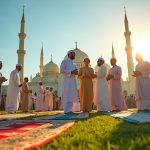
When Islam began (image: ABPray)
I begin with the obvious question, the one that gets asked at every dinner party, the one that seems simple until you realize it isn’t.
“When did Islam begin?” I ask.
Dr. Karim doesn’t answer immediately. He sets down his coffee, strong, bitter Turkish coffee, and leans back.
“That question assumes Islam is a discrete event,” he says. “A moment in time where nothing was Islam and then everything was Islam. But that’s not how lived religions actually emerge. What we call ‘Islam beginning’ is really three different events happening simultaneously, and they don’t have the same date.”
Before we talk about Islam’s arrival, I need to understand what was already there. This is where most popular accounts stumble. They treat pre-Islamic Arabia as a kind of religious and intellectual void, backward, pagan, waiting for monotheistic salvation. It’s a narrative convenient to later Islamic theology, but catastrophically inaccurate historically.
“The Arabia that Muhammad encountered,” Dr. Karim explains, leaning forward, “was not monolithic. You had competing theological and commercial systems already in place. This is crucial: Islam didn’t introduce monotheism to Arabia. Monotheism was already there.”
He stands and pulls down a volume I recognize, Patricia Crone’s “Meccan Trade and the Rise of Islam.” He opens it without looking, muscle memory from years of teaching.
“There were Christian communities in Yemen, along the trade routes, and even in Mecca itself. There were Jews in Medina, not recent converts, but established communities with their own theological schools. And there were the Hanifs, Arabs who rejected polytheism but weren’t fully Christian or Jewish. They were searching. This is the theological substratum.”
What strikes me is how this reframes the entire narrative. Islam doesn’t arrive in a vacuum. It arrives in a marketplace of ideas.
“The commercial dimension is equally important,” Dr. Karim continues. “Mecca wasn’t some backwater. By the late 6th century, it was a regional hub in the Arabian trade network, routes connecting the Byzantine Empire, the Sassanid Persian Empire, Yemen, and the Horn of Africa. The Quraysh, Muhammad’s tribe, were major merchants and brokers. They understood credit systems, contract law, inter-tribal diplomacy. When you understand this, you understand why Islam’s early social legislation focuses so heavily on commercial ethics, debt, and fair dealing. It wasn’t invented in a theological vacuum. It responded to real commercial problems these communities faced.”
Islam emerges not as abstract theology but as a response to specific social conditions. The pre-Islamic Arabian context wasn’t waiting passively for salvation. It was actively engaged in intellectual and commercial competition.
“There’s another layer,” Dr. Karim adds, and I can sense we’re now entering the territory where his own research has pushed back against conventional scholarship. “The question of linguistic continuity. People assume the Quran arrived as something linguistically revolutionary. Completely new language for Arabia. But Arabic was already a sophisticated literary language. The pre-Islamic poetry preserved in the Jahiliyyah, the Age of Ignorance, as Islamic sources call it, shows a complex grammatical system, theological vocabulary, reflective poetry. The Quran’s linguistic innovation wasn’t creating something from nothing. It was transformation. Elevation of existing Arabic into something perceived as divine.”
He sits again, and I notice he’s chosen each word carefully.
“When we ask ‘when did Islam begin,’ we have to answer separately: when did the theological rupture occur? When did the community form? When did the institutional structure consolidate? These are three different questions with three different answers.”
Revelation and rupture: the theological turning point (609-611 CE)
“Most Islamic tradition dates Muhammad’s first revelation to around 609 or 610 CE,” Dr. Karim says. “He was in a cave on Mount Hira, during the holy month of Ramadan, and he experienced what Islamic theology describes as the Angel Gabriel appearing with divine revelation. The Quran preserves the anxiety of this moment, ‘what are you?’ Muhammad asks in the text. ‘You whom I see, are you real or a demon?'”
I ask him what historians can actually verify about this period.
“Here’s where we move from theology into historical methodology,” he says. “We cannot verify the subjective experience of revelation. That’s not a historical question. What we can trace is the emergence of a new religious movement with characteristic features: a monotheistic message that critiqued existing Meccan religious practice, particularly the veneration of idols at the Kaaba; a doctrine of divine judgment and accountability; and increasingly, a social critique focused on wealth inequality and proper treatment of orphans and the poor.”
He pulls out a notebook, actual paper, I notice, where he’s written verses with their Quranic locations.
“Look at the Meccan surahs, the earliest chapters. They’re short, rhythmic, often in rhyming couplets. They focus obsessively on: first, the oneness of God; second, the reality of divine judgment; third, the corruption of the wealthy who deny the poor. This is a consistent theological program. And it’s one that created immediate social friction.”
“Why friction?” I ask.
“Because it delegitimized the existing religious order that the Quraysh merchants controlled. The idols at the Kaaba weren’t just religious symbols. They were economic infrastructure. Pilgrims came to Mecca partly for trade, partly for religious reasons. The sanctity of those idols and the rituals around them attracted wealth. When Muhammad’s message says ‘these idols are illusions, they have no power’, that’s not just theology. That’s economic threat.”
This is the kind of analysis that separates scholarly work from simplistic accounts. The theological rupture is inseparable from the social rupture.
“The revelation phase,” Dr. Karim continues, “lasts roughly 23 years. From around 609 to 632 CE. And the character of the revelation, according to Islamic tradition, changes significantly. The early revelations, the Meccan period, are confrontational, focused on absolute monotheism and moral accountability. The later revelations, after the Hijra to Medina around 622 CE, become increasingly legislative. They address specific legal questions: inheritance, marriage, warfare, treatment of prisoners, contracts. This shift reflects a shift in Muhammad’s position: from preacher to community leader responsible for actual social management.”
I ask if the historical record outside Islamic sources confirms any of this.
“This is where we hit a crucial limitation,” Dr. Karim admits. “We have almost no non-Islamic written sources from the first century of Islam. The earliest external references come from Byzantine and Sassanid sources, and they’re fragmentary. We have some epigraphic evidence, inscriptions on coins, stone, pottery. We have archaeological layers. But for Muhammad’s life specifically, we’re almost entirely dependent on Islamic sources: the Quran itself, the Hadith collections, the sira (biographical accounts).”
He pauses, and I sense he’s about to say something that bothers him.
“This creates a methodological problem that historians have been grappling with for decades. How reliable are these sources? Were they written down immediately? No. The Quran was likely standardized into written form under Uthman, the third caliph, around 650-656 CE. The Hadith collections were compiled 200+ years after Muhammad’s death. The biographical accounts, the most famous by Ibn Ishaq, come down to us through later transmitters. So we’re reading narratives that have passed through multiple generations of oral transmission and written compilation.”
“Does that mean we can’t trust any of it?” I push.
“That would be the extreme skeptical position, and I don’t hold it. But it means we need to distinguish between different kinds of evidence. The Quran itself is arguably earlier, it’s harder to forge wholesale, and the existence of variant readings and textual instability in early manuscripts suggests these weren’t artificially created documents. The biographical accounts are more fluid. They reflect later theological concerns. And the legal traditions especially show signs of development, what was originally Muhammad’s judgment in a specific case gets generalized into a universal rule, then gets integrated into competing legal schools with different methodologies.”
He looks at me directly.
“When I teach this, students resist it because it seems like relativism. But it’s not. It’s acknowledging that sources come from different moments of crystallization. The Quran is earlier. It has constraints. The sira is later. It has more flexibility. The Hadith is somewhere in between. A responsible historian uses all three, but weights them differently depending on what question you’re asking.”
The Hijra and institutionalization: when faith became a state (622 CE)
“This is where the real rupture happened,” Dr. Karim says, and I can hear the emphasis in his voice. “Not the revelation in the cave. That was theology. The Hijra, the emigration from Mecca to Medina in 622 CE, that’s when Islam became a community with political structure.”
I ask him to explain why the Hijra matters more than the initial revelation.
“Because revelation is personal. Institutional,” he says. “Muhammad preaching in Mecca for thirteen years created followers, but not a functioning society. The Meccan period is a movement. The Hijra creates the conditions for a state. In Medina, Muhammad isn’t just a preacher. He’s a judge, a military commander, a lawgiver, a political mediator between different tribal groups. The Quran changes. It becomes about governance.”
He stands and walks to a map on his wall, hand-drawn, actually. It shows Arabia with Mecca marked with a red circle and Medina with a blue one, a line connecting them marked with dates.
“The Hijra wasn’t an accident or a single dramatic flight. It was a carefully organized migration. Scholars like Watt and more recently Chase Robinson have shown evidence of negotiations, advance planning, and phased relocation. Muhammad’s position in Mecca had become untenable, the Quraysh opposed his message, his followers faced harassment, and his own tribe, the Hashim, were under economic boycott. But in Medina, there were communities that had already heard his message, merchants who’d visited Mecca, pre-existing Arab and Jewish communities searching for religious reform. They invited him to come as an arbitrator and leader.”
“What was Medina looking for exactly?” I ask.
“Stability,” Dr. Karim responds immediately. “Medina was fractious. It had Arab tribes, the Aws and Khazraj, who had been in conflict for generations. It had Jewish communities with their own resources and power. There were Christians. The economy was agricultural, not mercantile like Mecca. The social structure was clan-based and unstable. Muhammad arrived with a message that was explicitly trans-tribal: God’s message supersedes clan loyalty. That was revolutionary because it offered a solution to Medina’s fundamental problem, how do you organize a society without traditional tribal hierarchy tearing it apart?”
This is the kind of insight that sits at the junction of theology and sociology. Islam’s insistence on the equality of believers before God wasn’t just metaphysical doctrine. It was a response to a specific political problem.
“When did the Islamic state actually solidify?” I ask.
“That’s a good question,” Dr. Karim says, using the very vocabulary I’d briefed him on. “Most people think it’s immediate. It wasn’t. The first years in Medina are complex. Muhammad establishes a constitution, the Sahifah or Medina Charter, which historians like Michael Lecker have analyzed in detail. And what’s fascinating is that it’s not exclusively Islamic. It recognizes the rights of Jewish communities separately. It establishes rules of warfare, rules about oath-taking, mechanisms for settling disputes. It’s pragmatic governance.”
He returns to his desk and pulls out another reference, F.E. Peters’ “The Monotheists.”
“Peters makes a crucial observation: Islam in Medina doesn’t immediately displace existing legal structures. It overlaps with them. Muhammad functions as a final arbiter, but not as a legislator who abolishes previous practice wholesale. He’s integrating Islamic principles into an existing social fabric. This is why the Quran, from Medina onward, addresses so many specific cases. Someone brings a dispute to Muhammad. He rules. The Quran preserves that ruling or elaborates on the principle. Later legal schools will extract the principle and build entire jurisprudential systems from it.”
“How long until this consolidates?” I press.
“The first decade in Medina, roughly 622-632 CE, is the formation period. By the end of Muhammad’s life in 632, you have a functioning state, a military apparatus, a legal system, a treasury system, an administrative structure. You have alliances with neighboring tribes, treaties with Christian communities, conflicts with other groups. The Umma, the Islamic community, has institutional reality, not just theological definition.”
He pauses, and I see him choosing his words with precision.
“But here’s what’s important: the consolidation doesn’t end with Muhammad’s death. That’s where people get confused. They think Islam is ‘founded’ in 622, and that’s it. But actually, the real institutional consolidation happens in the decades after Muhammad. Under his successors, the Caliphs. The Umayyad and Abbasid dynasties will systematize what Muhammad initiated. They’ll create the legal schools, the bureaucratic structures, the religious hierarchies. What Muhammad established was the principle of an Islamic state. What his successors created was the actual architecture of Islamic civilization.”
Where historians, theologians, and sociologist diverge
I shift the conversation toward methodology. I ask Dr. Karim how different academic disciplines interpret the same events differently.
“This is where it gets interesting,” he says, “because the same historical moment, let’s say, the Hijra, means entirely different things depending on your analytical framework.”
He stands and walks to his bookshelf again, and I realize this office is organized like an argument, with books positioned to demonstrate intellectual genealogies.
“A theologian, someone working within Islamic theology, will interpret the Hijra as the moment when divine guidance shifted from personal revelation to social implementation. God willed that Muhammad establish a community. The events themselves are less important than the theological principle they embody. The theologian asks: what does this reveal about God’s plan? About humanity’s role in executing divine will?”
He pulls down Abdulaziz Sachedina’s “The Islamic Roots of Democratic Pluralism.”
“Sachedina argues that the Medina Charter embodies principles that are compatible with democratic governance because the Quran establishes consultation, shura, as a principle of decision-making. That’s a theological reading that’s also making a contemporary political argument.”
“Now,” he continues, moving to a different section, “take the historical-critical scholar. Someone like Patricia Crone or Chase Robinson. They ask different questions: What were the material conditions? What does the archaeological evidence tell us? What do the earliest texts actually say versus what later tradition claims they said? How do we account for textual development? For Crone and Robinson, the Hijra is a moment of political consolidation driven by specific social pressures and opportunities. The theological interpretation is secondary, it’s how the community understood and valorized what was fundamentally a political restructuring.”
He pulls out Robinson’s “Islamic Historiography,” which I notice is marked up extensively.
“Robinson, particularly in his work on Ibn Ishaq and the biographical tradition, shows how the sira, the biographical narrative, was shaped by later theological and legal concerns. The ‘pure’ historical narrative gets overlaid with moral lessons, with divine providence, with theological significance. A historically critical approach tries to separate these layers.”
“And the sociological approach?” I prompt.
“A sociologist, a scholar like Richard Bulliet or more recently, Elizabeth Key Fowler, asks: how do institutions actually function? How do social identities form? What mechanisms of assimilation exist? Bulliet’s work on conversion in Islam is sociological in this way. He doesn’t ask whether individual conversions were ‘sincere’ in a theological sense. He asks about the rates of conversion, the patterns of integration, the generational dynamics of how new religious identity embedded itself in existing social structures.”
Dr. Karim sits back down, and I notice he’s setting up for something important.
“Here’s where these approaches converge and diverge. They all agree on certain facts: Muhammad existed, he preached a monotheistic message, he migrated to Medina, he established a community there, he died in 632. They all agree that Islam spread rapidly across significant territories in the century after his death.”
“Where do they diverge?” I ask.
“On causation. The theologian emphasizes divine will, God’s plan unfolded. The historian emphasizes contingency and material factors, who had power, what conflicts existed, what trade routes enabled movement. The sociologist emphasizes the mechanisms of institutional adoption and identity formation. These aren’t contradictory in a logical sense, they’re different levels of analysis. But they prioritize different explanatory factors.”
He stands again, he’s a pacer, I realize, thinking through movement, and walks to the window overlooking Barcelona.
“Here’s a concrete example. Why did Islam spread so rapidly? From Medina to encompassing the Arabian Peninsula by 632, and then, under the Rightly Guided Caliphs, reaching North Africa, the Levant, Persia within 100 years. That’s extraordinary expansion.”
He turns back to face me.
“A theologian says: because God willed it, and the message was true. A historian says: because the Byzantine and Sassanid empires were exhausted from mutual warfare, because existing Christian and Jewish communities were sometimes receptive to a monotheistic alternative, because the Arab tribes were militarily organized and motivated, because the new Islamic state offered clearer property law and commercial regulation. A sociologist says: because the institution created mechanisms for rapid incorporation of new members, because religious identity superseded tribal identity, creating new forms of belonging, because the taxation and bureaucratic systems were structured to be more efficient than predecessor systems, and this attracted talented administrators and community members.”
“Are these compatible?” I press.
“Entirely,” Dr. Karim confirms. “A complete historical account needs all three. It needs the theological self-understanding of the community, Islam was indeed understood as divinely guided, and that belief shaped decisions. It needs the material and political analysis, empires in transition create opportunities for new states. And it needs the sociological understanding, institutions that work grow, institutions that don’t fail. Islamic institutions worked remarkably well at scaling.”
The evidence: tracing the routes, the numbers, the mechanisms
I want specifics. I ask Dr. Karim for the actual data on Islamic expansion.
“This is where we move into what we can actually measure,” he says, pulling out a volume on Islamic economic history. “Let me give you the geographic sequence and the timeline, with sources attached.”
He begins writing on a notepad, and I watch him construct the narrative:
“By 632 CE, Muhammad’s death, Islam controlled the Arabian Peninsula, roughly from the Red Sea to the Persian Gulf. The population of the Arabian Peninsula was maybe 3-4 million at this time, mostly nomadic or semi-nomadic, living in smaller settlements.
“By 650 CE, under the Umayyad Caliphate in its early phase, Islam controlled North Africa up to modern Tunisia, the Levant including Syria and Palestine, and parts of Persia. That’s expansion of roughly 2-3 million square kilometers in 18 years. Michael McCormick at Harvard has done sophisticated work on the speed of information and military movement in this period, the conquest of Syria and Palestine took maybe 5-6 years because of the distances involved and the logistical challenges.
“By 711 CE, 79 years after Muhammad’s death, Islamic states controlled from North Africa across to Central Asia and India. The population under Islamic rule had grown from maybe 4 million to somewhere between 50-70 million depending on your estimates. That’s the kind of expansion we’re talking about.”
“How do historians explain that speed?” I ask.
“It’s controversial,” Dr. Karim admits. “The traditional Islamic narrative emphasizes the military genius of commanders like Khalid ibn al-Walid and the religious motivation of the armies. And there’s certainly evidence that Islamic armies were effective. But there are other factors that have to be considered.”
He pulls out a map and begins marking routes.
“First, the existing road systems. The Silk Road through Central Asia, the Red Sea trade routes, the Mediterranean coastal routes, these were established networks. Islamic armies, once they controlled these routes, could move information and supplies quickly. Second, the receptivity of existing populations. Recent scholarship by historians like Luke Brubaker and Diarmaid MacCulloch suggests that in many cases, Christian and Jewish populations in conquered territories weren’t radically opposed to Islamic rule, they were often less oppressive than Byzantine or Sassanid rule could be. That meant less resistance, faster stabilization, easier integration. Third, the institutional sophistication of the Islamic administration meant they could maintain control over conquered territories without necessarily displacing local populations or burning local institutions.”
He marks a particularly complex region on the map.
“Look at Egypt. Conquered around 641 CE under Caliph Umar. The Coptic Christian population remained Christian, they still are, in significant numbers, as the Coptic Orthodox Church. But they integrated into the Islamic state structure. They paid taxes, accepted Islamic law where it applied, but maintained their own religious institutions. This is crucial: Islam didn’t require immediate mass conversion. It required political submission and economic participation. Conversion happened more slowly, over centuries. Bulliet’s conversion curves show significant Christian and Jewish populations persisting for 300+ years in Islamic territories.”
“So the expansion wasn’t about religious conversion?” I ask.
“Not primarily,” Dr. Karim says. “It was about political and military expansion that created the conditions for religious expansion. Conversion happened gradually, incentivized by tax benefits, non-Muslims paid a higher tax, the dhimmi tax, and by the social advantages of participating in the ruling culture. But the military and political expansion was driven by military power, administrative efficiency, and the particular moment of imperial weakness in the Byzantine and Sassanid systems.”
He leans back, and I can see him satisfied with having clarified this point.
“Here’s what gets lost in popular accounts: Islamic expansion isn’t uniquely rapid for its period. The Roman Empire’s expansion, the Mongol Empire’s later expansion, these show similar rates of territorial growth when you account for the technology and logistics available. What’s unique about Islamic expansion is that it was driven by a religious state that created mechanisms for permanent incorporation of conquered territories into a single administrative and religious system. The Umayyads and then the Abbasids created a sophisticated bureaucracy that could manage an empire spanning three continents. That administrative innovation might be more important than the military innovation for explaining the durability of the expansion.”
Where the schools converge: the surprising consensus
“Let me tell you what historians actually agree on, because it’s less dramatic than the disagreements but more important,” Dr. Karim says, settling into a more comfortable position in his chair.
“Everyone agrees on these points: First, Muhammad was a historical figure who preached a monotheistic message. This isn’t controversial among credible scholars. Second, a religious community formed around his teachings during his lifetime. Third, that community had political and military significance within about a decade, by the end of his life, it was a force that neighboring powers had to reckon with. Fourth, the community expanded dramatically in the century after Muhammad’s death. Fifth, that expansion created lasting institutional structures, the caliphate, Islamic law, Islamic scholarship traditions, that persisted and developed for centuries.”
He stands and walks to his books again.
“These are bedrock agreements. Where scholars disagree is on interpretation, causation, and how we account for textual development. But the basic narrative arc, a religious movement emerging in 7th-century Arabia, consolidating under a charismatic figure, expanding dramatically, and creating lasting institutional structures, nobody serious disputes this.”
“Why is that important to state?” I ask.
“Because popular discourse often presents historical scholarship as radically uncertain. People think: ‘Well, historians don’t know anything about Muhammad, they just disagree about everything.’ That’s not accurate. There’s substantial convergence on key facts. The disagreements are sophisticated disagreements about interpretation, about what caused what, about how we weigh different sources. That’s normal scholarship. It’s not evidence that the entire field is unreliable.”
He returns to his seat, and I notice him formulating something carefully.
“There’s also surprising convergence on what doesn’t match later pious tradition. All serious historians, whether religiously conservative or secular, agree that: the Islamic state that emerged was more pragmatic and less ideologically pure than later theological accounts suggested. Muhammad’s community included people with mixed motives, some genuinely religious, some seeking political power or economic advantage. The early caliphs weren’t simply executing a divine plan, they were making decisions under uncertainty, sometimes reversing previous decisions, sometimes adapting to circumstances.”
He pauses.
“This isn’t a controversial thing for modern Islamic scholars to say. Islamic scholarship has its own critical traditions. Scholars like Ali Shariati or Abdullahi Ahmed An-Na’im have long argued that Islam’s ideals aren’t identical to Islam’s historical implementations. The question is how you interpret that gap, as tragic deviation, as inevitable adaptation, as productive engagement with practical reality. But the gap itself is acknowledged.”
Revelation, community, state, institution
I ask Dr. Karim to synthesize everything he’s told me into a clear framework.
“You need to separate four things,” he says, “because ‘when Islam began’ is meaningless unless you’re clear about what you’re dating.”
He pulls out a sheet of paper and begins writing:
Revelation. Roughly 609-632 CE. Muhammad’s religious experience and his preaching of monotheistic message. This is theological and personal. It happened, but it’s verified primarily through Islamic sources, and the subjective experience isn’t historically testable. We can verify that a message existed and that it had a particular character, monotheistic, socially concerned, focused on judgment and accountability. That’s what the Quran shows us.
Community Formation. Roughly 622-632 CE, with acceleration after the Hijra. The formation of a trans-tribal religious community with shared beliefs and practices. This created new forms of belonging and identity. It’s verified through both Islamic sources and the evident fact that by 632, a coherent community existed with military capability and political organization.
State Formation. Roughly 632-661 CE, with the Rightly Guided Caliphate period. The institutionalization of Islamic community into a functioning political state with law, administration, taxation, military structures. This is historically verifiable through administrative documents, coin inscriptions, and external sources from Byzantine and Sassanid powers that reference the Islamic state as a political entity.
Civilizational Crystallization. Roughly 661-1000 CE, particularly under the Umayyads and Abbasids. The development of Islamic jurisprudence, theology, scholarship traditions, architecture, and cultural forms. The creation of sophisticated institutions that would transmit Islamic civilization forward through history.”
He looks up from his notes.
“Each layer is necessary. But when people ask ‘when did Islam begin,’ they’re usually conflating these. Someone might answer ‘632’ thinking of Muhammad’s death and the end of revelation. Someone else answers ‘622’ thinking of the Hijra and community formation. Someone else says ‘711’ thinking of the moment Islam became a major imperial power. All of these are defensible answers because they’re answering different questions.”
I ask which answer is most historically grounded.
“If I had to choose,” Dr. Karim says slowly, “I’d say the Hijra in 622 CE is the most defensible date for ‘when Islam began’ as a social and historical force, rather than a theological claim. That’s when something actually new emerged, a trans-tribal community organized around a religious principle rather than kinship or commercial interest. The revelation might be more important theologically, but the Hijra is more important historically.”
He pauses, and I sense he’s about to make a meta-point about scholarship itself.
“But here’s what I’d really argue: the question ‘when did Islam begin’ is slightly misconceived. Islam didn’t have a single beginning. It has multiple simultaneous beginnings, theological, social, political, institutional. Understanding Islam requires holding all of these in mind simultaneously. The revelation couldn’t have created the community without social conditions. The community couldn’t have become a state without political opportunity. The state couldn’t have created lasting civilization without sophisticated institutions. Each layer made the next possible, but none was inevitable.”
The lost voices: what disappears in historial reconstruction
As we approach the end of our conversation, I ask Dr. Karim the question that’s been forming in my mind: what do we not know? What gets erased in the process of historical reconstruction?
He’s quiet for a moment, and I realize this is the question that actually troubles him.
“The experience of ordinary women,” he says finally. “Islamic sources were written almost exclusively by and for elite males, scholars, rulers, generals. We know about Muhammad’s wives only through accounts written generations later, filtered through male narrators. We know almost nothing about the experience of early Muslim women, what it felt like to be part of this new community, how their lives changed, what they thought about the religious message. The Quran addresses women, and that’s significant. But we’re reading it through male-centered accounts of its meaning.”
He stands and walks to the window again.
“We also don’t know the experience of Jews and Christians in the early Islamic states in their own voices. We read about them through Islamic sources that described them as subordinate populations. We have some external sources, Byzantine chroniclers, but these are also filtered through prejudice. What did a Christian merchant in Damascus think about Islamic rule? What did a Jewish scholar in Medina think of Muhammad’s theological claims? We can infer, but we don’t know.”
He turns back to face me.
“We also don’t know why some conversions happened. We have numbers, Bulliet’s conversion curves, but not narratives of individual choice. Someone converted from Christianity to Islam. Was it genuine theological conviction? Economic pressure? Social pressure? Both? We can’t know in most cases. We see the aggregate pattern, but not the micro-level decision-making.”
“Does that bother you?” I ask.
“Yes,” he says simply. “It bothers me because it creates a temptation to impose narrative coherence on events that were probably experienced as fragmented, uncertain, multidirectional. History books make Islamic expansion sound inevitable, like there was a clear trajectory. But for people living through it, it probably felt chaotic. Empires rose, empires fell, religions spread, religions retracted. The coherence is something we impose afterward.”
He returns to his chair.
“I think the most honest historical stance is to acknowledge what we know, what we infer, and what we simply don’t know. We know the Quran existed and was memorized by communities. We infer a lot about Muhammad from it, but we’re not certain about specifics. We know Islamic states expanded rapidly. We infer a lot about why, but contingency played a role we can never fully quantify. We don’t know what it felt like to be a 7th-century Christian in the Levant experiencing Islamic conquest, or what it felt like to be a woman in early Medina learning the new community’s norms. Those silences are important to acknowledge. They’re not failures of our scholarship. They’re limits of the historical record itself.”
I gather my notes as the afternoon light changes. Outside Dr. Karim’s office, Barcelona moves through its evening routines. But in this room, we’ve been in conversation with multiple centuries, multiple scholarly traditions, multiple interpretive frameworks.
“One last question,” I say. “If someone comes to you and asks ‘when did Islam begin,’ what do you actually tell them?”
Dr. Karim smiles. It’s the smile of someone who’s answered this question many times and still hasn’t found a completely satisfying answer.
“I tell them: ‘It depends on what you want to know.’ If you want to know when Muhammad began preaching his religious message, the answer is around 609 CE. If you want to know when that message created a distinctive community, the answer is 622 CE with the Hijra. If you want to know when that community became a political state, the answer is consolidating during Muhammad’s lifetime but only establishing real administrative structure after 632 CE. And if you want to know when Islam created a lasting institutional and civilizational form, that’s a process that happened over centuries, particularly the 8th and 9th centuries.”
He leans back.
“But the real answer, the one that actually captures what happened, is that Islam began not as a single event but as a series of interconnected ruptures: a theological rupture in revelation, a social rupture in community formation, a political rupture in state creation, and an institutional rupture in civilization-building. Each made the next possible. Understanding Islam requires holding all of these ruptures in mind simultaneously, and recognizing that they weren’t inevitable, they happened through the contingent intersection of theology, personality, circumstance, and power.”
It’s the kind of answer that doesn’t fit on a timeline. But it’s the kind of answer that explains why the question ‘when did Islam begin’ is more complicated than it initially appears.
Conclusion
When we ask “when did Islam begin,” we’re often seeking a simple answer to a complex question. Dr. Karim’s framework suggests a different approach: rather than seeking a single moment, we should recognize that Islam’s emergence involved simultaneous ruptures, theological, social, political, and institutional. Each was necessary. None was inevitable. Understanding Islam’s beginning requires holding multiple analytical perspectives in tension: the theologian’s attention to divine meaning, the historian’s attention to material conditions and contingency, and the sociologist’s attention to institutional mechanisms and identity formation.
The expansion that followed was rapid, but not uniquely so for its period. The institutions that emerged were sophisticated, and they proved durable enough to structure civilizations for centuries. The voices that shaped these events were primarily elite male voices, scholars, rulers, generals, creating inevitable absences in our historical record.
What remains is not a simple narrative of inevitable triumph, but a complex history of transformation: revelation becoming community, community becoming state, state becoming civilization. Each transition involved adaptation, pragmatism, and confrontation with contingency. Understanding that complexity, and acknowledging its irreducibility to simple answers, is perhaps the most important outcome of serious historical inquiry into Islam’s origins.
José Lucas is a researcher driven by a lifelong fascination with the history of religions and how faith shapes the human experience. Specializing in the historical contexts of diverse traditions, José possesses a unique ability to translate ancient wisdom into practical, relevant insights for the modern seeker. At ABPray, his mission is to guide readers through the world’s vast spiritual heritage with both curiosity and reverence. He plays a crucial role in our Content Creation and Fact-Checking process, ensuring that all biblical, historical, and doctrinal references are grounded in legitimate sources and in-depth research. Through his articles and guides, José promotes understanding and compassion, connecting the facts of the past with the contemporary search for purpose. His work is essential in establishing ABPray as a global reference for interfaith content, nurturing the universal values that unite all of humanity.
To provide the best experiences, we use technologies like cookies to store and/or access device information. Consenting to these technologies will allow us to process data such as browsing behavior or unique IDs on this site. Not consenting or withdrawing consent, may adversely affect certain features and functions.
Functional
Always active
The technical storage or access is strictly necessary for the legitimate purpose of enabling the use of a specific service explicitly requested by the subscriber or user, or for the sole purpose of carrying out the transmission of a communication over an electronic communications network.
Preferences
The technical storage or access is necessary for the legitimate purpose of storing preferences that are not requested by the subscriber or user.
Statistics
The technical storage or access that is used exclusively for statistical purposes.The technical storage or access that is used exclusively for anonymous statistical purposes. Without a subpoena, voluntary compliance on the part of your Internet Service Provider, or additional records from a third party, information stored or retrieved for this purpose alone cannot usually be used to identify you.
Marketing
The technical storage or access is required to create user profiles to send advertising, or to track the user on a website or across several websites for similar marketing purposes.