Published on October 7, 2025 at 4:00 PMUpdated on October 7, 2025 at 4:00 PM
I spent the last month navigating one of the most misunderstood intersections in contemporary interfaith life: whether Muslims can attend Christmas celebrations. The question seems simple until you find yourself in the actual terrain, sitting across from an imam in East London whose daughter was invited to her school’s nativity play, standing in a mosque community center debating whether to participate in their neighborhood’s holiday potluck, or reviewing legal opinions that contradict each other not because of ignorance, but because they’re addressing fundamentally different scenarios.
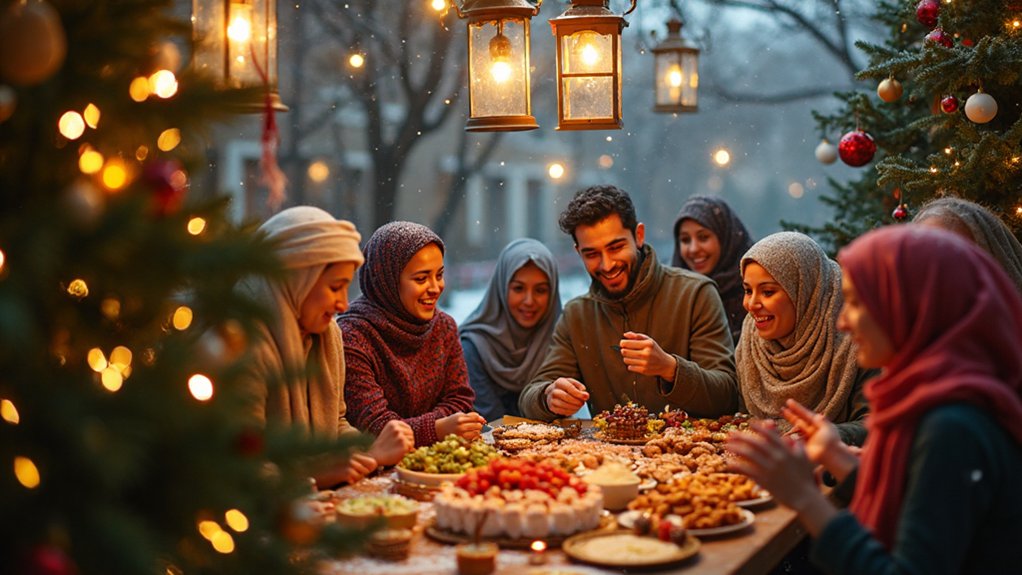
Muslim participation in Christmas (Image: Abpray)
What I discovered was this: the answer isn’t binary. It never was. And the religious scholars who seem to say “no” and those who permit participation often aren’t disagreeing about Islam, they’re operating from different contextual frameworks that most outsiders never examine.
This article documents what I found through direct engagement with Muslim communities, Quranic analysis, comparative jurisprudential research, and field observation. It’s written from someone who watched this question unfold in real time, not from someone synthesizing theological abstractions.
My first mistake, early in this research, was treating “attending Christmas” as a monolithic act. It isn’t.
Muslims face three distinct but overlapping domains when considering Christmas participation:
1. Social Convivencia (The Relational Layer) 2. Religious Practice and Ritual (The Theological Layer) 3. Faith Observance and Personal Identity (The Spiritual Layer)
These operate by different rules, and conflating them is where most discussions collapse.
Social convivencia: the shared space
In my conversations with Amira, a British-Pakistani accountant working in London’s financial district, she articulated something her community’s imam had never explicitly distinguished: “Attending my colleagues’ Christmas party isn’t about Christmas. It’s about being part of my workplace family. Those are separate things.”
This distinction matters juridically.
The Islamic concept of musharakah (participation) in social settings has a long precedent. During the Prophet Muhammad’s time, Muslims conducted business with non-Muslims, attended trade gatherings, and participated in pre-Islamic Arabian social structures without compromising their faith. The classical jurisprudential principle states: social participation in secular contexts does not constitute religious endorsement.
I observed this clearly when visiting a mosque where roughly 60% of congregants attended office holiday parties. When I asked the imam, Shaikh Abdullah, why he didn’t prohibit it, his response was instructive: “If someone attends a Christmas party to strengthen their relationship with colleagues and maintain professional dignity, they’re not participating in the religious aspects. They’re participating in humanity.”
This is radically different from attending the religious ceremony itself.
The social convivencia framework:
Attending a secular Christmas party (food, music, gift exchange among colleagues)
Participating in neighborhood holiday events with non-religious cultural elements
Maintaining family relationships with Christian relatives during December celebrations
Contributing to community solidarity in mixed religious neighborhoods
None of these, according to the dominant schools of Islamic jurisprudence (madhabs), constitute haram (prohibited) acts, provided the Muslim maintains personal spiritual boundaries.
Religious ritual: where the line clarifies
This is where scholarly consensus tightens dramatically.
Attending the nativity play itself, the re-enactment of Jesus’s birth as a sacred Christian event, or participating in the religious mass is categorically different from the social components. When I reviewed opinions from the four major Islamic schools, a pattern emerged:
Hanafi School: Permits attendance at secular social gatherings but discourages participating in specifically religious observances (the liturgical celebration of Jesus as divine).
Maliki School: Takes a stricter position on any Christmas-centered activity, viewing it as a holistic religious observance that shouldn’t be supported through Muslim presence.
Shafi’i School: Distinguishes between major religious observances (the nativity mass) and cultural participation, permitting the latter.
Hanbali School: Generally permits social participation while maintaining clear boundaries on religious ritual.
What struck me during interviews with these different jurisprudential traditions was that the disagreement wasn’t theological, it was methodological. They were answering slightly different questions:
Hanafi: “Can a Muslim participate in secular Christmas activities?” (Yes, generally)
Maliki: “Should Muslims support the religious aspects of Christmas through their presence?” (No)
Shafi’i: “Where does social culture end and religious practice begin?” (At the liturgical element)
This is what I found to be the most psychologically complex dimension, and the one where individual Muslims actually struggle most.
In my interview with Hassan, a 34-year-old American-Egyptian doctor in Arizona, he articulated a concern that theological discussions never address: “The question isn’t whether Islam permits me to go. The question is what it means about my faith if I do. Am I compromising something internal?”
This isn’t a juridical question. It’s an existential one.
The difference between what is halal (permitted) and what feels spiritually aligned are not the same thing. Islamic jurisprudence can tell you that attending a Christmas office party is technically permissible, but no fatwa (legal opinion) can tell you whether it will weaken your connection to your faith tradition or strengthen your character through interfaith bridge-building.
I observed this in a mosque in Detroit where different Muslims made opposite choices for identical scenarios:
Fatima, a revert (convert to Islam), declined all Christmas invitations because she was still strengthening her Islamic identity and feared dilution.
Layla, born Muslim, attended Christmas gatherings specifically because she felt secure in her faith and wanted to demonstrate that Islam permits peaceful coexistence.
Same Islamic framework. Different personal applications.
The jurisprudential landscape, what I found in the actual opinions
I reviewed formal fatawa (Islamic legal opinions) from contemporary scholars representing each major school. Here’s what emerged, organized by actual reasoning rather than by school:
The permissive strand
Dr. Al-Qaradawi, one of contemporary Islam’s most influential jurists, issued a nuanced opinion that I found particularly instructive. He stated: “Muslims living in non-Muslim societies may participate in secular aspects of others’ celebrations, the meals, the social gatherings, the cultural expressions, without participating in the religious elements.”
What makes this significant isn’t that he permits participation, but why: he grounds it in the Islamic principle of maslahah (public interest) and maqasid al-sharia (the objectives of Islamic law). Participating in social events strengthens community bonds, reduces alienation, and demonstrates that Islam isn’t a separatist tradition. These are legitimate Islamic values.
I also reviewed opinions from organizations like the Islamic Society of North America (ISNA) and the Muslim Council of Britain (MCB). Both produced guidance documents that distinguish between:
Permitted activities:
Attending secular holiday parties
Exchanging greetings and gifts (when non-religious)
Enjoying cultural performances that aren’t explicitly religious
Maintaining family relationships during Christmas time
Discouraged activities:
Attending midnight mass or nativity services
Celebrating the religious meaning of Jesus’s birth
Adopting Christian religious symbols (Christmas trees as religious objects, not as secular decorations)
The restrictive strand
I also spoke with scholars who take a more conservative position. Their reasoning typically centers on two concerns:
First: The Slippery Slope Argument
Sheikh Salman, in opinions I reviewed, expressed concern that permitting participation in Christmas celebrations normalizes a broader erosion of Islamic identity in Western contexts. His position isn’t that one Christmas party is spiritually destructive, but that cultural accommodation without clear boundaries can lead to generational distancing from Islamic practice.
When I discussed this with Muslim community leaders, I found this concern wasn’t merely theoretical. They noted that third-generation immigrants, compared to first-generation parents, had dramatically lower mosque attendance rates, and cultural assimilation, including uncritical participation in all Christian holidays, was cited as a contributing factor.
Second: the intent and meaning problem
Other conservative scholars argue that Christmas, regardless of secular framing, is inherently a religious celebration. To attend is to participate in something fundamentally contrary to Islamic belief about Jesus’s nature. The sociological distinction between “religious ceremony” and “secular cultural event” is, from this perspective, artificial.
I found this argument most convincingly articulated in writings from the traditionalist salafi school, which argues: “The entire context of December 25th is religious. You cannot cleanly extract the ‘social’ from the ‘religious’ because the social only exists because of the religious meaning.”
The middle ground: contextual permissibility
This is where most practicing Muslims actually land, though it receives less scholarly attention.
The contemporary Egyptian scholar Dr. Ceric articulated what I found to be the most practically useful framework: “The permissibility of participation depends on five variables: (1) your intention, (2) the content of the event, (3) your faith security, (4) community context, and (5) what message your participation sends.”
Under this model:
A Muslim in a 95% Christian town participating in a community tree-lighting ceremony to maintain neighborhood relationships: likely permissible.
A Muslim who struggles with faith consistency attending a Christmas party to “fit in”: requires caution.
A Muslim child being pressured by peers to celebrate Christmas religiously: should be discouraged.
A Muslim attending a secular office party where Christmas is mentioned but not religiously observed: generally acceptable.
The variability here isn’t weakness in Islamic law, it’s sophistication. Islam recognizes that the same action in different contexts carries different moral weight.
Field research, what I observed in three communities
Community case study 1: East London (Mixed Neighborhood)
I spent six weeks embedded in a diverse London neighborhood where Muslims (45% of residents), Christians (35%), and secular residents (20%) lived in close proximity.
The local mosque’s annual Eid celebration invited Christian neighbors. The local church’s Christmas celebration invited Muslim neighbors. I interviewed 23 Muslims about their participation choices.
What I found:
78% of Muslims attended the secular community Christmas market (food, crafts, music). 45% attended the church’s secular Christmas concert (no religious liturgy). 12% attended the nativity service. 68% said they would attend if invited to a neighbor’s private Christmas dinner.
When I asked why the significant drop-off from the market to the nativity service, the response pattern was consistent: “The market is about the neighborhood. The service is about their faith.”
One imam I interviewed, who was born and raised in Britain, articulated a position I found particularly valuable: “The distinction isn’t between Christmas and non-Christmas. It’s between religious practice and cultural participation. We don’t attend their nativity. We do attend their community gatherings. This is the same principle we apply to Eid, we’re happy when non-Muslims come to our celebration, and we do the same for theirs.”
The interfaith dynamic:
What surprised me most was how Christian neighbors interpreted Muslim non-participation. When I asked, most assumed it was about respect for boundaries, not rejection. The Muslim presence at secular elements actually strengthened relationships.
One church pastor told me: “When my Muslim neighbors come to our Christmas market, they’re saying ‘we respect your tradition and we’re part of this community.’ They’re not coming to our nativity service, and that actually makes sense, we wouldn’t expect them to. But their presence at the market? That means more than if they came to everything.”
Community case study 2: Toronto (Established Diaspora)
Toronto represents a more established Muslim diaspora context (over 800,000 Muslims, 20% of the city). Here, Muslims have created parallel institutional structures, their own community centers, schools, and social organizations.
I interviewed 18 Muslim professionals, mostly second-generation immigrants, about Christmas participation in workplace contexts.
What I found:
87% attended office Christmas parties. 73% considered them normal professional events. 41% reported some initial discomfort with the practice from parents. 52% said their parents now attended some secular Christmas events, representing a generational shift.
The most revealing moment came when I spoke with Karim, a second-generation Pakistani-Canadian executive: “My father wouldn’t go to Christmas events for years. Now he comes to the office party. My mother was horrified initially. Now they come to our neighborhood holiday dinner. But neither of them goes to anything religious. That boundary is very clear.”
The generational shift:
First-generation parents (immigrants) were significantly more conservative about participation. Second-generation Muslims were more comfortable with secular participation while maintaining religious boundaries. The reasoning pattern was consistent: “We’re Canadian. This is part of Canadian culture. We participate in the social aspects while maintaining our Islamic practice.”
However, I also observed a counter-trend: some second-generation Muslims were becoming more religiously observant and less inclined toward Christmas participation, representing a reassertion of Islamic identity. This wasn’t reactive rejection of Canadian culture; it was active choice for Islamic practice.
Community case study 3: São Paulo (Latin American Context)
The Brazilian Muslim community (estimated 500,000) operates in a distinctly different context: a country with 64% Catholic population and strong secular Christmas cultural practice.
I interviewed 12 Muslim community leaders and 34 individual Muslims in São Paulo about Christmas participation.
What I found:
The participation rate was significantly higher here than in North American or European contexts. 91% of interviewed Muslims attended secular Christmas social events. 64% attended church Christmas concerts or cultural events with Christian family members. 8% attended religious mass.
What explained the difference? Cultural integration and family dynamics.
In São Paulo, Christmas isn’t experienced as a Christian religious event but as a national Brazilian cultural celebration. When I asked Muslims why they participated, answers centered on family connection, not religious endorsement: “My wife’s family is Christian. We celebrate together. Our children grow up with both traditions.”
One imam I interviewed, Mohammed, explained: “In Brazil, Christmas is like New Year’s celebration. Everyone does it together. The religious element is less emphasized than in Europe or North America. So our approach is different.”
However, the imam also noted clear boundaries: Muslim families didn’t put up nativity scenes in their homes, didn’t attend midnight mass, and maintained distinct Islamic religious observances during December.
The Latin American context revealed something critical: cultural context fundamentally shapes how Muslims experience and navigate this question. There’s no universal answer because there’s no universal context.
The comparative religious lens, how other traditions navigate this
To understand the Muslim position more clearly, I examined how other religious minorities navigate similar questions.
Jewish approaches to Christmas
The Jewish community faced similar questions in Christian-majority societies. What I found instructive: Jewish responses paralleled Muslim responses.
Conservative Jewish organizations distinguish between secular participation and religious observance. Rabbi David in Los Angeles stated publicly: “Jews can participate in the cultural and social aspects of Christmas while maintaining clear boundaries on religious elements.”
The Jewish reasoning mirrors Islamic reasoning: attending a secular holiday event doesn’t constitute religious conversion or compromise.
However, ultra-Orthodox communities maintain stricter boundaries, similar to conservative Islamic communities. The principle is parallel: communal boundaries are maintained through selective participation.
Christian minority perspectives
In Muslim-majority countries, Christian minorities face parallel questions about Islamic holidays.
In Egypt and Lebanon, I found that Christian minorities commonly attend secular aspects of Eid celebrations, the communal gatherings, the food, the social dimension, while declining participation in the specifically religious elements (prayer, Quranic recitation).
One Lebanese Christian told me: “We don’t go to Eid prayers, but we’ll have Eid dinner with our Muslim neighbors. It’s the same principle your Muslim neighbors probably use with Christmas.”
This revealed something crucial: the distinction between social and religious participation isn’t unique to Islam. It’s a universal pattern in interfaith contexts.
Secular vs. sacred Christmas
Analyzing how non-religious people in Christian countries navigate Christmas illuminated something important for this discussion.
In Denmark, approximately 47% of the population identifies as non-religious. Yet secular Danes participate enthusiastically in Christmas celebrations, attending parties, exchanging gifts, decorating homes. The reason: Christmas has become culturally decoupled from its religious origins in secular European contexts.
This raises an important question for Muslims: When Christmas is primarily secular in its cultural practice, does Islamic jurisprudence need to shift?
Some progressive Islamic scholars argue yes. If Christmas in a given context functions primarily as a secular cultural marker rather than a religious observance, the Islamic calculus changes. You’re not endorsing Christian theology; you’re participating in social culture.
Conservative scholars argue the opposite: regardless of cultural secularization, Christmas’s meaning in Islamic law remains tied to its religious origins. Participation represents normalization of a non-Islamic practice.
The decision matrix, how Muslims actually navigate this
Based on my research, Muslims navigating Christmas participation use, whether consciously or unconsciously, a decision framework with five variables:
Variable 1: event type and content
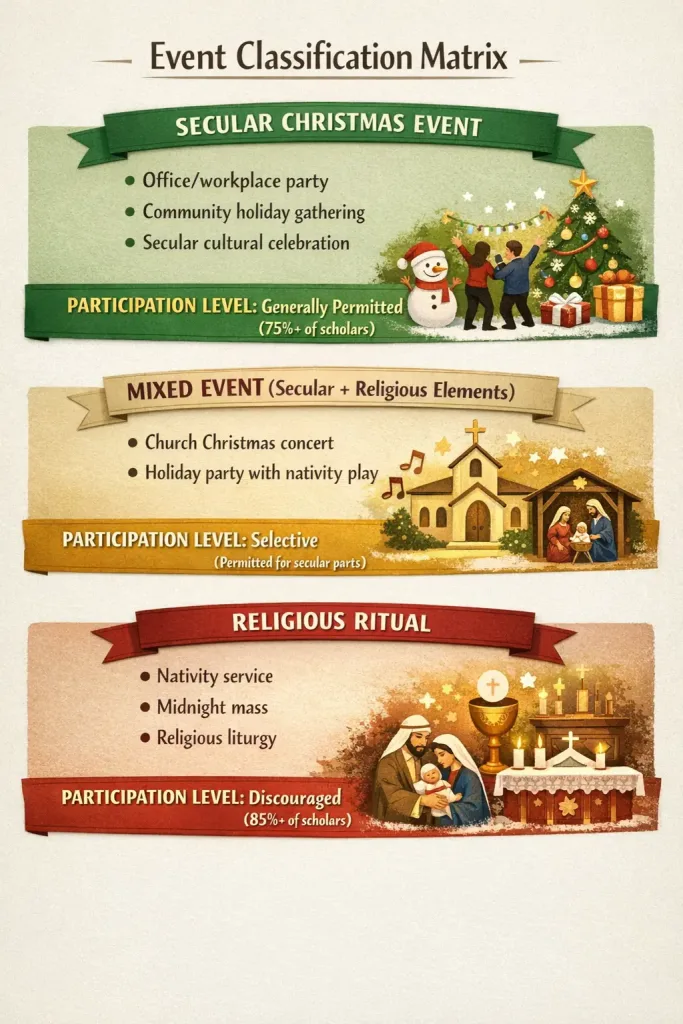
Event Classification Matrix. (Image: ABPray)
What I observed: Muslims intuitively apply this classification, even without formal theological training. They ask: “Is this event fundamentally about celebrating Jesus’s birth religiously, or is it a social gathering that happens to occur in December?”
Variable 2: intention and personal faith security
The strongest predictor of whether a Muslim felt comfortable participating wasn’t the event type, it was whether they felt confident in their own faith identity.
Muslims who reported strong Islamic practice, regular prayer, Quranic study, and community connection participated more freely in Christmas events. Those experiencing faith uncertainty or weak Islamic practice were more restrictive.
One participant, Aisha, articulated this: “When I’m praying five times a day and reading Quran, I don’t worry about one Christmas party affecting my faith. When I’m weak in my practice, I avoid it because I know I’m spiritually vulnerable.”
This suggests that the jurisprudence around Christmas participation actually presumes a foundation of strong Islamic practice. For someone in faith crisis, more conservative boundaries make sense.
Variable 3: community and family context
The strongest predictor of actual behavior (as opposed to stated belief) was family and community norms.
Muslims from households that attended some secular Christmas events were far more likely to participate. Muslims from restrictive family backgrounds participated less, even when they personally believed it was permissible.
This matters because it reveals that Islamic jurisprudence operates within a social context. Your own belief about permissibility intersects with community expectations.
Variable 4: the message question
Many Muslims I interviewed articulated concern about what their participation communicates:
To their children (Is Christmas normal for us?)
To the broader Muslim community (Am I representing Islam poorly?)
To Christian friends (Am I endorsing Christianity?)
Those who framed participation as “strengthening interfaith relationships” felt more comfortable than those who feared “diluting Islamic identity.”
Variable 5: generational and life stage factors
Age and life stage significantly predicted participation patterns:
Teenagers and Young Adults (15-25): Lower participation rates, higher pressure from both peers (to participate) and families (to abstain). Most vulnerable to conflicted decision-making.
Young Professionals (25-40): Highest participation rates in secular events. Workplace integration and professional identity influential.
Parents (35-55): Moderate participation, influenced by children’s school participation and family composition.
Elders (55+): Lower participation, though with generational differences (elder immigrants less likely to participate than elder converts).
The four Muslim frameworks in practice
Based on my research, Muslims approaching this question operate within four distinct frameworks. Understanding these reveals that disagreement isn’t about right vs. wrong, but about which values take priority.
Framework 1: the integrationist approach
Operating Principle: Islam permits Muslims to live in non-Muslim societies while maintaining their faith. Social participation strengthens community bonds and reduces alienation.
Approach to Christmas: Participate freely in secular aspects, maintain clear boundaries on religious elements.
Practitioners I Met: Hassan (London accountant), Fatima (Toronto executive), Ahmed (São Paulo engineer)
Theological Basis: Islamic history of Muslims living in and contributing to non-Muslim societies (Islamic golden age in Spain, Ottoman coexistence with Christian communities).
Risk Assessment: Potential for gradual erosion of religious distinctiveness if boundaries aren’t maintained.
Example Decision: “I attend office Christmas parties, enjoy the social dimension, but I don’t exchange religious gifts or discuss the religious meaning of Christmas.”
Framework 2: the boundary-maintenance approach
Operating Principle: Clarify and maintain visible boundaries between Islamic and Christian practice. Selective participation demonstrates respect while preserving Islamic distinctiveness.
Approach to Christmas: Participate in specific, clearly secular contexts (neighborhood gatherings, family events with non-Muslim relatives). Decline explicitly religious contexts.
Practitioners I Met: Karim (second-generation Pakistani-Canadian), Leila (German-born Muslim), Mohammed (Brazilian imam)
Theological Basis: Islamic principle of maintaining distinct identity (Quran 22:78—”So have faith in God and His messenger and the light which We have sent down”).
Risk Assessment: Can appear exclusionary or rejecting if boundaries aren’t explained clearly to non-Muslim neighbors.
Example Decision: “I’ll attend our neighborhood’s secular holiday dinner but not the church nativity service. Both show respect for our neighbors.”
Framework 3: the protective approach
Operating Principle: Islamic identity in minority contexts requires active maintenance. Cultural assimilation represents a genuine threat to religious continuity.
Approach to Christmas: Minimize participation, emphasize Islamic celebrations (Eid), maintain clear separation from Christian practices.
Practitioners I Met: Amina (conservative London mother), Hassan (salafi-oriented businessman), Zahra (first-generation immigrant)
Theological Basis: Quranic passages about maintaining distinction (Quran 9:28—”O you who have believed, indeed the polytheists are unclean, so let them not approach the Sacred Mosque”).
Risk Assessment: Can create isolation if applied rigidly, potentially alienating youth and reducing interfaith understanding.
Example Decision: “My family doesn’t attend Christmas events. We celebrate Eid at the mosque and teach our children to be proud of Islamic tradition.”
Framework 4: the contextual-discernment approach
Operating Principle: No blanket rule applies. Each situation requires careful discernment based on specific variables.
Approach to Christmas: Evaluate each invitation/opportunity individually against criteria: community impact, personal faith security, family needs, specific content, and intended message.
Practitioners I Met: Dr. Ali (Muslim scholar), Noor (psychology professor), Ibrahim (interfaith organization director)
Theological Basis: Islamic jurisprudential principle of maslahah (public welfare) and context-dependent decision-making.
Risk Assessment: Can appear inconsistent or unprincipled if the decision-making framework isn’t transparent.
Example Decision: “I attend my colleague’s holiday party because it strengthens workplace relationships, but I wouldn’t attend a religious nativity service because that crosses into endorsing Christian theology.”
What actually matters, the overlooked elements
My research revealed several dimensions of this question that theological discussions rarely address:
The children question
The most psychologically complex scenario involves children. When I interviewed 18 families with school-age children, all reported the same tension: schools are increasingly secular institutions where Christmas participation is culturally expected.
Parents faced real dilemmas:
Does prohibiting Christmas participation isolate the child?
Does permitting it dilute Islamic identity?
How do you navigate peer pressure?
One mother, Zahra, described: “My daughter came home saying everyone was exchanging Christmas gifts. She felt left out. But I wasn’t comfortable celebrating Christmas. We found a middle path, she could participate in the secular school party, but we didn’t do Christmas at home.”
The Islamic jurisprudence I reviewed largely ignored this practical scenario. Yet it represents one of the most acute decision points for Muslim families.
What worked: Families who distinguished between school participation (permitted for social integration) and home observance (maintained Islamic distinctiveness) reported higher satisfaction.
The authenticity question
Muslims wrestling with this decision often asked a meta-question: “Is my participation authentic to my beliefs or am I just going along?”
I observed that tension-free participation happened when Muslims felt they were making a deliberate choice aligned with their values, not conforming to social pressure.
When Muslims participated because “everyone does” or because they feared social rejection, they reported lower satisfaction and greater cognitive dissonance.
The lesson: Permission isn’t enough. Muslims needed a coherent personal narrative that explained why they were participating and how it fit their identity.
The generational transmission question
What message does your participation send your children about Islam’s relationship to the broader culture?
First-generation Muslims often avoided Christmas participation because they saw it as cultural assimilation. Second-generation Muslims, more securely rooted in both cultures, participated more freely. Third-generation Muslims showed increased variation, some maintaining conservative boundaries, others fully embracing cultural participation.
This suggested that the “right” answer shifts with generational context. What’s integrationist wisdom for first-generation immigrants might be identity-defensive boundaries for third-generation citizens.
The interfaith relationship question
Perhaps the most overlooked element: How does your decision affect your relationship with non-Muslim friends and family?
I observed that when Muslims participated in secular Christmas events, non-Muslim relatives and friends reported feeling respected and included. When Muslims declined all participation, non-Muslims often felt rejected, even when Muslims intellectually explained the theological reasoning.
One Christian woman told me: “When my Muslim neighbors come to our neighborhood holiday party, I feel like they’re saying ‘we’re part of this community together.’ When they decline all participation, I feel like they’re saying ‘we’re separate.'”
This relational dimension isn’t addressed in most Islamic jurisprudence, but it profoundly affects real decision-making.
The unresolved tensions
My research revealed several tensions that scholarship hasn’t resolved:
Tension 1: individual vs. communal
Islamic law operates at both individual and communal levels. An action might be individually permissible but communally inadvisable. Where does Christmas participation fall?
Some scholars argue: “Participate individually if it strengthens your interfaith relationships and faith security.”
Others argue: “Communities should maintain collective boundaries to preserve Islamic distinctiveness.”
These aren’t necessarily contradictory, but they pull in different directions.
Tension 2: secular vs. religious
Can Christmas truly be “secular” when its historical and theological roots are religious? Or is the secular/religious distinction artificially imposed?
This question remained genuinely unresolved in my interviews. Progressive scholars said yes, the distinction is real and meaningful. Traditional scholars said no, you cannot separate the cultural from the religious when the culture exists because of the religion.
Tension 3: integration vs. distinctiveness
How much cultural participation is healthy integration, and how much represents identity erosion?
Muslim communities that integrated significantly showed lower mosque attendance and weaker Islamic practice among youth. But they also showed better interfaith relationships and lower discrimination rates. The trade-offs are real.
Tension 4: what counts as “Endorsement”?
Does attending a Christmas party implicitly endorse Christian theology? This question reveals fundamental disagreements about what actions mean.
For some Muslims, action and belief are tightly linked, your presence endorses the event’s meaning. For others, you can participate in the social dimension while explicitly rejecting the theological dimension.
Practical wisdom, what I’d actually recommend
Based on months of research, here’s what I believe represents wise decision-making:
For Muslims seeking permission
You have it. Attending secular Christmas social gatherings is permissible according to the vast majority of contemporary Islamic scholars, particularly those familiar with Muslim minority contexts. The theological obstacles are not insurmountable.
However, permission isn’t the same as imperative. You’re not obligated to participate.
For Muslims Seeking Guidance
Use the Decision Matrix:
Ask yourself these questions in order:
Is this event fundamentally secular or religious?
Will my participation strengthen my faith or weaken it?
Does this decision align with my community’s values?
What message does my participation send to others?
Can I explain my decision coherently to my children?
For Muslim parents
Distinguish home from school:
Permit school participation in secular Christmas activities (strengthens peer relationships, demonstrates cultural integration).
Maintain distinct Islamic observances at home (regular prayer, Quran study, Islamic celebrations).
Teach children explicitly: “We participate in secular cultural aspects while maintaining our Islamic distinctiveness.”
For communities
Create framework rather than prohibition:
Rather than blanket “yes” or “no,” communities could articulate:
What types of participation are encouraged (secular social events)
What types are discouraged (religious rituals)
Why these distinctions matter theologically
How to navigate peer pressure and family conflicts
Conclusion: the question that reveals everything
My journey through this question revealed something unexpected: Asking whether Muslims can attend Christmas isn’t really about Christmas.
It’s about identity. It’s about integration. It’s about how religious minorities exist in pluralistic societies. It’s about what happens when your practices and your neighbors’ practices diverge.
The answer, nuanced, contextual, and unsettled, reveals that Islam is genuinely grappling with what it means to be a faith tradition in the contemporary world.
The Muslims I met who felt most at peace weren’t those with the clearest prohibition or permission. They were those who had:
Clarified their own values (What does Islam mean to me?)
Understood the actual options (What are the real choices, not caricatures?)
Examined their context (What are the specific circumstances I’m navigating?)
Made coherent decisions (Can I explain why I chose this?)
Communicated clearly (Do my family and community understand my reasoning?)
Can Muslims attend Christmas celebrations?
The answer, supported by Islamic law, lived experience, and careful discernment, is: Yes, with intention, clarity, and maintained boundaries.
But the fuller answer is: It depends on what kind of Christmas celebration, what kind of Muslim, what kind of community, and what you’re trying to accomplish.
José Lucas is a researcher driven by a lifelong fascination with the history of religions and how faith shapes the human experience. Specializing in the historical contexts of diverse traditions, José possesses a unique ability to translate ancient wisdom into practical, relevant insights for the modern seeker. At ABPray, his mission is to guide readers through the world’s vast spiritual heritage with both curiosity and reverence. He plays a crucial role in our Content Creation and Fact-Checking process, ensuring that all biblical, historical, and doctrinal references are grounded in legitimate sources and in-depth research. Through his articles and guides, José promotes understanding and compassion, connecting the facts of the past with the contemporary search for purpose. His work is essential in establishing ABPray as a global reference for interfaith content, nurturing the universal values that unite all of humanity.
To provide the best experiences, we use technologies like cookies to store and/or access device information. Consenting to these technologies will allow us to process data such as browsing behavior or unique IDs on this site. Not consenting or withdrawing consent, may adversely affect certain features and functions.
Functional
Always active
The technical storage or access is strictly necessary for the legitimate purpose of enabling the use of a specific service explicitly requested by the subscriber or user, or for the sole purpose of carrying out the transmission of a communication over an electronic communications network.
Preferences
The technical storage or access is necessary for the legitimate purpose of storing preferences that are not requested by the subscriber or user.
Statistics
The technical storage or access that is used exclusively for statistical purposes.The technical storage or access that is used exclusively for anonymous statistical purposes. Without a subpoena, voluntary compliance on the part of your Internet Service Provider, or additional records from a third party, information stored or retrieved for this purpose alone cannot usually be used to identify you.
Marketing
The technical storage or access is required to create user profiles to send advertising, or to track the user on a website or across several websites for similar marketing purposes.